






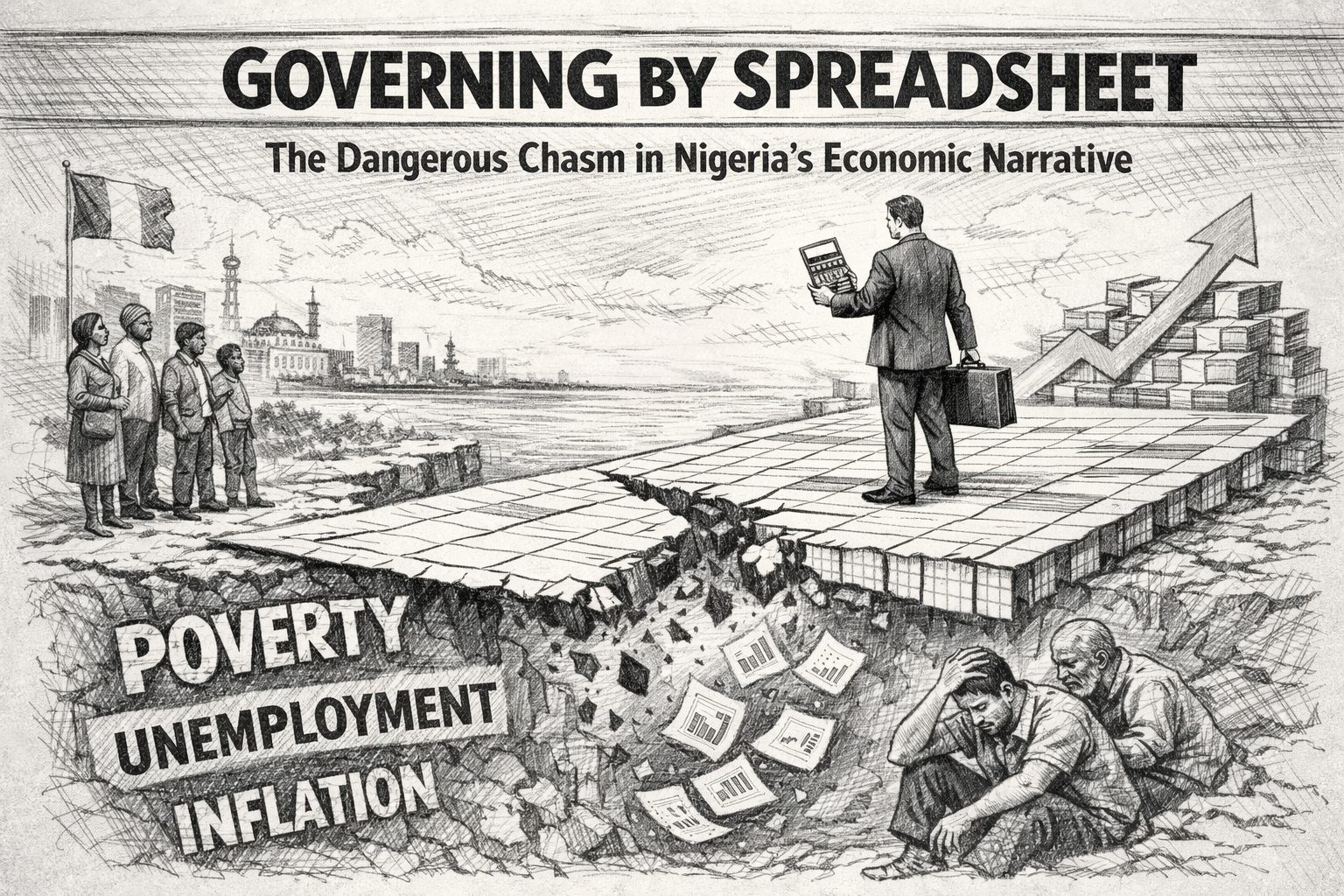
The National Bureau of Statistics has released its latest scorecard, and on the surface, Nigeria is a nation finally turning the corner. To the analysts in Abuja’s glass towers, the data represents a hard-won triumph: a real GDP growth rate of 3.87% for 2025 and a fourth-quarter acceleration to 4.07%. Headline inflation, which threatened the very fabric of the republic in the dark days of 2024, has retreated to 15.1%, while foreign reserves sit at a seven-year high. To a bondholder in London or a World Bank economist, this is the textbook success story of a Renewed Hope agenda that traded short-term agony for long-term stability. Yet, as we enter March 2026, a ghost remains in the machine. While the spreadsheets are glowing green, the dinner tables in Lagos, Kano, and Port Harcourt are seeing red. We are witnessing “The Great Decoupling”—a state where macroeconomic indicators have successfully detached themselves from the lived reality of the Nigerian citizen.
This administration’s defense of its trajectory is not entirely without merit. By unifying the exchange rate and dismantling the parasitic fuel subsidy regime, the government arguably pulled the state back from the brink of fiscal collapse. The technical recovery is tangible in the 6.79% growth of a stabilized oil sector and the resilience of a services industry that refused to buckle. However, statistics are aggregate masks that hide the distribution of human pain. The fundamental flaw of governing by spreadsheet is the assumption that a rising tide lifts all boats, forgetting that millions of Nigerians are currently treading water without a boat at all. The 2026 Economic Outlook paints a chilling contrast to the state’s optimism, projecting that 141 million people—roughly 62% of the population—will live in poverty this year. This raises a haunting question for the Presidency: how does an economy grow while its poverty rate expands?
The answer lies in a recovery that is both jobless and capillary-free. Wealth is currently pooling at the apex of the pyramid—within a banking sector reaping windfall profits and an extractive oil sector that employs only a fraction of the workforce. Meanwhile, the working poor remain trapped in a pincer movement of disinflation. For a mother in a rural ward, the news that inflation has slowed is a distinction without a difference; prices are still rising, albeit at a slower pace, on top of a 2024 price floor that had already doubled the cost of survival. When the Central Bank celebrates ten months of declining inflation, it speaks a language the market woman does not understand. To her, a 15% increase on an already unbearable price is not a victory; it is a continued sentence.
This disconnect extends to the agricultural sector, where a reported 4% growth serves as a mirage for food security. While industrial-scale agro-processors may be scaling up, the smallholder farmers who form the backbone of the nation’s food supply are still paying a “security premium” in blood and sweat. In the North-Central breadbasket, the “spreadsheet” sees a future yield based on input financing, but the “street” sees abandoned fields and harvest taxes paid to bandits. Security, therefore, cannot be treated as a mere line item for the defense budget; it is the most potent tool for controlling food inflation. Until the farmer can return to the field without the fear of abduction, any talk of agricultural growth remains a hollow academic exercise.
As we move toward the 2027 political cycle, the danger of this chasm becomes existential. History warns that when reformer fatigue sets in without a visible “democracy dividend,” the vacuum is invariably filled by populism and social unrest. The administration cannot continue to answer the cry of “we are hungry” with a lecture on GDP percentages. You cannot eat a decimal point, and you cannot clothe a child with a narrowed fiscal deficit. If the 2026 budget is to be more than a fiscal exercise, it must shift its focus from fixing the economy of the State to fixing the economy of the Citizen. This requires a move beyond the promise of CNG buses to a massive, functional transport intervention that crashes the cost of logistics, and a wage mechanism that reflects the actual cost of a loaf of bread.
Governing by spreadsheet is a technical necessity, but leading a nation is a human endeavor. If the President does not find a way to bridge the gap between his data rooms and the dark rooms of the average household, the statistical triumphs of this week will be remembered only as the prelude to a social crisis. The chasm is open, and it is widening. It is time for the government to stop looking at the charts and start looking at the people.


