






Elegbede Abiodun
* They agreed to closely monitor implementation of the commitments reached.
Nigeria and the United Kingdom have agreed to deepen their security and defence partnership, committing to stronger collaboration in counter-terrorism, cybersecurity, maritime security, intelligence sharing, and the fight against fraud and illicit finance.
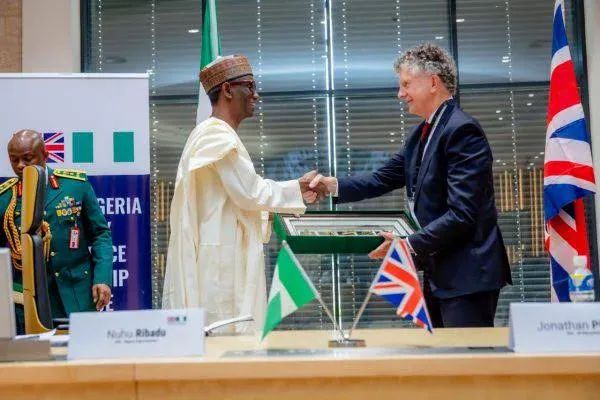
The commitment was contained in a communiqué issued after the Fourth United Kingdom–Nigeria Security and Defence Partnership Dialogue, held at the Office of the National Security Adviser (ONSA) in Abuja on June 23 and 24, 2026.
The communiqué, published by the UK Foreign, Commonwealth and Development Office (FCDO), was made available to journalists by the British High Commission in Abuja on Monday.
The dialogue was co-chaired by Nigeria’s National Security Adviser, Nuhu Ribadu, and the United Kingdom’s National Security Adviser, Jonathan Powell, with senior government officials from both countries in attendance.
According to the communiqué, both governments agreed to strengthen cooperation “based on mutual accountability and delivery of commitments while working in a spirit of partnership.”
As part of the renewed partnership, the UK reaffirmed its long-term commitment to supporting the Nigerian Armed Forces through joint military doctrine, specialised training, technical assistance, and lessons learned to counter threats posed by Uncrewed Air Systems (UAS) and Improvised Explosive Devices (IEDs).
Both countries also reaffirmed support for Nigeria’s Joint Doctrine and Warfare Centre, maritime domain awareness and hydrography while agreeing to explore opportunities to strengthen defence trade relations.
The communiqué stated: “Both governments underscored their shared commitment to deepening cooperation on maritime security in the Gulf of Guinea. Recognising the critical importance of regional stability and secure trade routes, both governments committed to aligning efforts to combat illicit maritime activities, and transnational threats.”
On cybersecurity, the two countries agreed to establish a structured framework for cooperation focusing on cyber resilience, intelligence sharing, capacity building and strategies to counter misinformation, cyber-attacks and organised crime.
The communiqué noted: “Both countries committed to advancing a new structured framework for cooperation on countering hybrid threats.”
Nigeria and the UK also resolved to strengthen collaboration against terrorism and violent extremism through enhanced intelligence sharing, multi-agency coordination, investigations and forensic capabilities.
The UK pledged continued support for aviation security at the Murtala Muhammed International Airport, Lagos, and the Nnamdi Azikiwe International Airport, Abuja. It also backed Nigeria’s plan to expand the Multi-Agency Anti-Kidnap Fusion Cell across states.
The two governments reaffirmed their commitment to tackling violent extremism through non-kinetic approaches, including Disarmament, Demobilisation and Reintegration (DDR) programmes and wider peacebuilding initiatives.
According to the communiqué, “Nigeria and the United Kingdom have renewed their commitment to preventing violent extremism through non-kinetic approaches including Disarmament, Demobilisation and Reintegration and implementing a comprehensive, whole-of-society approach to building sustainable peace under Nigeria’s national security framework.”
The UK also welcomed Nigeria’s efforts to fast-track terrorism-related cases through remote court proceedings and ongoing mass terrorism trials at the Federal High Court.
On human rights, both countries emphasised the need to protect civilians, ensure accountability and prevent conflict while supporting transparent investigations into violations committed by both state and non-state actors.
Ahead of Nigeria’s forthcoming general elections, the two governments stressed the importance of strengthening election security before, during and after the polls to safeguard democratic institutions, protect voters and minimise election-related violence.
The communiqué stated: “Recognising the importance of Nigeria’s upcoming national elections, both sides noted the importance of effective election security before, during and after polls, including efforts to protect voters and institutions, public order management in line with international standards, and reducing the risk of violence.”
The partnership will also focus on combating fraud and illicit financial flows through stronger intelligence sharing, asset recovery, cryptocurrency oversight and coordinated law enforcement actions.
On regional security, Nigeria and the UK expressed concern over the worsening security situation in the Sahel and reaffirmed Nigeria’s leadership role in promoting peace and stability across West Africa.
The communiqué stated that both countries agreed on “the importance of Nigeria leveraging its regional relationships and its participation in significant regional platform including through the Economic Community of West African States and emphasised the importance of continued outreach and collaboration with countries in the Alliance of Sahel States.”
The UK further welcomed Nigeria’s progress towards transforming the National Counter Terrorism Centre into a Regional Centre of Excellence and pledged continued support for the country’s regional counter-terrorism initiatives.
Both governments agreed to closely monitor implementation of the commitments reached during the dialogue ahead of the next United Kingdom–Nigeria Security and Defence Partnership Dialogue, which is scheduled to be hosted by the UK in 2027.


