






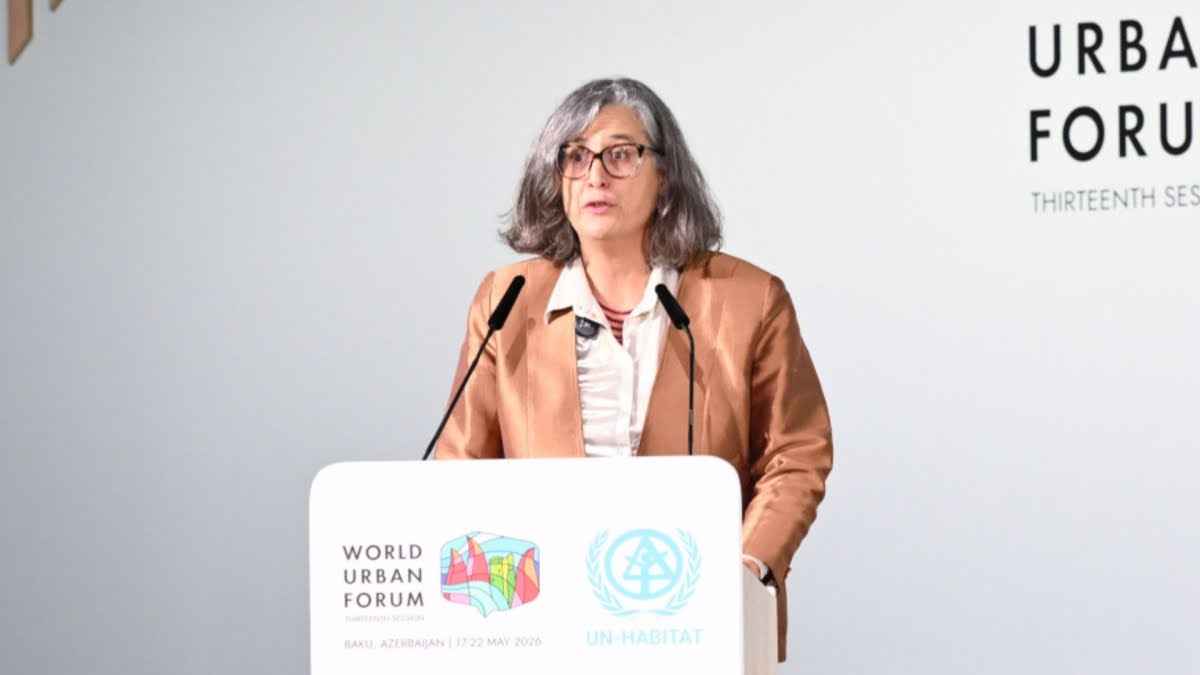
Executive Director of UN-Habitat, Anacláudia Rossbach Credit: WUF13 Communications
The thirteenth session of the World Urban Forum (WUF13) concluded today in Baku, Azerbaijan, after a week of global dialogue, partnership-building and commitments focused on addressing the global housing crisis and accelerating sustainable urban development.
Convened by UN-Habitat and co-organized with the Government of the Republic of Azerbaijan under the theme “Housing the world: Safe and resilient cities and communities,” WUF13 brought together over 57,000 participants (including over 3,000 online) from 176 countries, making it the largest World Urban Forum to date. WUF13 concluded with the presentation of the Baku Call to Action, a stakeholder-driven document calling for accelerated action on housing and sustainable urbanization.
The Forum hosted 579 sessions throughout the week, while the Urban Expo brought together 260 exhibitors, innovators and solution providers. WUF13 featured 11 heads of state, 9 high-level guests, 88 ministers and 76 deputy ministers, and 130 mayors, alongside representatives of international organizations, financial institutions, academia, civil society and grassroots organizations, reflecting growing global momentum around housing and sustainable urbanization. Women and girls represented over 55 per cent of participants. The Forum also reflected broad participation across sectors, with academia and research institutions accounting for roughly a quarter of all participants, alongside strong engagement from the private sector at around 13 per cent. Participants from Asia accounted for over 90 per cent of all visitors.
“WUF13 will go down in history not only as the largest Forum, but also as the platform that brought housing back to the centre of the global political agenda,” said Anar Guliyev, Chairman of the State Committee for Urban Planning and Architecture of the Republic of Azerbaijan and WUF13 National Coordinator. “The participation of heads of states and international leaders demonstrated that issues of housing, sustainability, and the future of cities are no longer merely a sectoral topic – they are a matter of global stability and the quality of life of millions of people.”
A defining moment for housing and cities
The Forum took place at a defining moment for cities and communities worldwide. Nearly three billion people globally live in inadequate housing conditions, while climate change, conflict, displacement, inequality and rising costs continue to deepen urban vulnerabilities. Throughout the week, WUF13 emphasized the need to place housing at the centre of sustainable development, recognizing its critical role in advancing resilience, equity, stability and opportunity.
“We are at a decisive moment for the future of housing. We can no longer afford the luxury of inaction,” said Anacláudia Rossbach, Executive Director of UN-Habitat. “As we mark the midpoint of the New Urban Agenda, the message is clear: The next decade must be defined by accelerated implementation, scaled delivery, and measurable impact in people’s lives.”
Housing at the centre of global action
Across six high-level dialogues and over 370 partner-led events, participants examined the structural drivers of the global housing crisis and explored practical pathways to expand access to adequate, affordable and resilient housing.
Discussions focused on integrated housing and land policies, upgrading informal settlements and slums, strengthening housing finance systems, supporting crisis recovery and reconstruction, and addressing the growing impacts of climate change on homes and communities.
Leaders and experts also examined the risks posed by speculative investment and financialization in housing markets, while highlighting approaches that prioritize social inclusion, community participation and long-term sustainability.
UN-Habitat also launched the World Cities Report during WUF13, providing updated analysis on global urban trends and the future of housing and sustainable urbanization.
The climate–housing nexus
A major focus of the Forum was the growing intersection between housing and climate change. Participants discussed how cities can reduce emissions from the built environment while protecting communities from rising heat, flooding, storms and other climate-related risks.
Sessions highlighted low-carbon construction, resilient urban planning, nature-based solutions and approaches that protect vulnerable populations while expanding access to housing and basic services.
Informal settlements and inclusive urban development
WUF13 also emphasized the importance of working with, rather than against, informality. Discussions explored in-situ upgrading, flexible planning systems, diverse tenure arrangements and community-led approaches to improving living conditions in informal settlements and underserved neighbourhoods.
Participants highlighted the importance of empowering communities, strengthening local governance and expanding access to infrastructure, services and economic opportunities.
A new deal for housing finance
Governments, financial institutions, development banks and private sector leaders examined how housing finance systems can better serve lower-income communities and support affordable, resilient homes.
Discussions explored innovative financing models, public investment, community-based approaches and mechanisms to mobilize capital while strengthening regulation and reducing inequalities in housing access.
Baku Call to Action calls for accelerated housing action
A key outcome emerging from WUF13 was the presentation of the Baku Call to Action, a stakeholder-led document developed through contributions from civil society organizations, local authorities, practitioners, researchers, community representatives and other urban actors. Framed around the urgent global housing crisis, the Call to Action advocates for renewed political commitment to adequate housing through people-centred, inclusive and climate-resilient approaches, while encouraging stronger multilevel governance, investment and community participation in housing solutions.
Assemblies amplify local leadership and participation
At the outset of the Forum, dedicated assemblies brought together women, youth, grassroots and civil society organizations, businesses, and local and regional governments to shape the global urban agenda from the ground up.
The assemblies reinforced the importance of inclusive participation, multilevel governance and community leadership in advancing housing solutions and sustainable urbanization.
From dialogue to delivery
WUF13 underscored the growing recognition that many of today’s global challenges – including inequality, displacement, climate vulnerability and housing insecurity – are increasingly concentrated in cities and communities.
Throughout the week, participants emphasized the need to translate commitments into practical action through stronger partnerships, financing, local leadership and international cooperation.
“We must use the remaining window to 2030 to accelerate implementation of the Sustainable Development Goals, especially SDG 11 and the commitment to adequate housing for all,” said Amina J. Mohammed, Deputy Secretary-General of the United Nations, during the closing ceremony of the Forum. “I extend my sincere gratitude to the Government and people of Azerbaijan for their extraordinary generosity and leadership in hosting the thirteenth World Urban Forum here in Baku.”
Transition to WUF14
The closing of WUF13 also marked the formal handover of the World Urban Forum to Mexico, which will host the fourteenth session of the Forum (WUF14) in 2028.
UN-Habitat reaffirmed that WUF remains the world’s leading global platform on sustainable urbanization and housing.
About the World Urban Forum
Established in 2001 by the United Nations, the World Urban Forum is the premier global conference on sustainable urbanization, designed to examine the impacts of rapid urbanization on cities, communities, economies, and climate change. Since its inception, WUF has been hosted in cities across the world, with the first session held in Nairobi, Kenya, in 2002.