






Manny Ita –
The United States has intensified its military campaign targeting Iran’s missile capabilities, with officials stating that the operation is aimed at preventing threats to American national security interests.
In a video message announcing the escalation, US authorities said the operation would focus on dismantling Iran’s weapons infrastructure. “To prevent the Iranian dictatorship from endangering America and our fundamental national security interests, the U.S. military is conducting a massive and continuous operation,” the statement said. “We intend to demolish their missiles and destroy their missile industry.”
As tensions deepened across the Middle East, Israeli Defence Minister Israel Katz declared a nationwide state of emergency, warning citizens to prepare for imminent retaliation through drone and missile attacks.
The Israel Defense Forces confirmed that air raid sirens sounded across several parts of Israel following security alerts. Civilian flights were suspended while residents were advised to remain close to designated shelters. Military authorities also imposed restrictions on non-essential activities, including social gatherings and educational operations, as precautionary measures against potential strikes.
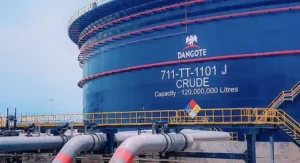
Amid the geopolitical uncertainty, developments within Nigeria’s oil and gas sector indicate renewed momentum driven largely by increased domestic refining capacity. The Dangote Refinery, with an installed processing capacity exceeding 650,000 barrels per day in 2026, has significantly altered Nigeria’s downstream petroleum landscape.
Industry data show that Nigeria is refining a growing proportion of its crude oil locally, marking a shift from decades of exporting crude while relying heavily on imported refined petroleum products. The refinery, regarded as the first globally to achieve such production scale using a single processing train, was observed operating at about 661,000 barrels per day during a recent inspection by the Nigerian National Petroleum Company Limited, surpassing its original design capacity.
Officials say increased refining output has positioned Nigeria to achieve self-sufficiency in Premium Motor Spirit (PMS), commonly known as petrol, reducing pressure on foreign exchange previously used for fuel imports.
The Federal Government’s 2026 fiscal projections are benchmarked on a conservative crude oil price of 64.85 dollars per barrel, alongside an ambitious daily production target of 1.84 million barrels. Nigeria’s crude production in January 2025 averaged approximately 1.48 million barrels per day, slightly below the Organisation of Petroleum Exporting Countries (OPEC+) quota of 1.5 million barrels per day.
In further efforts to expand crude market competitiveness, Nigeria introduced the Cawthorne crude grade with an API gravity of 36.4 degrees in February 2026. The development follows earlier introductions of the Utapate and Obodo crude grades in 2024 and 2025 respectively, reflecting ongoing diversification within the country’s hydrocarbon exports.


