






Manny Ita –
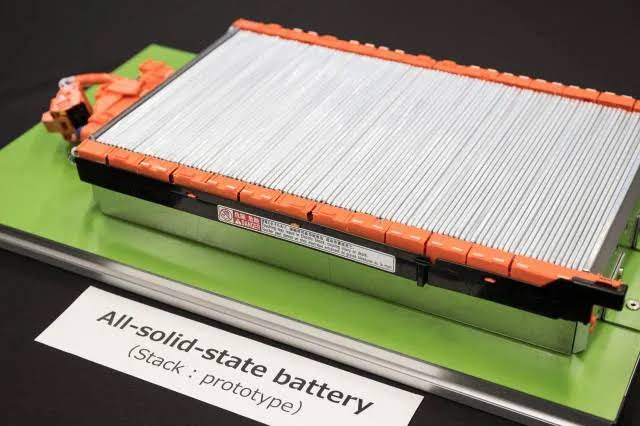
Automakers and battery developers are accelerating efforts to commercialize solid-state batteries, with Toyota and QuantumScape now targeting late 2027 for initial limited-production runs, a milestone that could reshape electric-vehicle performance, charging speed, and safety. The companies say the technology could enable charging from 0 to 80 percent in under 15 minutes, a benchmark long viewed as critical for mass EV adoption.
Solid-state batteries replace the liquid electrolyte used in conventional lithium-ion cells with a solid material, reducing fire risk while allowing higher energy density. Engineers involved in the programs say the approach could deliver significantly longer driving ranges and improved durability. “This is a fundamental shift in battery architecture,” one industry executive said, noting that the technology “combines faster charging with greater stability.”
Toyota, which has invested heavily in next-generation battery research for more than a decade, has previously indicated it aims to deploy solid-state packs first in premium or limited-volume models before broader rollout. Company officials say the initial production phase will focus on proving real-world reliability and manufacturing scalability. “Our goal is not just performance, but batteries that can be produced consistently at high quality,” a Toyota spokesperson said.
QuantumScape, backed by major automotive partners, has reported steady progress in prototype testing, including improved cycle life and performance at high charging rates. The company maintains that its lithium-metal solid-state design can deliver both rapid charging and extended range without the degradation typically associated with ultra-fast charging. “We are moving from laboratory validation toward commercial readiness,” a QuantumScape representative said.
Analysts caution that late-decade timelines remain tentative, citing the technical challenges of scaling production, managing costs, and ensuring long-term durability. Manufacturing solid electrolytes at automotive volumes has proven difficult, and even limited production signals only an early stage of commercialization. Still, the prospect of sub-15-minute charging is seen as transformative, potentially narrowing the convenience gap between electric vehicles and gasoline cars.
If successful, the first vehicles equipped with solid-state batteries could arrive in select markets shortly after the initial production run, likely at premium price points. Industry observers say broader adoption would depend on cost reductions and supply-chain expansion, but the 2027 target marks one of the clearest timelines yet for bringing the long-anticipated technology out of the laboratory and onto public roads.