

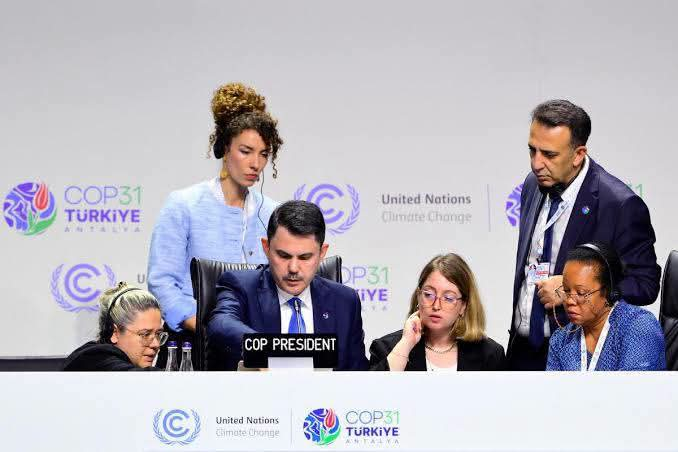
The COP31 climate summit ended in disagreement on Monday after contentious negotiations over fossil fuels collapsed, with the meeting running a record 49 hours past its scheduled conclusion.
The final agreement was rejected Sunday in a chaotic finale to the UN climate conference, highlighting the challenges of diplomatic consensus in an increasingly fractured world.
UN Secretary-General Antonio Guterres, who had urged nations to send fossil fuels “the way of the dinosaurs” during a passionate address at the talks, expressed deep dismay at the outcome.
“I share the very profound frustration of all those who expected governments to rise to the moment the climate crisis demands,” the outgoing UN chief said in a statement.
COP31 negotiations chair Chris Bowen, who sought to broker consensus among nearly 200 nations, acknowledged he could not overcome what he called “unbridgeable red lines.”
“Unfortunately, we were unable to reach agreement on a cover decision… And that’s disappointing. Very disappointing,” Bowen, Australia’s climate minister, told reporters.
COP31 President and Turkish Environment Minister Murat Kurum banged the gavel to conclude the marathon talks more than 49 hours after the summit was supposed to end.
Geopolitical Tensions Complicate Talks
Bowen described the summit backdrop as “the most complicated and fraught geopolitical environment in living memory,” citing soaring energy prices and fallout from the Middle East war as factors complicating the search for unity.
Australian Prime Minister Anthony Albanese, whose country co-hosted the summit with Turkey, attributed the failure to “difficult geopolitical times.”
Bowen had sought an overarching “cover decision” to demonstrate countries remained united in tackling the climate crisis, but his plan unraveled as familiar fault lines emerged over fossil fuels. The EU and Saudi Arabia clashed over the pace of transition away from coal, oil and gas, with oil-producing states blocking any mention of phasing out fossil fuels in the final deal.
“We will not endorse a cover decision… that does not even mention fossil fuels, which is the key driver of climate change,” said Ireland’s climate minister, Darragh O’Brien, whose country holds the rotating EU presidency. “And we will not accept a COP that greenwashes fossil fuel.”
Panama, Vanuatu and the Marshall Islands also objected, and as the deal imploded, COP31 became the longest climate summit on record.
Former US vice president and climate advocate Al Gore said it was “outrageous that a handful of petrostates have veto power over any mention of fossil fuels.”
The COP process is “in need of significant reform,” Gore said on X, as most countries sought “to move forward in good faith.”
The outcome revived memories of the failed Copenhagen summit of 2009 and raised fresh doubts about the effectiveness of climate diplomacy.
“It certainly fell short today,” said UN climate chief Simon Stiell. “The world cannot afford a repeat.”
Countries Push Ahead Outside COP Process
Frustrated by the inertia, countries are pursuing climate action outside the COP framework. Around 60 countries joined a first-of-its-kind conference in April on phasing out fossil fuels, while several nations at COP31 unveiled their own plans to exit coal, oil and gas.
In a last-ditch bid for compromise, COP31 co-hosts Turkey and Australia could only muster a veiled reference to fossil fuels in the final text. The pact also drew criticism for retaining a call to expand carbon capture—a costly technology championed by the fossil fuel industry.
“We believe that climate change requires all solutions on the table,” said Mohammad Ayoub, a climate negotiator for oil giant Saudi Arabia.
Facing blowback over the fossil fuels omission, the co-host nations tried to rally support behind a global goal to electrify the world economy, saying “electrification” could cut heat-trapping emissions and bolster energy security. But the target was ultimately torpedoed along with the rest of the doomed Antalya Pact.
“Profoundly Disappointed”
Countries lamented a missed opportunity to reinforce the Paris agreement’s 1.5C target, which scientists expect the world to overshoot in a few years as carbon-cutting goals fall short.
The summit also widened fault lines over science, with a fight over the work of the Intergovernmental Panel on Climate Change (IPCC) spilling into the negotiations.
“We are profoundly disappointed by the substance of the cover decision,” said UK climate negotiator Kate Hughes. “It moves us backwards on the science… It is a lowest common denominator where it should have been, instead, presenting bold collective ambition on climate action.”
The summit laid bare the divide between major polluters driving climate change and smaller nations bearing the brunt of its impact. Developing nations pushed for a $120 billion target climate goal that disappeared from the failed deal.
