





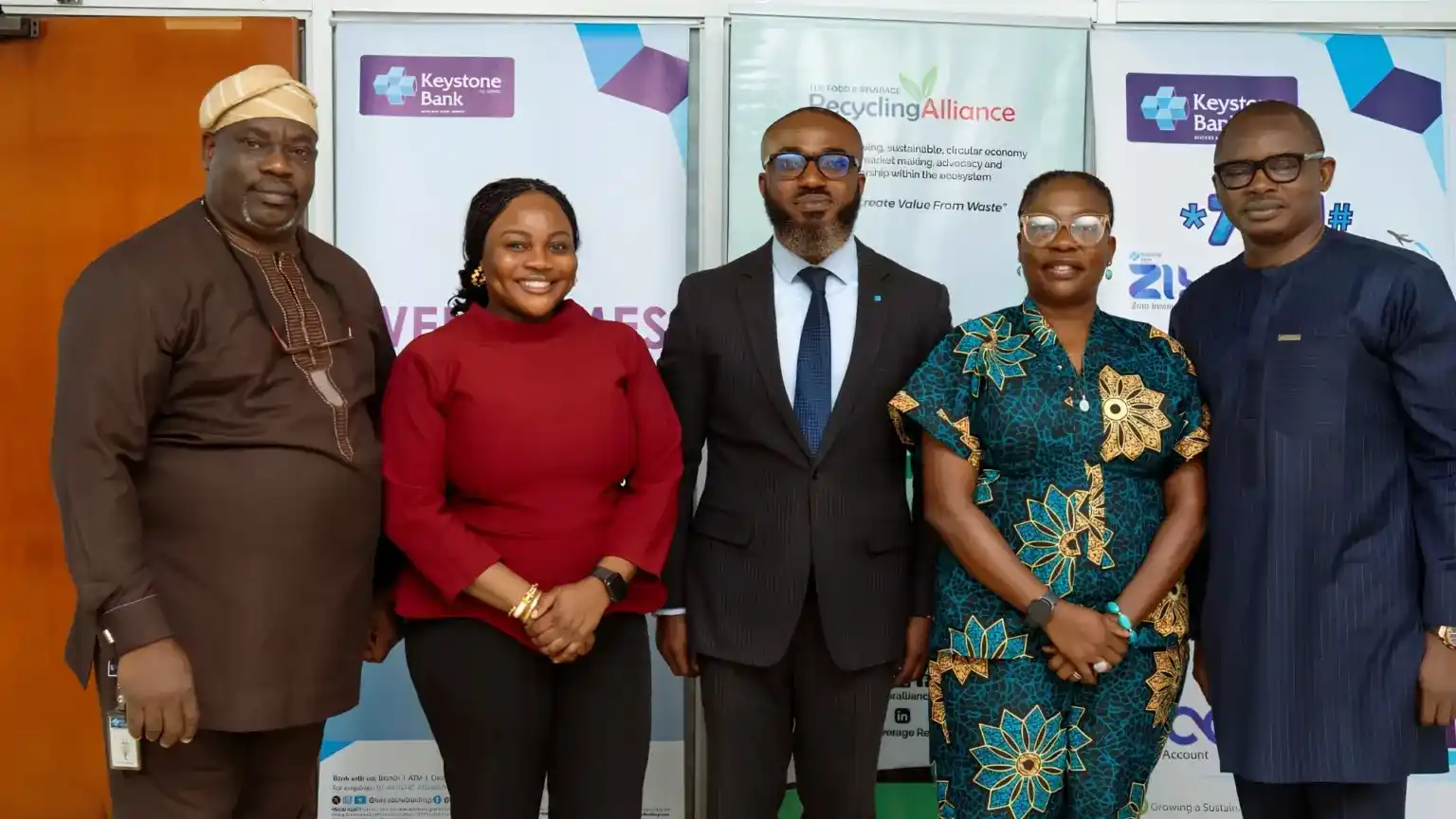
L-R: Abimbola Alabi, Head, Learning Academy, Human Capital Management, Keystone Bank; Tamilore Tayo-Oyetibo, Team Member, Alternative Banking, Retail & Digital Banking Group, Keystone Bank; Martins Ofiegbe, Unit Head, SME Banking, Retail & Digital Banking, Keystone Bank; Agharese Onaghaise, Executive Director, FBRA and Akinwunmi Karunwi, Department Head, Regulatory Reporting & Tax Management, Keystone Bank, at the Keystone-FBRA Green SME Master Class, where 100 Green SMEs were equipped with practical skills to transform waste materials into commercially viable products, organised by Keystone Bank and FBRA in Lagos.
Keystone Bank Limited has partnered with the Food and Beverage Recycling Alliance (FBRA) to train 100 Green Small and Medium Enterprises (SMEs) on converting waste materials into commercially viable products and building sustainable businesses.
The training, tagged the “Keystone-FBRA Green SME Master Class”, provided participants with practical sessions on upcycling rubber and food and beverage packaging, as well as business management, financial preparedness, taxation and strategies for business growth.
In a statement on Monday, Keystone Bank said the initiative was part of efforts to deepen its participation in Nigeria’s green economy and support businesses operating within the circular economy.
The lender said the programme was designed to combine practical waste-management skills with the financial and business knowledge required by entrepreneurs to build commercially sustainable enterprises.
According to the bank, the initiative aligns with its Waste-to-Wealth sustainability approach, which focuses on helping entrepreneurs convert environmental challenges into economic opportunities.
“The Master Class aligns with our Waste-to-Wealth sustainability approach, which seeks to empower entrepreneurs to transform environmental challenges into economic opportunities while fostering innovation, job creation and sustainable business practices,” the bank said.
Participants were also introduced to financial products offered by the bank to SMEs and businesses operating within sustainability-related sectors.
These included the Eco Cycle Product, MSME Time Loan, MSME Asset Finance and Sustainable Energy Finance.
Keystone Bank said its Eco Cycle Product was developed to provide businesses operating within the circular economy with financial support for expansion and other enterprise needs.
“The participants were also introduced to the Bank’s financial solutions, including the Eco Cycle Product, MSME Time Loan, MSME Asset Finance and Sustainable Energy Finance, designed to provide tailored funding and support for businesses at different stages of their growth,” the lender said.
Speaking during the programme, Unit Head, SME Banking, Retail and Digital Banking at Keystone Bank, Martins Ofiegbe, facilitated sessions on financial discipline, revenue growth and preparing businesses to access funding.
His sessions, titled “Financial Discipline and Revenue Growth Strategies” and “Preparing Business Documentation and Positioning Businesses for Funding”, focused on financial management, business documentation and the requirements entrepreneurs should consider when seeking financing.
Department Head, Regulatory Reporting and Tax Management at Keystone Bank, Akinwunmi Karunwi, also addressed participants on the implications of Nigeria’s tax regime for small businesses.
His session, “Understanding the New Tax Regime: What SMEs Must Know”, provided an overview of tax considerations and compliance requirements relevant to SMEs.
Other stakeholders involved in the initiative included the Small and Medium Enterprises Development Agency of Nigeria (SMEDAN), Lagos State Waste Management Authority (LAWMA) and Zannytecture Recycling Company Limited.
Keystone Bank said the collaboration was intended to strengthen the capacity of entrepreneurs participating in the circular economy by combining technical training with business development and access-to-finance information.
The initiative also reflects growing efforts to connect waste management with entrepreneurship as businesses explore commercial opportunities around recycling, reuse and the conversion of discarded materials into new products.