




Manny Ita
Nigeria’s downstream petroleum sector is undergoing a major shift as a price war among fuel retailers intensifies in January 2026, with market competition, rather than government intervention, driving pump prices downward. For the first time in decades, several independent filling stations are selling petrol below the benchmark set by the Dangote Refinery, signalling a new phase in the country’s deregulated fuel market.
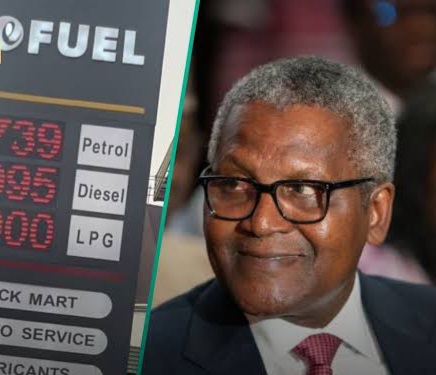
The price competition gained momentum in late December 2025 after the Dangote Refinery reduced its ex-gantry price to N699 per litre in a bid to secure market dominance. To reflect this reduction at the retail level, Dangote’s major distribution partner, MRS Oil, began selling petrol nationwide at N739 per litre.
As of January 12, 2026, however, a number of independent marketers, particularly in Lagos and Ogun states, had further reduced their prices in an effort to attract motorists. SAO Filling Stations were selling petrol at N735 per litre, while outlets operated by Ardova Petroleum were dispensing at N736 per litre, including locations situated close to MRS stations. Akiavic stations dropped prices to N737 per litre, while NIPCO outlets were selling at N738 per litre.
Industry observers attribute the sharp decline in pump prices to a combination of structural and market-driven factors. One key development is the commencement of direct supply agreements between the Dangote Refinery and independent marketers under the Independent Petroleum Marketers Association of Nigeria, eliminating intermediary costs previously associated with distribution dominated by the Nigerian National Petroleum Company Limited.
Retailers are also reported to be clearing older inventory at reduced prices to remain competitive, as motorists increasingly avoid stations selling above the N800 per litre mark. In addition, stakeholders have linked the price stability to the Federal Government’s “Naira-for-crude” policy, under which crude oil is sold to local refineries in local currency, helping to stabilise production costs and limit exposure to foreign exchange volatility.
The NNPCL has also adjusted its pump prices downward but remains above those of many independent marketers. In several Abuja and northern outlets, petrol prices were reported to range between N815 and N840 per litre, with the company citing higher transportation and bridging costs associated with supplying fuel to the region.
Despite the relief for consumers, some major marketers have raised concerns that the aggressive undercutting represents a “race to the bottom” that may not be sustainable. Industry reports indicate that with the landing cost of imported petrol averaging about N762 per litre, stations selling at N735 are likely operating on very thin margins or absorbing short-term losses in a bid to secure market share.
Analysts have described the current situation as the first true phase of “price discovery” in Nigeria’s deregulated fuel market. They note that if the Dangote Refinery sustains its N699 ex-depot price, the N730 to N750 range could emerge as the new national benchmark for petrol pricing.