






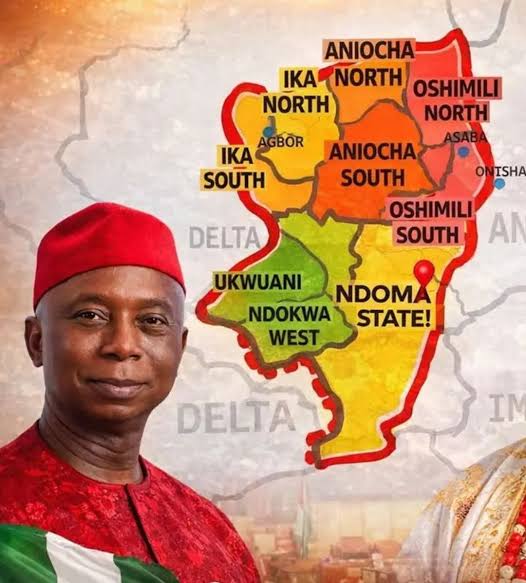
For decades, the map of Nigeria has been treated less like a sacred covenant of people and heritage, and more like a political Etch-A-Sketch. Every few years, the ink begins to flow again, promising administrative salvation through the birth of a new state. Today, the spotlight falls on Anioma. But as the 10th Senate moves with uncharacteristic speed to carve out Nigeria’s 37th state, we must ask: Is this the dawn of grassroots prosperity, or merely a sophisticated exercise in political gerrymandering?
At its heart, the Anioma debate is a crisis of identity masquerading as a quest for development. The proposal, championed by Senator Ned Nwoko and backed by the heavy weight of the Senate leadership, seeks to address a historical imbalance—giving the South-East its long-overdue sixth state. On paper, the logic is neat. On the ground, however, the human reality is far more jagged.
To walk the streets of Asaba is to walk through a cultural paradox. Linguistic ties pull the Anioma people toward the South-East, yet history anchors them firmly in the narrative of the Mid-West. There are those who see a merger with the South-East as a homecoming; there are many others who view it as a cultural exile.
For the septuagenarian in a village in Ndokwa, “Anioma” isn’t just a line on a map—it is a distinct identity forged through Benin ancestry and the unique rhythm of life along the Niger. To ignore these nuances is to treat a people like pieces on a chessboard. If the creation of a state requires the erasure of a sub-culture’s chosen alignment, is it truly a victory for the people?
The “grassroots development” argument is the standard hymn of state creation. Proponents point to the vast gas reserves of the Ndokwa region and the strategic gateway potential of Asaba. They argue that a smaller administrative unit will bring the government closer to the kitchen table.
Yet, Nigeria’s history with state creation tells a more sobering tale. Too often, a new state capital brings a flurry of new contractors and a bloated civil service, while the rural farmer still waits for a paved road to the market. With 97 senators reportedly signing off on the bill, one smells the distinct aroma of political expediency. Are we creating a state for the disenfranchised, or are we creating new seats at the table for an elite class looking to diversify their political portfolios ahead of 2027?
The proposed “Capital Shuffle”—elevating Warri while ceding Asaba—threatens to upend the delicate ethnic equilibrium of the Niger Delta. Redrawing these lines isn’t just an administrative task; it is a surgical procedure on the soul of the region. If not handled with the precision of a scalpel, we risk leaving behind a trail of resentment that no new governor’s lodge can soothe.
Anioma should not be a state created in a vacuum or a closed-door legislative session. If it is to be a “State of Mind” that truly reflects the aspirations of its people, the process must be transparent, inclusive, and culturally sensitive.
We do not need another state that exists only to collect federal allocations and pay political debts. Nigeria is currently in an economic winter; we cannot afford the luxury of “vanity states.” If Anioma is to be born, let it be because it is a functional necessity for the man in Agbor and the youth in Ogwashi-Uku, not because it fits the strategic math of a looming election.


