






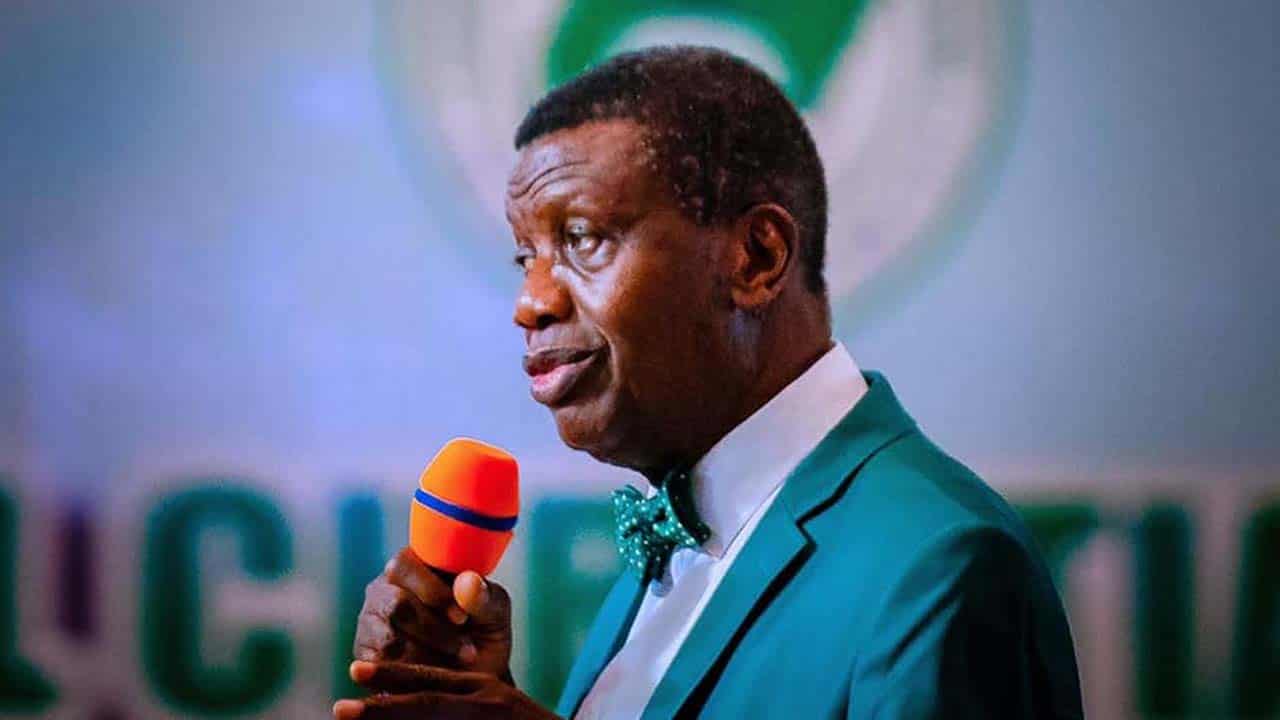
The RCCG Leader Worldwide, Pastor EA Adeboye
By Steven Ede
There is a passage in Shakespeare’s Macbeth where Ross, returning from a ravaged Scotland, tells Macduff: “Each new morn, new widows howl, new orphans cry, new sorrows strike heaven on the face.” He was describing a land under siege , a country whose grief had become its daily rhythm. You would be forgiven for thinking he had seen Nigeria first. This is not a nation merely struggling; it is a nation in which uncertainty has become the permanent weather. We build, but we build over rubble. We hope, but our hope wears the face of someone who has hoped before and been disappointed. The forest swallows our children. The highways return no one. And the songs we sing in our places of worship must now compete with the wailing from homes that have been emptied by violence.
A procession of grief has passed through the Oriire Community of Oyo State, but its echoes are now being heard all the way to Redemption City in Ogun State.
The Nigerian condition carries a long and growing catalogue of afflictions , choreographed expressions of anguish on the streets, in offices, the marketplace, institutions, and places of worship. Adding fresh sorrow to the mouths of Nigerians is a wave of abductions making a grim and deliberate transition from the North to the South. The harrowing image reports from this epidemic are not only troubling; they have put the constitutional requirement of security by government to a most serious question. The enemies of peace no longer only rule the bush , their sphere of influence has extended to our emotions and our morale.
Between May 13 and 15, 2026, coordinated attacks in Borno and Oyo States led to the abduction of at least 82 pupils. In Oyo, the attack was particularly gruesome: a teacher was beheaded. But Oyo is not where this story begins. They had done this before, in Kebbi, where 25 schoolgirls were kidnapped from a government secondary school in November 2025; in Niger State, where 303 students and 12 teachers were abducted from St. Mary’s Catholic School in Papiri in what became the largest mass school abduction since Chibok; in Kwara, where three worshippers were killed and 30 others abducted from a Christ Apostolic Church in Eruku; and in Borno, where insurgency has ground communities into dust across years of sustained terror. As of May 2026, more than 1,600 school children have been kidnapped since the 2014 Chibok abduction, and the actual figure, accounting for underreported incidents in rural communities, is almost certainly steeper. Nigeria recorded 12,954 violent deaths in 2025, with kidnapping-related fatalities rising from 425 in 2024 to 747 in 2025. These are not statistics. These are names that families can no longer call at dinner.
Fourteen days ago, while politicians were on the militantist mission of party primaries , gathered in hotel conference rooms and party secretariats, negotiating the currency of power and the arithmetic of delegates , armed men were conducting their own form of selection.
They chose teachers. They chose children. They chose the Onire Community of Oyo State, as they had chosen so many communities before it, and they carted away people whose only offence was subscribing to education in a country that had promised them its protection. While one class of Nigerians was buying votes, another class was losing lives. In a land where insecurity is striking like a whirlwind, the battle for daily survival now requires fresh ammunition against the uncertainty that the plague of abductions brings. The images and voices released by the abductors have drawn piety, public outrage, and shows of alarm from even the strongest minds. But more than sorrow, they are leaving a ponderous reflection on the capacity of the authorities to protect citizens as a mother hen covers her chicks. For the perpetrators, it is a transaction of wealth and their vicious mission. For the vulnerable, it is a gory tunnel of broken victims , a racing heartbeat anticipating the return of loved ones, the labour of immense prayers seeking the resolution of heaven’s advance. The tears have still not ended. Hopes still hang in the balance.
There is, however, a dimension to this crisis that deserves honest naming. Nigeria has, over the decades, become a nation that glamorises and deodorises bad behaviour. We have built a culture that celebrates outcomes without interrogating methods, that rewards noise over substance, and that has allowed religious institutions , the very spaces meant to be the conscience of society , to drift towards teachings that no longer speak to the core of righteous pattern. The pulpit that once afflicted the immoral has, in too many places, become a stage for the affirmation of it.This moral drift has seeped into the public square. It has produced officials who perform governance without practicing it, and citizens who demand accountability from others while excusing it in themselves. The rage that now surrounds the Redeemed Christian Church of God is, in part, a product of this broken value system , a society looking outside itself for the discipline it has refused to build within.
Talking about hope and prayers , we witnessed the prayers of Mrs. Alamu, the abducted Principal, directed to Nigerian authorities and every well-meaning Nigerian. In the video, she spoke as a woman in a world none of us would willingly inhabit. She said: “Please, negotiate with them. Do not leave us in the bush. The adults and children are suffering under the rain and the sun. Do not use force. Do not let them waste our lives.” That is the prayer of despair different from the accentuation of accomplishments and self-interest you would commonly hear in most religious houses. It is raw. It is without theatre. It is a prayer that has no language for self desire, only for survival.
As these prayers are being made in the tragic forest, the social media streets have now constructed a song whose melody is not sweet to the Redeemed Christian Church of God and her highly revered General Overseer, Pastor Enoch Adejare Adeboye , a man I believe has walked where the angels of the Lord fear to tiptoe.
Baba Adeboye is a devout man of God, a foremost pillar of Christian faith in Nigeria , a country that has perceptibly become the hub of end-time revivals , and a spiritual father to millions. A man whose heart is given to deep consecration and humanity, professing the belief of Jesus as the pathway to heaven and equally as the solution to the multifaceted challenges the world may be facing. His holy fervour has never neglected the reality of Nigerians. As a man who carries a burdened heart for the Church and the nations, he has led the RCCG to become a global phenomenon with the testimonies to show for it. He leads arguably the most geographically distributed church in the world, with Nigeria as the base headquarters. He once described himself as “made in heaven, assembled in Nigeria, exported to the world”. In 2009, he led the pre-summit prayers at the 64th General Assembly of the United Nations in New York. A man whose intercession has been sought not only by local congregants but by the gathered representatives of the nations of the earth.
Adeboye has lived out the conviction of redemption travelling beyond borders. His engagement with Nigeria’s development has never been limited to the altar. In 2022, he convened a meeting with ministers of the RCCG, pressing upon them the urgent need for righteous participation in the political process , that the church could not merely pray for better governance while its members disengaged from the very democratic structures that determine who governs. In November 2025, following the Abuja Holy Ghost Service, Adeboye met with young people during a hangout session in Abuja where he challenged them to become agents of righteous influence in their communities, professions, and spheres of engagement. His message was clear: the church could not afford spectators when the nation required builders. He believes that the exaltation of righteousness remains the only sustainable infrastructure for national development.
Yet today, it is not his achievements that have occupied social media , it is his silence.
A photograph showing Pastor Adeboye holding a placard during a public walk has been repeatedly misrepresented online and falsely attributed to a protest against former President Goodluck Jonathan’s administration. The facts tell a different story entirely. The photograph was taken during a peaceful nationwide prayer walk organised by the Christian Association of Nigeria on 2 February 2020, under the administration of former President Muhammadu Buhari. CAN had declared a three-day fasting and prayer programme beginning on 31 January 2020, calling on God’s intervention against terrorism, killings, and rising insecurity across Nigeria. Adeboye marched holding a placard that declared: “All Souls are Precious to God.” It was not a protest against any government. It was an act of intercession. The insinuation that he marched against Jonathan but falls silent under Tinubu is not only factually wrong, it is built on a photograph that has been recycled, reframed, and deliberately misread. The suggestion that the man of God was willing to take to the streets under one president but has maintained studied quietude under President Bola Tinubu, a man of Yoruba extraction, given that the First Lady is reportedly a pastor within the RCCG, collapses entirely under the weight of the actual record.
But it must be examined with honesty, not heat.
Pastor Adeboye himself addressed his participation in past civic protests, explaining that his involvement was based on directives from the Christian Association of Nigeria. “That was because the then chairman of CAN asked all Christians to go out for a peaceful protest. If he talks tomorrow and asks me to march, I will,” he said. This is not the language of a man who has chosen tribe over truth. It is the language of a man who has chosen institutional order over personal impulse, a distinction that critics have, in their grief, failed to honour. RCCG further clarified that the 2020 prayer walk was not a protest against any administration but the communication of a directive from the Pentecostal Fellowship of Nigeria , the plan being to hold the grand finale of a three-day prayer programme at a centralised venue.
And this pattern of institutional intercession has continued. In May 2026, under the directive of the Pentecostal Fellowship of Nigeria (PFN), a prayer walk was observed by Christian leaders across Lagos. Among those present were Pastor Yemi Davis, Chairman of the Lagos State chapter of PFN; Pastor Emmanuel Iren, President of the PFN Youth Wing; and Pastor Leke Adeboye, son and Personal Assistant to Pastor Enoch Adejare Adeboye. They stood in the gap for a nation burdened by insecurity and uncertainty. That this walk received little of the attention now being directed at Adeboye is itself a commentary on the selective nature of public outrage.
RCCG cited remarks made by Pastor Adeboye during the November 2025 Holy Ghost Service, where he reportedly urged the President to give security chiefs a clear ultimatum to end terrorism or resign, warning that continued insecurity could invite foreign intervention. That is not the language of a man who has traded his conscience for proximity to power. That is the language of a shepherd who has chosen the precision of a scalpel over the bluntness of a machete.
RCCG firmly rejected allegations that the cleric intentionally keeps silent on national issues, noting that Adeboye has spoken on several occasions about insecurity, corruption, economic hardship, elections, governance, and the need for righteous leadership , often through moral guidance, prayer, and counsel rather than partisan political confrontation.
And here lies the deeper tension.
Nigeria is a country whose people know how to yell louder than they read. The demand on Adeboye in this moment is not primarily theological , it is sociological. It is the demand of a people whose grief has nowhere else to land. And when the church , the one institution Nigerians have continued to trust above all others , appears to hedge, the wound doubles. They have seen the God of Adeboye move. They have seen altars shaken, and prophecies fulfilled to the letter. Now, with teachers and children swallowed by the forest, with a country fraying at every seam, they want to see the Adeboye of God on the move.
That is not an unreasonable longing.
But the call of this moment is not Baba Adeboye’s alone. It belongs to every Nigerian who has a voice and has chosen to use it only for personal advancement. It belongs to religious institutions that have substituted therapeutic messaging for prophetic courage. It belongs to public officials who have mistaken appointment as a convenient crutch to earn a better life. And it belongs to citizens who have mastered the art of trending outrage without sustaining the discipline of righteous demand.
The more urgent question is not whether God will arise for Nigeria. The question is whether Nigeria, its leaders, its pulpits, its citizens, and yes, its fathers in the faith, will arise for God.
As RCCG itself declared: “Pastor Adeboye and the RCCG will not be defined by falsehood, and neither will the Church remain silent while inaccurate narratives are repeatedly circulated as facts.” Fair enough. But Nigerians are not all circulating malice , many are circulating pain. And pain, left without a pastoral address, has a way of becoming something far louder than accusation.
The God of Adeboye has moved before. The question the nation is asking , not in hatred, but in hunger, is whether the Adeboye of God will move again.


