





Manny Ita –
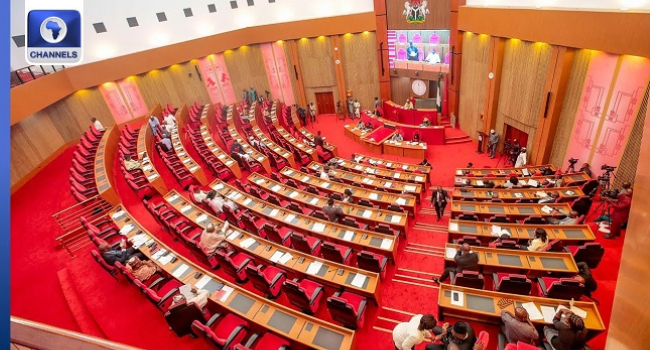
The Senate Committee on Banking, Insurance and Other Financial Institutions has urged the Central Bank of Nigeria (CBN) to strengthen its oversight of Nigeria’s rapidly expanding fintech sector in order to curb increasing cases of financial fraud within the country’s banking system.
The chairman of the committee, Adetokunbo Abiru, made the call on Wednesday during an investigative hearing into the operations of Ponzi schemes in Nigeria, with particular reference to the recent activities of Crypto Bullion Exchange (CBEX). The hearing was jointly organised by the Senate Committees on ICT and Cyber Security, Capital Market, and Anti-Corruption and Financial Crimes.
Mr Abiru, who represents Lagos East Senatorial District, advocated legislative reforms that would explicitly place fintech operations under the supervision of the CBN. He said the Banks and Other Financial Institutions Act 2020 (BOFIA), which regulates Nigeria’s banking system, should be amended to incorporate technology-enabled financial service providers.
“It is far more effective to strengthen the BOFIA framework, modernise CBN supervisory powers, and mandate robust coordination with agencies such as the Securities and Exchange Commission, Nigerian Communications Commission, National Information Technology Development Agency, Corporate Affairs Commission, Federal Competition and Consumer Protection Commission, the Office of the National Security Adviser and the Federal Ministry of Finance,” he said.
According to him, the proposed amendment would empower the CBN to designate qualifying fintech and digital financial institutions as important institutions, establish a national registry to improve transparency and beneficial ownership disclosure, strengthen risk-based supervision tailored to technology-driven financial services, and promote data sovereignty and systemic stability.
Mr Abiru also addressed proposals suggesting the establishment of a new standalone regulatory agency for fintech supervision, stating that such a move could complicate the existing regulatory structure.
“The question has arisen as to whether the creation of a new standalone regulatory agency would be a preferable pathway for supervising fintechs. However, after careful consideration, it is evident that establishing an entirely new agency would duplicate functions, create bureaucratic overlap, increase administrative costs, and fragment regulatory authority in a sector where coordination and coherence are essential,” he said.
Nigeria’s fintech industry has expanded rapidly over the past decade, driven by rising mobile phone penetration, increased adoption of digital payments, and financial inclusion initiatives championed by the CBN. The country is widely regarded as one of Africa’s leading fintech hubs, attracting significant investments and hosting numerous digital payment, lending and investment platforms.
However, the rapid expansion of the sector has also exposed regulatory gaps, as some digital platforms operate in grey areas between traditional banking, capital markets and telecommunications regulations. While the CBN regulates banks under the Banks and Other Financial Institutions Act, fintech firms often fall under multiple regulatory frameworks, creating coordination challenges among regulatory agencies.
In recent years, Nigeria has witnessed a surge in Ponzi schemes and unregulated digital investment platforms promising unrealistic returns to investors. Many of these schemes rely on social media promotion, cryptocurrency narratives and digital payment channels to attract victims. The collapse of platforms such as CBEX has renewed concerns about consumer protection, regulatory oversight and inter-agency coordination.
Previous experiences, including the MMM Ponzi Scheme that gained traction in Nigeria in 2016, have highlighted the scale of financial losses Nigerians can suffer when fraudulent investment platforms proliferate without timely regulatory intervention. Despite repeated warnings from authorities such as the Securities and Exchange Commission and the Central Bank of Nigeria, enforcement has often lagged behind the rapid emergence of such schemes.