





Nigeria: The Belly of the Beast
Drive northeast from Abuja toward Maiduguri and the road will tell you the truth before any official does. The tarmac is smooth, paid for by Chinese contractors and World Bank loans, but the checkpoints come faster than the kilometres. Soldiers in fading camouflage wave you through with the tired hands of men who stopped expecting good news a long time ago.
Beyond them the bush thickens, the villages thin out, the network bars on your phone disappear one by one. Somewhere in that green silence, the insurgents are waiting. This is Nigeria today. A country of over 220 million people, the demographic giant of an entire continent, the biggest economy on the African ledger, and quietly one of the most dangerous places on earth that nobody has declared a war zone.
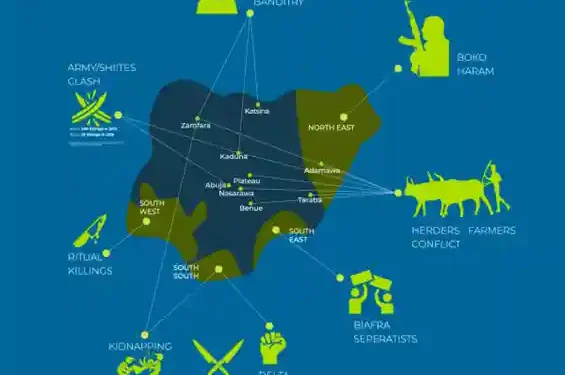
Nigeria does not have one conflict. Nigeria has many, running side by side like rivers that never meet but drain into the same flood. In the northeast, Boko Haram has buried more than 350,000 people since 2009 and its breakaway, ISWAP, has only grown sharper with practice, slipping across the Lake Chad basin into Cameroon, Chad and Niger as though borders were suggestions. In the northwest, banditry has become an industry with its own logic and its own currency: schoolchildren taken in the dead of night, ransoms negotiated like supply contracts, entire local economies of fear built around the gun. Zamfara, Katsina and Kaduna have watched their school gates close not from policy but from terror. A generation is growing up unlettered because going to class has become a gamble nobody wants to take.
In the Middle Belt, Nigeria’s farmer-herder crisis has hardened into something closer to ethnic cleansing than the lazy word “clashes” the government prefers. Climate change is pushing herders south into farmland that belongs to other people, of other faiths, of other tribes, and what follows is not communal friction but organised slaughter, mass graves dressed up in official statements as unfortunate misunderstandings. And in the southeast, Nigeria’s oldest unfinished argument has reignited: the secessionist hunger of IPOB, the gun-enforced Monday lockdowns of the Eastern Security Network, and a military response that burns villages in the name of order. Different regions. Different grievances. Same conclusion. The Nigerian state cannot hold its own ground.
The last few weeks alone read like a catalogue of how far the rot has spread. On May 15, gunmen on motorcycles stormed three schools in Oriire Local Government Area of Oyo State, snatching close to fifty pupils, teachers and a toddler from classrooms in broad daylight, a horror made worse two days later when the kidnappers circulated a video showing the beheading of one of the abducted teachers. Weeks have passed and most of the victims remain in the forest, their captors reportedly demanding the release of jailed Ansaru commanders in exchange for their freedom, while landmines planted around the hideout have slowed every rescue attempt. What stings most is the geography of it. This was not Borno or Zamfara, the places Nigeria has trained itself to expect bad news from. This was Oyo State, deep in the southwest, proof that the contagion no longer respects regional comfort zones.
Then came the death of Major General Rabe Abubakar, a retired army spokesman abducted alongside his wife on the road to a wedding in Katsina State and held for weeks until he died in his captors’ custody in mid-June. The state government called it diabetes and hypertension. His own son does not believe it, pointing instead to a video the kidnappers released before his death and insisting the marks on his leg looked like the work of a snakebite, not an underlying illness. Whatever finally killed him, a senior Nigerian general who once stood before cameras explaining the military’s victories died restrained in a forest, and his wife was only freed afterward when troops traced the gang to a village and fought their way through gunfire to reach her. Around the same death, gunmen struck the National Institute for Policy and Strategic Studies near Jos, a citadel built for the country’s most senior public servants, killing two soldiers and a policeman on the grounds where Nigeria trains the people meant to fix all of this.
The map of smaller horrors keeps filling in around these headline cases. Bandits hit a community in Tureta, Sokoto State, in a failed raid that still cost two police officers their lives in the ambush that followed. In Niger State’s Borgu axis, villagers in Dakera District now live under a quieter, more insidious arrangement, handed cash and shopping lists by bandits hiding in the surrounding forest and forced to run errands for their own tormentors or face reprisal. Human Rights Watch’s most recent accounting puts Zamfara alone at over a thousand abductions in a single year, with Kaduna, Katsina and Sokoto trailing close behind, and it documents mosque worshippers gunned down in Katsina, farming villages razed in Plateau and Benue, and travellers burned alive on the Okigwe-Owerri highway in the southeast. Nigeria does not run out of new wounds. It simply waits for old ones to fall out of the headlines before opening fresh ones.
To understand why Nigeria bleeds, look at who is bleeding it. The median age in the country is just over eighteen. By the end of this decade Nigeria will carry over 260 million people, three out of five of them under twenty-five. That is not a demographic dividend waiting to be cashed. That is a demographic bomb with a long, slow fuse. Four million young Nigerians walk into the labour market every single year and the economy, addicted to oil and strangled by corruption, can absorb maybe a tenth of them properly. The rest hustle. They hawk recharge cards in traffic. They ride okada until government bans swallow their livelihoods overnight. They queue at embassies hoping for a visa to anywhere that pays in dignity. Some of them, eventually, pick up a rifle instead.
Nigeria’s army has quietly become the employer of last resort for its own desperate youth, but a soldier without pay, without proper kit, without trust in his commanders, is a soldier who deserts, or sells his weapon, or vanishes into the very insurgency he was sent to crush. Meanwhile, Boko Haram offers a motorcycle and a wife. A bandit syndicate in Zamfara can hand a young man more from a single kidnapping than his father earned across an entire farming life. This is not ideology. This is arithmetic. And the cruellest part of Nigeria’s youth crisis is that this generation is also the most connected, most literate, most globally aware Nigeria has ever produced. They watch Burna Boy fill out London arenas. They scroll through the diaspora’s curated good life. They know exactly what is being denied them, and the distance between what they see and what they are given has curdled into rage.
Nigeria’s tragedy has never been a shortage of wealth. It is the theft, waste and weaponisation of it. The country pumps roughly 1.3 million barrels of oil a day, though sabotage and theft have eaten deep into what was once double that figure. The Niger Delta, where this wealth is dragged out of the ground, has paid for it in poisoned farmland and dead fishing grounds, while the money it generated built Abuja’s marble ministries and Lekki’s walled estates. But oil is no longer the only prize Nigeria is sitting on. Lithium, tin, tantalum and niobium run through the Jos Plateau and the Nasarawa-Keffi corridor. Rare earths sit under the Mambilla highlands. These are the raw materials of the next industrial century, the batteries and magnets the world is now scrambling for, and once again Nigeria is exporting them as unrefined ore while the jobs, the technology and the profit all leave with the ship.
Foreign powers have noticed, and they are not arriving as friends. America offers training and drone intelligence to Nigeria’s military, hedged carefully by human rights law and a long memory of extrajudicial abuse. China offers infrastructure and mining concessions with no such hesitation, even after bandits stormed its flagship Abuja-Kaduna railway in 2022 and kidnapped 168 passengers off it. The Gulf states are circling Nigeria’s lithium and phosphate. And in the shadows sits Russia, whose Wagner network has already replaced Western influence across the Sahel with security-for-resources deals, a model some frustrated Nigerian general, watching his troops retreat from Boko Haram, might one day find tempting. None of these powers is in Nigeria to rescue it. They are in Nigeria to feed off its instability, because a fractured Nigeria is a Nigeria that can be bought cheaply, piece by piece.
Behind every line of this story is a human being who cannot be reduced to a statistic, though Nigeria keeps producing statistics anyway. Two million people remain displaced around Maiduguri alone, an entire generation born and dying inside camps without ever knowing what a home is. In Zamfara, farmers cannot plant their own fields without risking death or kidnap, and the World Food Programme counts 8.5 million Nigerians now in need of emergency food, not because the rain failed, but because the gun has made farming a death sentence. In the southeast, families that can afford to leave have already gone, while those who remain live inside the fear of masked enforcers who answer to no government and no law. There are barely 200 psychiatrists serving over 220 million people. Nigeria’s trauma is generational, untreated, and growing quietly louder.
None of this happened by accident. Nigeria’s politics has functioned for decades as a machine for distributing oil rents rather than delivering public good, run by the same recycled political class that has simply rotated titles among itself since the nineties. Corruption is not the exception inside this machine. It is the operating system. Billions vanish from public accounts every year with nobody held meaningfully accountable, while soldiers on the front line eat garri and beans as their commanders cruise Abuja in imported Land Cruisers. Into every gap this failure leaves, a non-state actor has stepped in, armed and patient, offering the order, income or identity that the Nigerian state has failed to provide.
And yet Nigeria is not finished. There is a difference between a state that has failed and a state that is failing, and that difference is everything. Failed states collapse into chaos with no way back. Failing states still have institutions, however bruised, still have citizens with extraordinary talent, still have resources, however plundered, still have an identity worth fighting to repair. Nigeria has all of this in abundance. What Nigeria does not yet have is leadership willing to match the scale of what is required: a military reformed and made accountable rather than feared, an economy weaned off oil and pointed toward its own minerals and its own factories, a generation of young people handed real opportunity before the gun gets there first, and a long-overdue reckoning with the wounds Biafra, the Delta, the Middle Belt, that successive governments have preferred to bury rather than heal.
The road to Maiduguri is still long, and the checkpoints have not gone away. But the road has not stopped either, and somewhere along it there remains a version of Nigeria that works for the people who actually live on it. Whether anyone in Abuja is finally willing to drive it is the only question that has ever mattered.
By Seunmanuel Faleye