
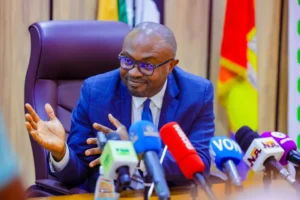







FILE: Minister of Communications, Innovation and Digital Economy, Bosun Tijani.
Elegbede Abiodun
This will include the deployment of 90,000 kilometres of fibre optic network nationwide to improve connectivity.
The Federal Government has said it will deliver at least 1,000 telecommunications towers to rural communities in 2026 as part of efforts to expand digital connectivity and bridge access gaps across the country.
The Minister of Communications, Innovation and Digital Economy, Bosun Tijani, disclosed this on Tuesday in Abuja during a press briefing on the National Digital Economy Research Clusters Programme, funded under Project BRIDGE.
He said, “The president has approved for us to install 3,700 towers… We’re working hard to deliver at least 1,000 of those this year,” noting that over 20 million Nigerians still live in areas without any form of connectivity.
Tijani explained that the tower rollout is part of a broader digital infrastructure plan that includes the deployment of 90,000 kilometres of fibre optic network nationwide to improve connectivity across all states, local governments and wards.
He stated, “If we have a ubiquitous fibre network all across Nigeria, the complaints that you give today on the quality of connectivity will change totally… If you want true real connectivity, it has to be through fibre.”
He stressed that the government is pursuing a coordinated infrastructure strategy that also includes upgrading Nigeria’s communication satellites and expanding digital access, adding that no developing country is currently investing simultaneously in fibre, towers and satellites at such a scale.
Beyond infrastructure, the minister said the government is prioritising evidence-based policymaking through the newly launched National Digital Economy Research Clusters, a university-led initiative designed to support Nigeria’s digital transformation.
Tijani said the programme would focus on six thematic areas and bring together top Nigerian academics to generate insights for policymaking, correcting earlier misconceptions about participation.
He said, “We want to pick six professors, up to six professors per cluster… it has nothing to do with how many states that we have in Nigeria,” adding that the goal is to assemble the best researchers to work collaboratively on national priorities.
He explained that each professor would be supported by three postdoctoral researchers and three PhD candidates, resulting in over 200 researchers working across the clusters over the next three years.
Bosun added that the programme would strengthen policy design and provide data-driven insights for both government and private sector decision-making.
The minister noted that the initiative is backed by about N12bn in funding over three years, with each cluster receiving $1.5m, and an additional allocation for programme management.
He added that international collaborations are expected to deepen the initiative, as foreign institutions partner with Nigerian researchers and bring additional resources into the programme.
On governance, Tijani said the clusters would operate under a structured framework involving both the communications and education ministries, alongside independent management to ensure transparency and accountability, particularly given the World Bank backing.
He urged the media to actively monitor the programme’s implementation.
Tijani also emphasised that Nigeria’s digital economy is expanding rapidly, with the sector’s contribution to GDP rising from about 16–18 per cent to nearly 20 per cent, with a target of 21 per cent next year.
He highlighted flagship initiatives, including the 3 Million Technical Talent programme, which he described as the largest technology talent accelerator globally, with participants across all 774 local government areas.
He added that Nigeria leads Africa in telecommunications investment inflows and hosts the continent’s largest telecoms market, noting that operations of major firms in Nigeria surpass those in their home countries.
The minister further disclosed that the Federal Government is working on a Digital Economy Bill currently before the National Assembly, which will provide a unified legal framework for the sector for the first time.
He said the government is also building a national data exchange system to enable seamless data sharing across public and private institutions, alongside implementing a national artificial intelligence strategy and a digital postcode system to improve commerce and service delivery.
Tijani stressed that universities must move beyond teaching to become centres of innovation and problem-solving, adding that research must be rigorous, peer-reviewed and aligned with global standards.
“We cannot rely on ideas developed elsewhere. We must generate our own insights that are rooted in our realities,” he said.
Also speaking at the event, the Minister of Education, Tunji Alausa, said the initiative reflects the government’s commitment to repositioning Nigeria’s education system to support economic growth.
He said, “We say education is the bedrock of society, but without communication, there would not be anything to facilitate education,” adding that the fibre project would prioritise connectivity for schools and hospitals.
Alausa disclosed that the government secured a $2bn World Bank facility to fund the fibre rollout, noting that integrating research into the project would help maximise its long-term impact.
He emphasised the importance of digital skills, noting that millions of global jobs now exist in areas such as artificial intelligence, cybersecurity, software development and automation, which Nigerian youths can access remotely.
He said the research clusters would address issues such as digital governance, online safety, job creation and agricultural innovation, while building capacity among postgraduate researchers.
Alausa added that the initiative would catalyse further investment and stimulate entrepreneurship, noting that the government is already supporting student-led ventures with equity-free grants.
Speaking on behalf of the academic community, the Vice-Chancellor of Olabisi Onabanjo University, Professor Ayodeji Agboola, said the programme would accelerate digital transformation and address youth unemployment.
Agboola added that aligning education with practical solutions would help reverse brain drain and create opportunities for young Nigerians, and called for the inclusion of security-focused research within the programme.
Similarly, the Vice-Chancellor of Ajayi Crowther University, Ebunoluwa Oduwole, commended the initiative, describing Project BRIDGE as critical to integrating education into the digital economy.
She noted that effective digital transformation in education depends on strong collaboration between the communications and education ministries, adding that the project would help ensure Nigerian universities are fully integrated into the digital ecosystem.


