






Manny Ita –
Israel and Hezbollah exchanged cross-border fire amid rapidly escalating hostilities linked to the ongoing war involving Iran, as United States President Donald Trump warned that the conflict could extend for several weeks while pledging retaliation for the deaths of American service members.
The Israeli military said it carried out strikes against Hezbollah positions across Lebanon after the Iran-backed group launched rockets and drones toward Israeli territory. In a statement, the military said that “in response to Hezbollah’s projectile fire toward the State of Israel,” Israeli forces had “begun striking targets of the Hezbollah terrorist organisation across Lebanon.” Authorities also issued evacuation warnings to residents in about 50 towns and villages in southern Lebanon, citing imminent military operations targeting militant infrastructure.
Tensions widened across the Gulf region as the United States and several Arab allies condemned Iran over missile and drone strikes targeting Gulf states hosting American troops. In a joint statement issued alongside Bahrain, Jordan, Kuwait, Qatar, Saudi Arabia and the United Arab Emirates, the US State Department described the attacks as “reckless and destabilizing behavior,” adding that the targeting of civilians and countries not directly engaged in hostilities heightened regional insecurity.
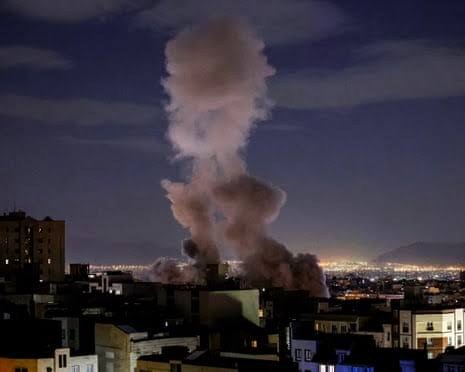
Israel confirmed it had launched what it described as “large-scale strikes” on Tehran, intensifying military operations two days after the start of a joint US-Israeli campaign against Iran. The Israeli military stated that “the Israeli Air Force… has begun an additional wave of strikes against the Iranian terror regime at the heart of Tehran,” signaling an expansion of attacks targeting Iranian command structures.
Trump, speaking in interviews with international media, said he had “three very good choices” for potential leadership in Iran but declined to identify them, stating, “I won’t be revealing them now. Let’s get the job done first.” The US president also vowed to avenge the deaths of three American soldiers killed during operations linked to the conflict, warning Iran’s Revolutionary Guards to surrender or face “certain death,” while urging Iranian citizens to rise up, saying, “America is with you.”
The Pentagon announced that Defence Secretary Pete Hegseth would hold his first press briefing on the military campaign alongside Chairman of the Joint Chiefs of Staff General Dan Caine. Senior US officials, including Secretary of State Marco Rubio and CIA Director John Ratcliffe, are also scheduled to brief members of Congress on the justification for the strikes against Iran.
Britain’s defence ministry confirmed that its forces were responding to a suspected drone strike targeting the RAF Akrotiri military base in Cyprus, describing the situation as ongoing but reporting no casualties. The incident followed London’s decision to permit the United States to use British military installations for what were described as “defensive” strikes against Iranian missile systems.
Commercial shipping disruptions intensified after Danish shipping giant Maersk announced it was suspending transit through the Strait of Hormuz and the Suez Canal for safety reasons, following Iran’s Revolutionary Guards’ declaration that the strategic waterway had been closed.
Gulf Cooperation Council member states meanwhile pledged collective self-defence, warning they would respond to further Iranian aggression if necessary after convening an emergency virtual meeting to coordinate regional security responses.
Israeli emergency services reported that seven people were injured in the Jerusalem area following a fresh missile barrage launched from Iran, underscoring the continued civilian impact of the conflict.
European Union officials announced plans to reinforce their naval mission in the Red Sea amid fears that Iranian retaliation could threaten international shipping routes. EU foreign policy chief Kaja Kallas warned that the Middle East “stands to lose greatly from any drawn-out war,” adding that escalation could carry “unpredictable consequences” for regions beyond the Middle East.
The US military’s Central Command stated that strikes had destroyed the headquarters of Iran’s Islamic Revolutionary Guard Corps, declaring that “America has the most powerful military on earth, and the IRGC no longer has a headquarters.” Israel’s military separately reported strikes on multiple Iranian military command centres, including intelligence facilities and internal security headquarters.
Iranian media reported that a police station on the outskirts of Tehran had been hit during the strikes, with casualties feared and several individuals believed trapped under rubble. The ISNA news agency also reported that Gandhi Hospital in northern Tehran sustained damage, with video footage circulated by local agencies showing debris scattered inside medical facilities.
Trump said he anticipated the military campaign could last approximately four weeks, telling the Daily Mail that “it’s always been a four-week process,” while acknowledging the scale of operations required against Iran, describing the country as “a big country” that would take time to subdue.
The developments signal a widening regional confrontation involving multiple state and non-state actors, raising international concern over the risk of a prolonged conflict with significant humanitarian, economic and security consequences across the Middle East and beyond.


