





Manny Ita
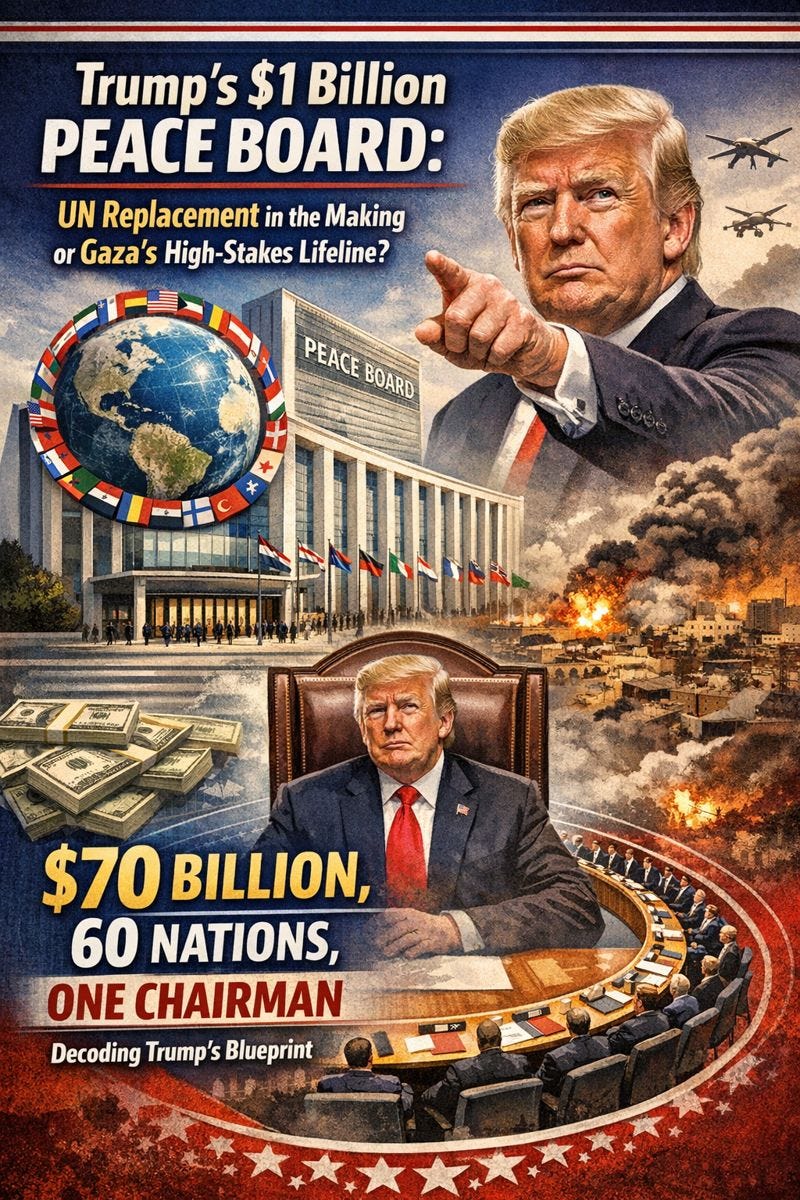
The World Economic Forum in Davos became the stage for a radical restructuring of international diplomacy on Thursday as President Trump officially unveiled the charter for his Board of Peace. What was initially introduced last year as a temporary mechanism to oversee the reconstruction of the Gaza Strip has now been formalized as a permanent, standalone international organization. Addressing a ceremony in Davos, President Trump declared it a “very exciting day” and claimed that the body would eventually “get a lot of work done that the United Nations should have done,” even suggesting the board “might” replace the UN entirely as a more efficient alternative for conflict resolution.
Under the terms of the private charter obtained by international observers, the organization is governed by a rigid hierarchy centered on Chairman Trump, who is designated as a member for life with the exclusive authority to create or dissolve subsidiary entities. The body operates on a unique pay-to-play model where permanent seats are reserved for nations that contribute 1 billion dollars in cash funds within the first year. Countries that do not meet this financial threshold are restricted to three-year terms at the sole discretion of the Chairman. Experts have characterized the move as a transactional evolution of the UN Security Council, with George Washington University professor Paul Williams noting that the board allows Trump to “exercise veto power” alone while bypassing traditional multilateral bloat.
The newly appointed Executive Board, which will manage the organization’s strategic and financial portfolios, consists of a mix of political loyalists and global finance figures. The lineup includes U.S. Secretary of State Marco Rubio, Special Envoy Steve Witkoff, and the President’s son-in-law Jared Kushner, alongside World Bank President Ajay Banga, former British Prime Minister Tony Blair, and Apollo Global Management CEO Marc Rowan. This group is currently tasked with implementing Phase Two of the administration’s 20-point Gaza peace plan, which involves the total demilitarization of the territory and the installation of a technocratic Palestinian government—the National Committee for the Administration of Gaza—under the board’s direct supervision.
Response to the initiative among the 60 invited world leaders has been sharply divided along ideological and financial lines. While nations such as Israel, Hungary, Argentina, and India have expressed varying levels of interest or formal acceptance, key Western allies have reacted with significant hesitation or refusal. France has officially declined the invitation, with Foreign Minister Jean-Noël Barrot stating that the board’s expansive charter is “incompatible with France’s international commitments.” Similarly, the United Kingdom has voiced concerns over the inclusion of Russian President Vladimir Putin on the invite list, while Canada has signaled it will participate in discussions but has no intention of paying the 1 billion dollar membership fee.
As the Board of Peace begins its operations, critics point to the lack of Palestinian representation in its top-tier executive structure as a sign of ultimate marginalization. However, the White House maintains that the board is the only body capable of restoring dependable and lawful governance in conflict zones. With the Gaza ceasefire entering a fragile second phase and the board’s mandate expanding to broader global conflicts, the international community remains split on whether this prestigious board represents a viable new era of deals-based diplomacy or a fundamental threat to the existing rules-based international order.


