







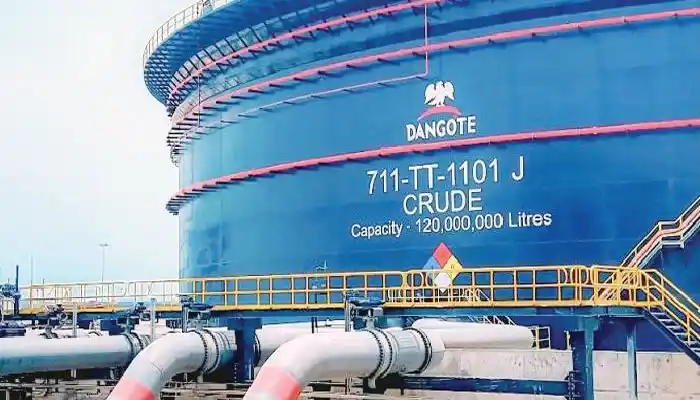
File: Dangote Refinery
Dangote Petroleum Refinery shipped about 466,000 metric tonnes of jet fuel to Europe in June, valued at an estimated N757bn, overtaking shipments from the United States and others.
This is as Nigerian jet fuel exports to the continent reached their highest level since the country became a net exporter of aviation fuel in 2024.
According to a market report by S&P Global Commodity Insights, the refinery’s exports came as the European jet fuel market turned increasingly bearish following a sharp decline in prices from the highs recorded during the Middle East conflict.
The report stated that flows of jet fuel from Nigeria to Europe rose from 232,000 metric tonnes in May to 466,000 metric tonnes in June, the highest volume exported from the country to Europe since Nigeria became a net exporter of jet fuel in 2024, when the Dangote Refinery commenced aviation fuel production.
The June export volume is equivalent to about 582.5 million litres of jet fuel. At an estimated domestic value of N1,300 per litre, the shipment is worth about N757.25bn.
On the other hand, aviation fuel exports from the United States fell sharply in the past months. The report showed that jet fuel exports from the United States to Europe declined steadily over the same period, falling from a record 818,000 metric tonnes in April to 560,000 metric tonnes in May and further to 399,000 metric tonnes in June, leaving Nigeria as a bigger supplier to Europe during the month.
Commenting on the market, a trader attributed the oversupply partly to increased shipments from Dangote and the United States. “Jet is oversupplied because of high local refinery production; refineries pushed back maintenance to make the most of the high prices.
“The US and Dangote also shipped large volumes. Now there are some flows resuming through the Suez, too, from the UAE, but let’s see how it goes,” the trader was quoted as saying.
The report noted that the European jet fuel forward curve had weakened significantly after reaching record highs during the Middle East war, as traders now anticipate an oversupplied summer market amid weaker-than-expected aviation demand.
According to Platts, part of S&P Global Commodity Insights, the Northwest Europe jet CIF cargo financial assessment for July dropped to $981.75 per metric tonne on June 30, down sharply from the all-time high of $1,694.25 per metric tonne recorded on March 30.
Similarly, the August contract declined from $1,507.50 per metric tonne on March 30 to $968.25 per metric tonne by June 30.
The report added that Europe could receive even more jet fuel supplies in the coming months as the East-West arbitrage remains attractive, encouraging exporters in the Middle East and India to ship cargoes westward.
While flows from the United Arab Emirates and Kuwait were absent in June, shipments from Saudi Arabia increased to about 106,000 metric tonnes, up from 7,000 metric tonnes in May, while exports from India rose from 129,000 metric tonnes to 197,000 metric tonnes over the same period.
Despite the current oversupply, two European jet fuel traders reportedly told Platts that market conditions would depend largely on developments in the Strait of Hormuz and the pace at which Middle Eastern refineries recover from disruptions caused by the recent conflict.
They also noted that stronger summer travel demand and refiners’ growing preference to maximise diesel production over jet fuel could gradually help rebalance the aviation fuel market.
Data from the Nigerian Midstream and Downstream Petroleum Regulatory Authority showed that the Dangote refinery exported an estimated 1.66 billion litres of refined petroleum products in April 2026.
This was during the mounting tensions in the Middle East that caused disruption to global fuel supply routes.
An analysis of the NMDPRA’s April 2026 fact sheet showed that the country exported about 513 million litres of premium motor spirit, popularly called ‘petrol’; 534 million litres of automotive gas oil, also known as diesel; and 615 million litres of aviation fuel within the month in April.
The Dangote refinery is the only major functional refinery in Nigeria that currently produces enough refined petroleum products for both local consumption and export.
Nigeria has become a net petrol exporter for the first time in decades due to rising output from the Dangote refinery. The refinery had earlier exported about 434 million litres of petrol in March after domestic production exceeded local consumption levels.
The latest figures underscore Nigeria’s gradual transition from a major importer of refined petroleum products to an export hub within Africa. It was observed that jet fuel exports may rise further with the instability caused by the Middle East crisis, which disrupted traditional supply chains serving Europe and other regions.


