






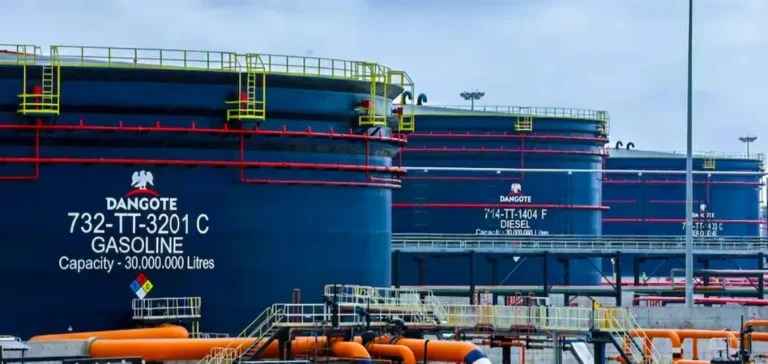
Dangote Refinery
Elegbede Abiodun
The cooking gas price will ease gradually across Nigeria after Dangote Petroleum Refinery and major liquefied petroleum gas marketers must have dropped their prices, offering some relief to households facing persistent energy costs.
Dangote Refinery lowered its LPG gantry price by N30 to N950 per kilogram.
The latest reduction places the refinery’s LPG price at a level that could encourage further downward movement across the supply chain, particularly if marketers pass the savings on to consumers.
Several major operators have already reduced their ex-depot prices.
11PLC, formerly Mobil, alongside NAVGAS, Ranoil and PPMC, cut their ex-depot LPG prices to between N955 and N960 per kilogram. The reductions ranged from N15 to N30 per kilogram, according to the survey.
The adjustments came swiftly after Dangote Refinery’s latest price reduction, highlighting the refinery’s growing influence on domestic petroleum product pricing.
At the retail end of the market, however, consumers are still paying considerably more than the latest depot prices.
LPG sold at filling stations operated by Ranoil, the Nigerian National Petroleum Company and Shafa was priced between N1,300 and N1,450 per kilogram, according to the report.
Other retailers in Abuja and surrounding areas were selling at about N1,500 per kilogram, the same level recorded in July.
The difference between depot and retail prices means that the full impact of the latest reduction may take some time to reach households, depending on transportation costs, distribution margins and local market conditions.
For households that rely on LPG for cooking, any sustained reduction could provide welcome relief after years of elevated energy and food costs.
The latest development also comes against the backdrop of significant changes in Nigeria’s LPG supply market.
Data from the Nigerian Midstream and Downstream Petroleum Regulatory Authority showed that LPG imports surged by about 1,400 per cent in June, indicating a sharp increase in imported supplies as the country sought to meet domestic demand.
The increase in imports comes as Nigeria continues to develop its domestic refining capacity and expand LPG availability.
Dangote Refinery has increasingly become an important supplier of petroleum products to the Nigerian market, while other domestic and imported sources continue to contribute to supply.
The combination of increased supply and lower depot prices could put further pressure on retailers to reduce their rates if the trend is sustained.
However, the price consumers ultimately pay will continue to depend on the cost of transporting LPG from depots to retail outlets, local demand, operating expenses and regional supply conditions.
The latest adjustment therefore represents an encouraging development for consumers, but it remains too early to determine whether the reduction will translate into a uniform nationwide decline.
If marketers maintain the lower depot prices and distribution costs remain stable, households could begin to see more noticeable savings in the coming weeks.
For now, Dangote Refinery’s N30 reduction and the subsequent response from major depot owners have created a fresh downward momentum in the LPG market, raising hopes that cooking gas could become more affordable for Nigerian households.