




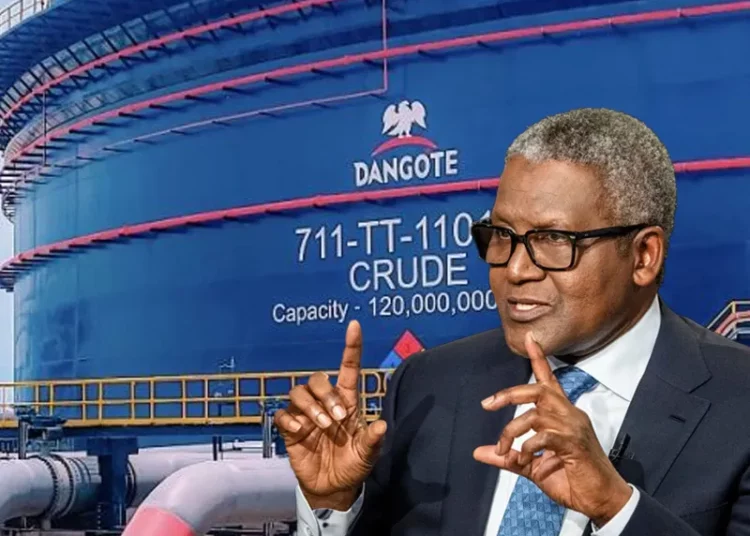
File Copy: Chief Executive Officer of Dangote Group, Aliko Dangote
The Dangote Petroleum Refinery has reached an offtake agreement with 12 major petroleum marketing companies to distribute between 60 million and 65 million litres of Premium Motor Spirit (petrol) daily across the country, in a move expected to stabilise supply and deepen Nigeria’s fuel self-sufficiency.
President of the Dangote Group, Aliko Dangote, said this in Lagos, noting that the structured framework would guarantee nationwide availability of petrol while exporting surplus volumes.
According to a statement issued, Dangote said, “We have agreed an offtake framework to supply up to 65 million litres daily for the domestic market. Any surplus, estimated at between 15 and 20 million litres, will be exported.”
Dangote stated that the initiative marks a major shift in the country’s downstream petroleum sector, as Nigeria’s daily consumption currently ranges between 50 million and 60 million litres.
This means the refinery is expected to supply about 1.8 billion to over 2 billion litres of petrol monthly, depending on daily output and the number of days in the month.
The latest offtake and distribution arrangement follows an earlier agreement reached in October 2025 between the Dangote Petroleum Refinery and downstream operators aimed at stabilising fuel supply and curbing volatility in pump prices.
At the time, independent petroleum marketers disclosed that the refinery had set a target to release up to 600 million litres of Premium Motor Spirit monthly to the domestic market as part of efforts to address supply disruptions and rising costs across the country.
Under the arrangement endorsed by the Nigerian Midstream and Downstream Petroleum Regulatory Authority, selected marketers will handle nationwide distribution to prevent supply disruptions and eliminate speculative practices.
The marketers include MRS Oil Nigeria Plc, Nigerian National Petroleum Company Limited Retail, 11 Plc, TotalEnergies Marketing Nigeria, Rainoil Limited, Northwest Petroleum & Gas Company Limited, Ardova Plc, Bovas & Company Limited, AA Rano Nigeria Limited, AYM Shafa Limited, Conoil Plc, and Masters Energy.
The statement noted that the structured offtake model is designed to ensure efficient logistics, reduce hoarding, and support price stability. It added that the refinery would export between 15 million and 20 million litres daily once domestic supply obligations were met.
“This would conserve foreign exchange, improve the country’s trade balance and strengthen external reserves, as Nigeria will no longer rely heavily on imported fuel,” the statement explained.
For decades, Africa’s largest oil producer depended on imported refined products, exposing the economy to exchange rate volatility, global supply disruptions and recurring shortages.
The Group Chief Executive Officer of the Nigerian National Petroleum Company Limited, Bayo Bashir Ojulari, recently described the refinery as a transformative national asset capable of redefining the country’s energy security architecture.
He said, “This plant was designed for 650,000 barrels per day. None of us thought it would even touch 550,000. What we saw live today was 661,000. These are live parameters, not reports or photographs.”
Ojulari added that the refinery represents a new era of industrial capability and technological advancement for Nigeria.
Nigeria has intensified reforms in the oil and gas sector following the deregulation of the downstream market and removal of fuel subsidy under President Bola Tinubu.
The Dangote refinery, Africa’s largest, is expected to play a central role in ending decades of petrol importation, stabilising prices, and positioning Nigeria as a net exporter of refined petroleum products across West and Central Africa.
The success of the structured offtake model could usher in a more stable fuel supply chain and reduce the risk of shortages that have plagued the country for years.


