






By Manny Ita –
Nyesom Wike has, over time, evolved into one of the most polarizing figures in Nigeria’s contemporary political landscape. As Minister of the Federal Capital Territory and a longstanding stalwart of the People’s Democratic Party (PDP), his political choices—particularly his open and vigorous support for President Bola Ahmed Tinubu of the All Progressives Congress (APC)—have stirred debate, criticism, and, in some quarters, reluctant admiration.
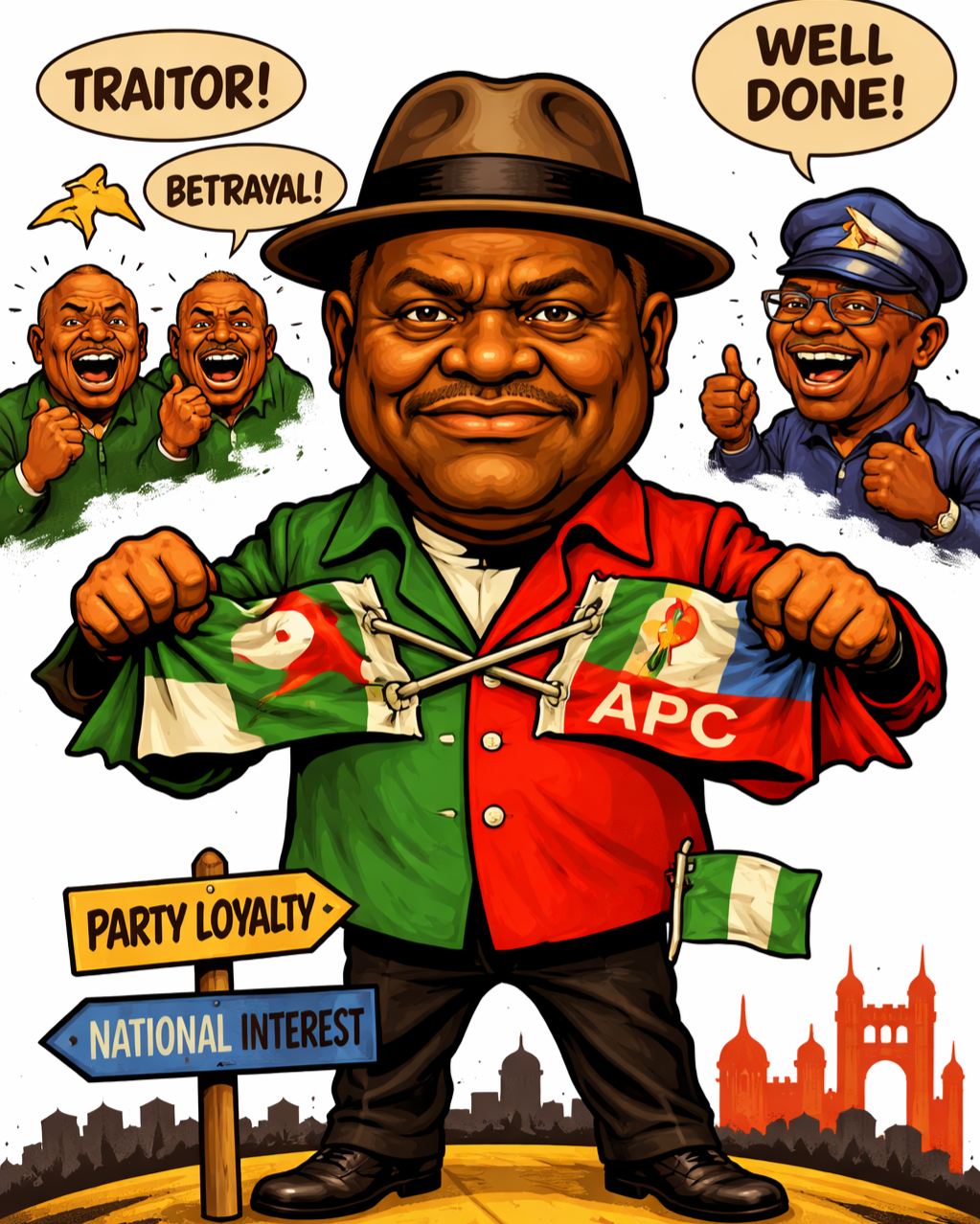
At the heart of the controversy lies a fundamental question: should political loyalty to party structures outweigh allegiance to national interest? Wike’s posture suggests a decisive answer—no. His actions, often described as unorthodox or even rebellious, present a compelling case for a politics that prioritizes perceived competence and national direction over rigid party lines.
Critics argue that his stance undermines party discipline and erodes the ideological coherence necessary for democratic stability. In conventional political systems, party allegiance serves as a framework for accountability and policy continuity. A prominent figure openly supporting a rival platform risks blurring these lines, potentially fostering opportunism disguised as patriotism. For many within the PDP, Wike’s position is not a bold reformist gesture but a betrayal that weakens opposition strength in a system already grappling with imbalance.
Yet, there is another perspective—one that frames Wike’s approach as a rare display of political candor. In a system where covert alliances and silent compromises are often the norm, his openness disrupts the culture of duplicity. Rather than cloak his preferences in ambiguity, he declares them unequivocally. This transparency, whether one agrees with his judgment or not, introduces a level of honesty that is often absent in Nigerian politics.
More importantly, his stance raises a broader philosophical argument about governance in developing democracies. When party structures become vehicles for personal ambition rather than instruments of public service, strict loyalty to such systems may, in fact, hinder national progress. In this context, Wike’s alignment with a rival administration can be interpreted as a pragmatic calculation—one that places perceived effectiveness above partisan identity.
However, this argument is not without its risks. If widely adopted without principled boundaries, such fluidity could devolve into political instability, where allegiance shifts not on ideology or national benefit, but on convenience. The challenge, therefore, is distinguishing between principled independence and opportunistic defection. For Wike’s model to hold merit, it must be anchored in consistent, demonstrable commitment to national development rather than personal or factional gain.
What makes his case particularly significant is its symbolic weight. Nigeria’s political environment has long been criticized for elevating party supremacy above national cohesion. Elections are often framed as existential battles between parties, rather than contests of ideas. Wike’s approach—controversial as it is—challenges this orthodoxy. It suggests that political actors can, and perhaps should, transcend party boundaries when national interest is at stake.
In essence, his politics introduces a disruptive but necessary conversation: can patriotism exist independently of party loyalty? And if so, how should it be defined and practiced?
The answer likely lies in balance. Political parties remain essential to democratic organization, but they must not become ends in themselves. National interest—though often invoked and rarely defined—should serve as the ultimate benchmark against which political decisions are measured. Where party directives conflict with this benchmark, there may be a case, however contentious, for dissent.
Wike’s brand of politics may not be universally admirable, but it is undeniably instructive. It exposes the tensions between loyalty and leadership, between conformity and conviction. In doing so, it compels both politicians and citizens to reconsider what true patriotism demands in a complex and evolving democracy.
Whether history judges his actions as courageous or contradictory will depend not only on outcomes, but on the consistency of the principle he appears to champion—that the nation must, at critical moments, come before the party.


