





By Manny Ita –
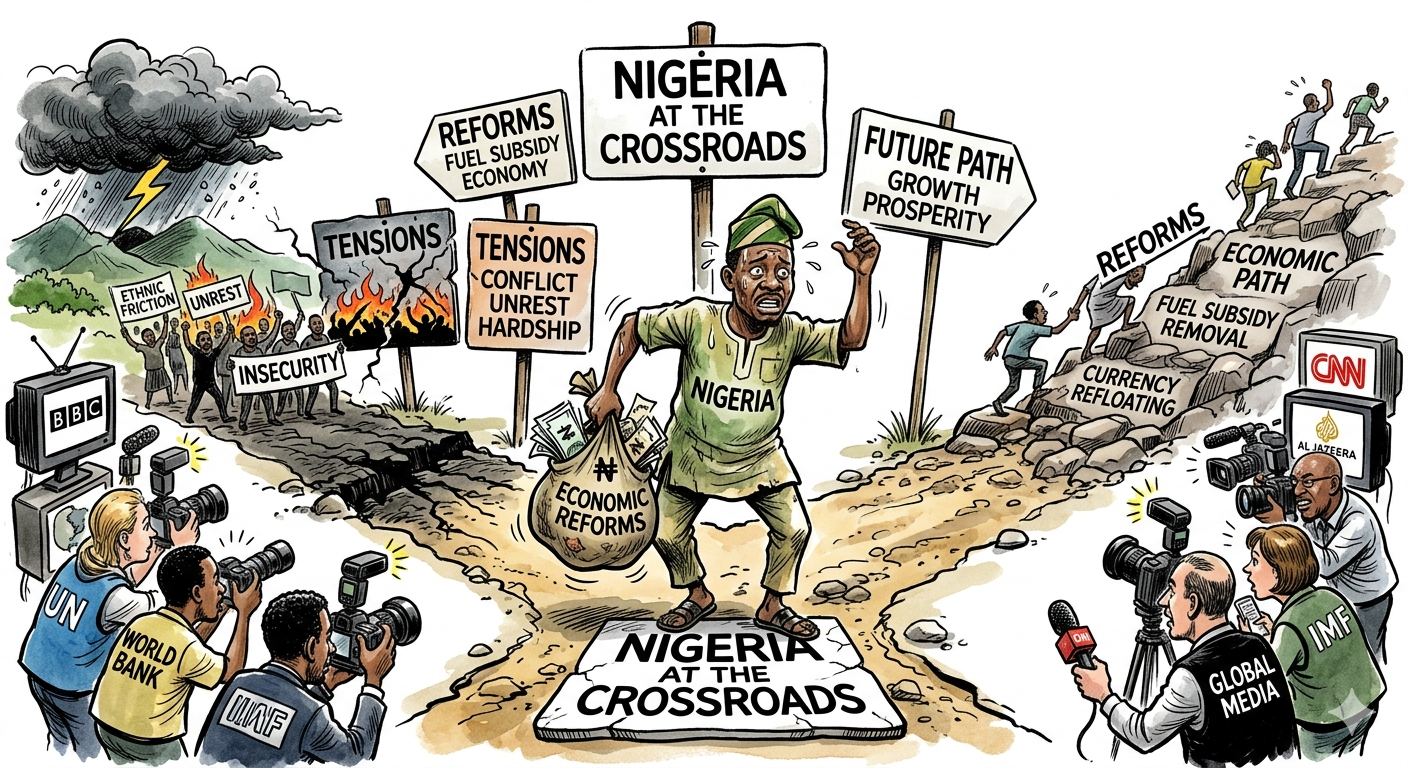
Nigeria, Africa’s most populous nation and largest economy, is currently standing at a critical juncture. For decades, the country has navigated a complex path marked by both remarkable potential and significant challenges. Today, however, a unique convergence of factors has brought Nigeria to a defining moment, placing it squarely in the global spotlight. This confluence of reforms, rising tensions, and increased international scrutiny underscores the magnitude of the crossroads Nigeria faces.
At the heart of Nigeria’s current predicament is a renewed push for reform. President Bola Tinubu, who assumed office in May 2023, has embarked on a series of ambitious, and often painful, economic and structural changes. These reforms, broadly aimed at revitalizing the economy and improving governance, are central to the current narrative.
One of the most significant and controversial reforms was the abrupt removal of the fuel subsidy in June 2023. While the subsidy had been a massive drain on public finances for decades, its removal led to an immediate and sharp increase in transportation costs and food prices, placing immense pressure on ordinary Nigerians. The government argues that removing the subsidy is necessary to free up funds for critical investments in infrastructure, health, and education.
Another critical area of reform has been the unification of Nigeria’s foreign exchange market. Previously, the country operated a complex system of multiple exchange rates, which was prone to abuse and created uncertainty for investors. The unification of the rates aims to attract foreign investment and stabilize the naira. However, the initial effect was a significant devaluation of the naira, which further exacerbated inflation and increased the cost of imports.
Beyond these headline reforms, the Tinubu administration has pledged to tackle corruption, improve revenue generation, and diversify the economy away from its over-reliance on oil. These efforts are seen as crucial for long-term sustainable growth.
While the need for reform is widely acknowledged, the manner and pace of their implementation have fueled significant tensions within Nigerian society. The immediate economic impact of the fuel subsidy removal and naira devaluation has led to widespread hardship, triggering protests and labor strikes. Trade unions and civil society organizations have demanded palliative measures to cushion the blow for vulnerable populations.
The economic anxieties are layered upon pre-existing security challenges that have plagued Nigeria for years. The country continues to grapple with the Boko Haram and ISWAP insurgency in the northeast, banditry and kidnapping in the northwest, and farmer-herder conflicts in the middle belt. These security threats not only claim lives and displace people but also hinder economic activity and deter investment.
The combination of economic hardship and pervasive insecurity has heightened social and political tensions. There are concerns that the reforms, if not managed carefully, could exacerbate inequality and fuel further instability. The government’s ability to effectively communicate the long-term benefits of the reforms and provide timely relief to those most affected will be critical in mitigating these tensions.
Nigeria’s size and economic importance mean that developments within the country have far-reaching implications, placing it under the global spotlight. International partners and investors are closely watching the progress of the reforms, weighing the risks against the potential rewards.
For Western nations, Nigeria is a key partner in areas such as trade, counter-terrorism, and regional stability in West Africa. The success of the reforms is seen as essential for Nigeria to fulfill its potential as an economic powerhouse and a bulwark against instability in the region.
On the other hand, the humanitarian situation, compounded by the economic hardship and insecurity, is a major concern for international human rights organizations and aid agencies. The global community is urging the Nigerian government to ensure that the reforms are implemented in a way that protects the most vulnerable and upholds the rule of law.
Nigeria is indeed at a crossroads. The reforms initiated by the current administration are ambitious and could, if successful, set the country on a path to sustainable growth and development. However, the path is fraught with challenges, and the potential for instability is real.
To successfully navigate this crossroads, Nigeria needs a combination of bold leadership, effective governance, and national consensus. The government must prioritize transparency and accountability in the implementation of the reforms. It must also address the immediate needs of the population and invest in social safety nets.
Furthermore, tackling the security challenges must remain a top priority. Without peace and stability, economic reforms cannot yield their full potential. This requires a comprehensive approach that combines military action with addressing the root causes of conflict, such as poverty and inequality.
The global spotlight on Nigeria is both a challenge and an opportunity. By demonstrating a commitment to reform, good governance, and the well-being of its citizens, Nigeria can attract the investment and support needed to overcome its challenges.
The road ahead is difficult, but Nigeria has a history of resilience. The current crossroads presents a unique opportunity for the country to redefine its future and emerge stronger. The world is watching, and the choices Nigeria makes today will resonate for years to come.


