







Manny Ita –
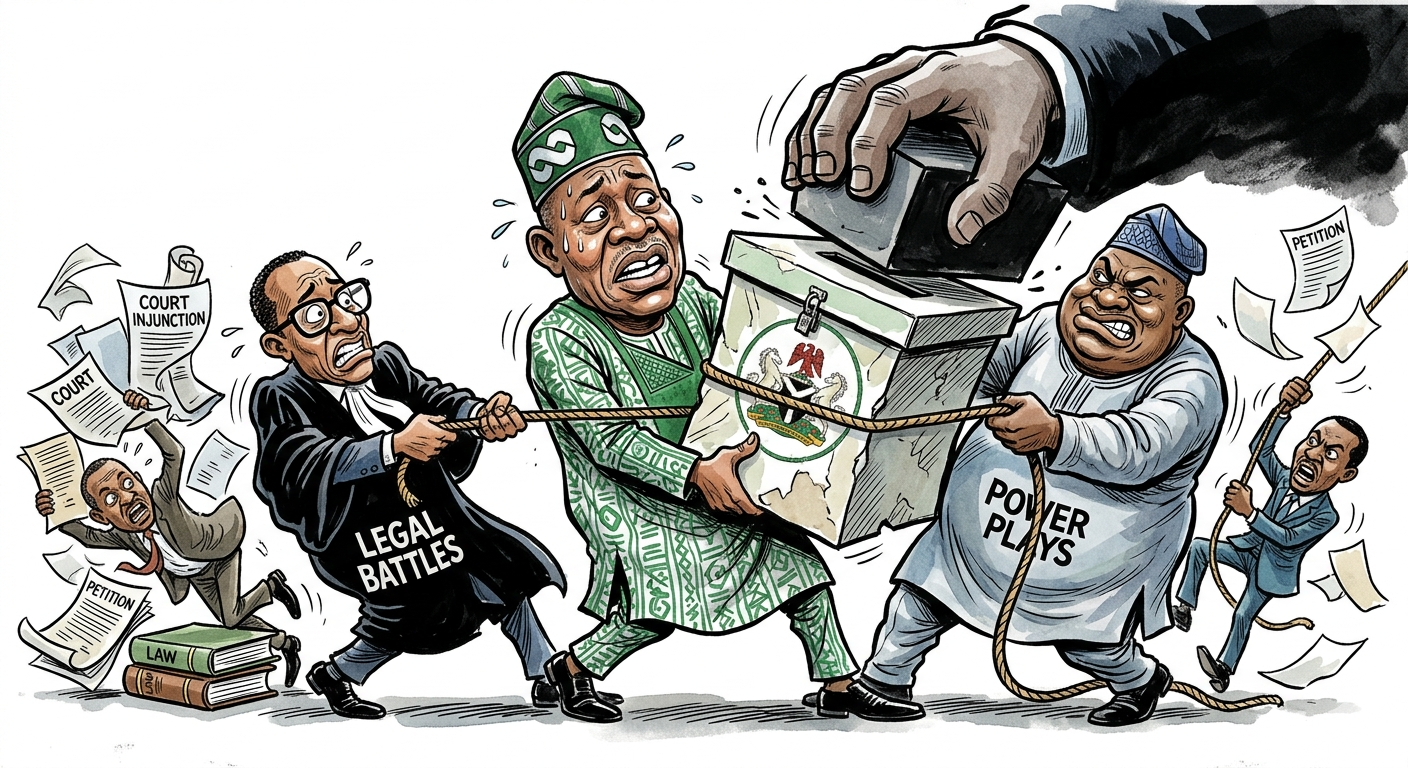
Nigeria’s political atmosphere is steadily warming as the country inches closer to the 2027 general elections. What might once have been routine disagreements within the political class are now evolving into high-stakes legal battles, strategic realignments, and narratives that point to a broader struggle for power. From courtrooms to campaign corridors, the early signals suggest that the road to 2027 will be anything but quiet.
At the center of the unfolding tension is the increasing reliance on legal instruments to settle political scores. High-profile cases—such as the ongoing defamation suit involving Natasha Akpoti-Uduaghan and former Kogi State governor Yahaya Bello—underscore how political disputes are now being reframed as legal contests. While the courts remain a legitimate avenue for redress, the frequency and intensity of such cases raise questions about whether litigation is becoming a proxy battleground for political influence.
Beyond individual cases, broader institutional concerns are also coming into focus. The role of the Independent National Electoral Commission is once again under scrutiny, particularly as controversies emerge around party recognition and internal disputes. Political parties, including the African Democratic Congress, are grappling with internal fractures that could shape their viability as credible challengers in the next election cycle. In a landscape where party cohesion often determines electoral strength, these cracks may prove decisive.
Equally significant are the political maneuvers playing out behind the scenes. Allegations surrounding comments attributed to Femi Gbajabiamila have added another layer of complexity, fueling debates about the boundaries of political strategy and the ethics of influence. Whether verified or not, such narratives contribute to a growing perception that the contest for 2027 has already begun in earnest—far earlier than many anticipated.
For the administration of Bola Ahmed Tinubu, these developments present both a challenge and a test. Managing political stability while maintaining public confidence in democratic institutions will be critical in the months ahead. The government’s response to emerging controversies—particularly those with legal and electoral implications—could shape both domestic perception and international confidence in Nigeria’s democratic process.
What is perhaps most striking is how quickly the lines between governance, law, and politics are blurring. Legal arguments are no longer confined to courtrooms; they are being amplified in public discourse, media spaces, and political rhetoric. At the same time, political strategies are increasingly being executed through legal channels, creating a cycle that feeds into the overall sense of tension.
Yet, within this climate lies an opportunity. A politically engaged judiciary, an assertive electorate, and active institutions can collectively strengthen democratic accountability—if managed with transparency and restraint. The key lies in ensuring that legal processes remain impartial and that political competition does not erode institutional integrity.
As Nigeria moves closer to 2027, the signs are clear: the contest will not be defined solely by campaign rallies or manifestos, but by a complex interplay of legal battles, strategic positioning, and institutional credibility. The stakes are high, and the temperature is rising. Whether this tension ultimately strengthens or strains the nation’s democracy will depend on how these forces are navigated in the critical months ahead.


