

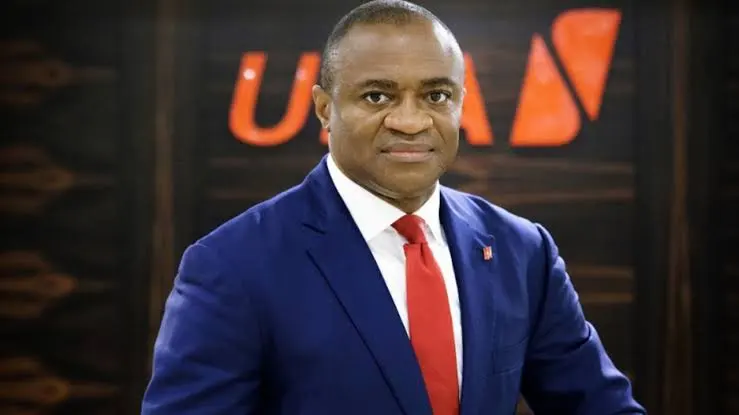
Africa’s Global Bank, United Bank for Africa (UBA) Plc, marked Africa Day with a group-wide celebration across its offices in 20 African markets, bringing employees together in a shared observance of cultural and continental pride.
Speaking at the event, UBA Group Managing Director and Chief Executive Officer, Oliver Alawuba, drew a direct line between the Group’s pan-African footprint and the wider economic transformation underway across the continent.
“As a Group with presence in 20 African countries, UBA is more than a bank. We are a bridge across markets, cultures, people and opportunities,” Alawuba said. “Every day, through our people, our technology, our capital and our customer relationships, we connect Africa to itself and Africa to the world.”
Alawuba’s address came at a moment of notable momentum for African banking, as digital finance is reshaping how individuals and businesses transact, cross-border trade volumes are growing, and demand for locally owned, globally competitive institutions is intensifying.
“Africa’s story is changing,” Alawuba noted. “Young people are innovating, entrepreneurs are creating new businesses, women are leading boldly, creatives are taking our culture global, and institutions are beginning to reimagine the future of trade, finance, technology and development. At UBA, we must continue to see ourselves as enablers of this transformation.”
Alawuba challenged staff to see the Group’s diversity of languages, cultures, and geographies as a structural advantage in serving African markets that no external institution can replicate.
He demanded that all UBA staff transfer the energy of the celebration into their client relationships and day-to-day execution, citing simplicity, responsiveness, and goal orientation as core standards the Group must hold passionately.
“Let us bring the same energy we display today into our work, with excellence, enterprise and execution,” Alawuba said. “Let us continue to prove that African institutions can be world-class, trusted, innovative and globally competitive.”
