





Manny Ita
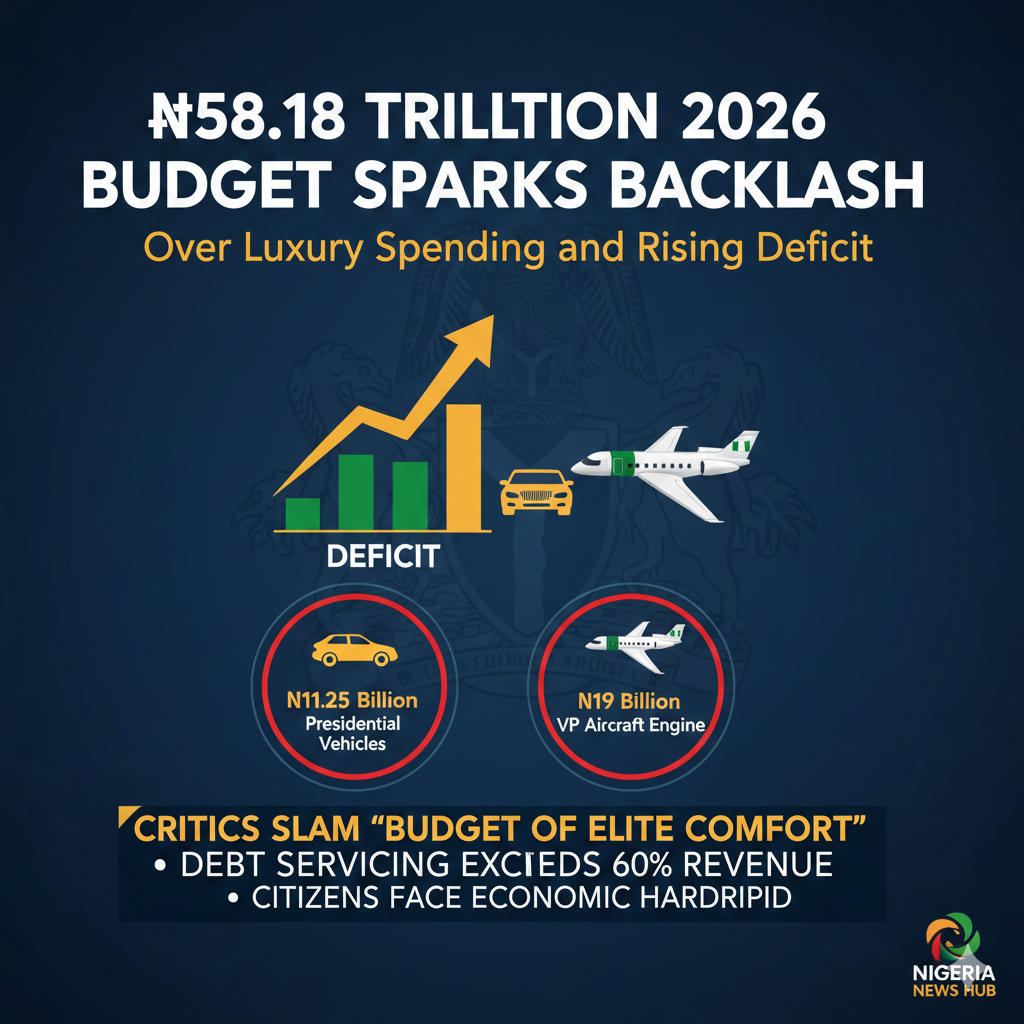
The ₦58.18 trillion 2026 Appropriation Bill, titled the “Budget of Consolidation, Renewed Resilience and Shared Prosperity,” has generated widespread criticism across Nigeria, with civil society groups and opposition parties questioning its priorities amid rising inflation and economic hardship. While President Bola Tinubu has presented the budget as a pathway to economic stability and long-term growth, critics have described it as a “budget of elite comfort” because of several high-cost allocations linked to the presidency and key government institutions.
A major source of controversy is the proposed increase in spending for the State House. The budget provides ₦11.25 billion for the procurement of presidential vehicles, representing a 135 per cent increase from the approximately ₦4.76 billion allocated in 2025. In addition, ₦36 billion has been set aside for the rehabilitation and maintenance of State House facilities, including offices and residential buildings.
Further criticism has been directed at ₦16.78 billion collectively earmarked by the State House, the Nigerian Army, and the Economic and Financial Crimes Commission for “miscellaneous” expenses. Opponents argue that the category is insufficiently defined and lacks transparency.
The cost of maintaining the Presidential Air Fleet has also attracted scrutiny. The budget allocates ₦19 billion for the overhaul of engines for two Falcon 7X aircraft. It also includes ₦500 million, under the Office of the National Security Adviser, for the construction of a new presidential aircraft hangar. Overall, about ₦6 billion has been designated for engine overhauls across the fleet, including ₦3.8 billion for the aircraft with registration number 5N-FGW.
Operational spending lines have further intensified the debate. The budget projects that President Tinubu and Vice President Kashim Shettima will spend a combined ₦12.2 billion on travel in 2026, with the President’s international trips accounting for ₦6.1 billion of that amount. Despite ongoing government advocacy for digitalisation, 10 ministries and the Office of the Head of Service plan to spend a combined ₦2.5 billion on stationery and office supplies. An additional ₦7 billion has been allocated for the construction of a mini-solar grid at the Presidential Villa.
In response to the criticism, the Federal Government has defended the budget, arguing that it prioritises sectors critical to achieving its long-term goal of building a $1 trillion economy. The proposed allocations include ₦5.41 trillion for security, the largest single sectoral provision, aimed at addressing defence and counter-terrorism challenges. Infrastructure development is also prioritised, with ₦3.56 trillion earmarked for projects such as the Lagos–Calabar Coastal Highway, alongside funding for the Renewed Hope Ward Development Plan, which is designed to deliver projects directly to Nigeria’s 8,809 political wards.
Civil society organisations, including BudgIT and the Centre for Social Justice, have criticised the budget, accusing the government of “fiscal recklessness” and warning that large sums are being committed without adequate legislative scrutiny, particularly in light of the repeal and re-enactment of previous budgets. Opposition parties have also voiced strong objections, with the African Democratic Congress describing the proposal as a “debt trap,” arguing that plans to borrow ₦17.89 trillion to finance the deficit are unsustainable at a time when debt servicing is said to consume more than 60 per cent of government revenue.