

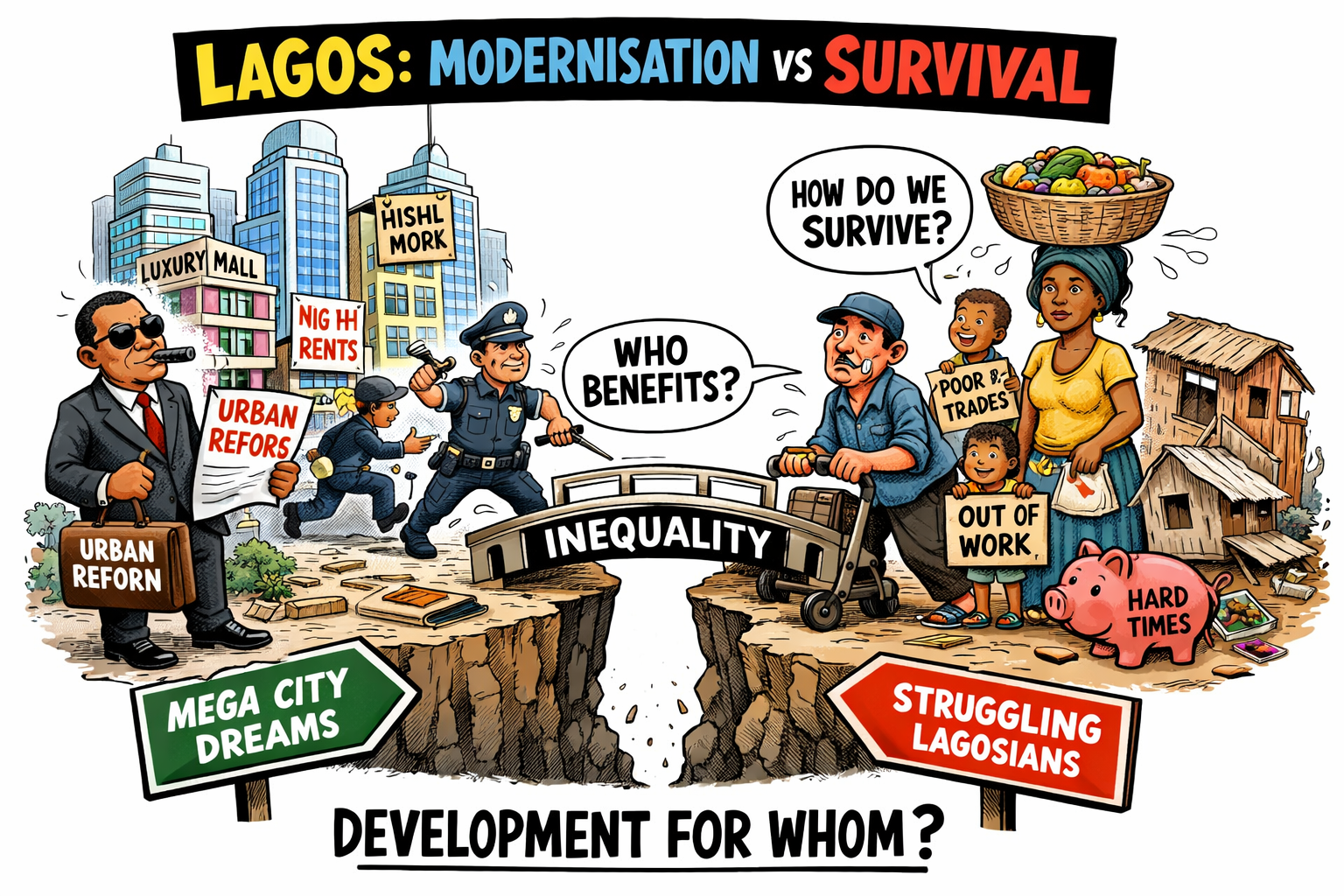
The tension between urban renewal and economic survival is fast becoming one of the defining fault lines of life in Lagos. Beneath the glossy rhetoric of a “megacity in the making” lies a quieter, more uncomfortable reality: the steady displacement of the informal economy that has long sustained millions.
From street traders to small-scale artisans, the informal sector is not a marginal appendage—it is the backbone of Lagos’ economic life. Yet, recent crackdowns on roadside trading, escalating shop rents, and tighter regulations on market spaces suggest a city increasingly impatient with its own grassroots engine. The question is no longer whether Lagos should modernise, but whether it can do so without erasing the very people who keep it alive.
Authorities argue that order, sanitation, and global competitiveness demand stricter controls. There is merit in this. A city choking on congestion and environmental hazards cannot thrive indefinitely. But policy, when divorced from lived realities, risks becoming punitive rather than progressive. For many traders, relocation schemes are either poorly implemented or economically unviable, pushing them further into precarity rather than formalisation.
At the heart of the issue is a fundamental disconnect: modern urban planning often imagines a Lagos that mirrors global cities, yet ignores the unique socio-economic fabric that defines it. Unlike structured economies where formal employment dominates, Lagos runs on hustle—on adaptability, informality, and micro-enterprise. Attempting to “clean up” the city without integrating these realities is akin to treating symptoms while ignoring the system.
The consequences are already visible. Displaced traders return to the streets in cycles, enforcement becomes a game of cat and mouse, and public trust in governance erodes. More critically, livelihoods are destabilised in a city where social safety nets are thin to nonexistent. In such an environment, enforcement-heavy policies risk deepening poverty and widening inequality.
This is not an argument against reform. Rather, it is a call for smarter reform—one that recognises the informal economy not as a nuisance to be eliminated, but as a sector to be structured, supported, and gradually integrated. Affordable market spaces, accessible microcredit, and inclusive urban design are not luxuries; they are necessities for sustainable transformation.
Lagos stands at a crossroads. It can pursue a model of development that prioritises aesthetics over equity, or it can chart a path that balances ambition with inclusion. The true measure of a modern city is not how well it hides its poor, but how effectively it empowers them.
If Lagos is to become a global city in more than name, it must answer a difficult but essential question: development for whom?
