

Manny Ita –
The Federal Government has announced plans to scrap the National Common Entrance Examination as part of a sweeping reform of Nigeria’s basic education system, replacing it with a continuous assessment model and a nationwide student tracking mechanism.
The Minister of Education, Tunji Alausa, disclosed the proposal during an interactive session with journalists in Lagos, stating that the new policy is designed to improve access to education and strengthen monitoring of pupils across the country.
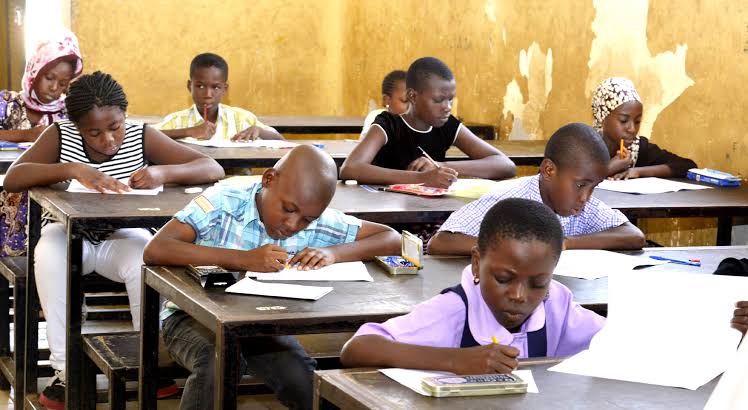
Under the proposed reform, the long-standing entrance examination taken by primary school pupils seeking admission into junior secondary school will be phased out and replaced with a Continuous Assessment system that evaluates learners from their early years in school.
“It will be replaced by Continuous Assessment, CA. The CA will reflect the performance of the pupil from primary one and even if a pupil is transferring from one school to another, he will take it along to his new school,” the minister said.
Central to the reform is the introduction of a Learner Identification Number, a unique digital identity assigned to each pupil from primary school, which will follow them throughout their academic journey regardless of transfers between schools.
Alausa explained that the system would enable authorities to track students’ progression and detect cases where children drop out of school. “If somebody is expected to be in JSS class one and he is not there, we will be able to know the reason why he is not continuing his education,” he stated.
The minister justified the reform with data highlighting a significant gap in Nigeria’s education pipeline, noting that while the country has over 50,000 public primary schools with more than 23 million pupils, only slightly above three million transition into junior secondary school within the public system.
“We have over 50,000 public primary schools… only a little over 3 million… move to the junior secondary school level… where are the about 20 million not enrolled?” he queried, pointing to what he described as a major access problem.
He further stressed that the shortfall cannot be absorbed by private institutions alone and called on state governments to expand infrastructure by building more schools to accommodate the growing number of pupils.
In addition, the government is considering reviving the school feeding programme to boost enrolment and retention, with plans to strengthen oversight by placing it under the supervision of the Federal Ministry of Education.
The proposed changes form part of broader efforts by the administration of Bola Ahmed Tinubu to reform the education sector, reduce dropout rates, and ensure that more Nigerian children complete basic schooling.
However, officials have indicated that discussions on scrapping the examination are still evolving, even as the government pushes ahead with the introduction of the learner identification system to improve accountability and planning within the sector.
