





Manny Ita –
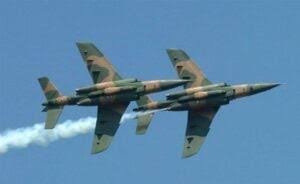
The National Human Rights Commission has called on the Nigerian Air Force to explain the growing number of civilian casualties linked to recent military airstrikes across different parts of the country, describing the incidents as deeply concerning and incompatible with human rights standards.
In a statement issued on Wednesday, the Executive Secretary of the commission, Tony Ojukwu, said the repeated reports of civilians being killed during aerial military operations raise serious humanitarian and legal concerns that cannot be ignored.
The commission’s reaction followed several recent airstrikes carried out by the Nigerian Air Force in parts of the North-east, North-west and North-central regions, where residents and local sources claimed that non-combatants were among those killed.
One of the incidents reportedly occurred in April when a military airstrike targeting suspected insurgents hit a market in Jilli, a border community between Yobe State and Borno State, resulting in civilian casualties despite the operation being described as a precision strike.
Another wave of airstrikes carried out on May 10 in Niger State and Zamfara State reportedly left over 100 civilians dead while targeting armed groups and terrorists.
Although military authorities and some state governments denied claims that civilians were killed, insisting that only terrorists and bandits were eliminated, residents in affected communities disputed those accounts and expressed outrage over the incidents.
The development has sparked widespread reactions from Nigerians and human rights organisations, including Amnesty International, with growing calls for independent investigations into the alleged killings.
Reacting to the situation, Ojukwu acknowledged that the Nigerian government has a legitimate responsibility to combat insurgency, terrorism and banditry. However, he stressed that military operations must still comply with the Nigerian Constitution, international human rights obligations and humanitarian law principles.
According to him, repeated cases involving civilian deaths, including women, children and other vulnerable persons, raise troubling questions about the military’s adherence to precautionary measures and proportionality during operations.
He stated that the protection of human life and dignity must remain central to all security operations and warned against treating civilian casualties as unavoidable collateral damage.
The NHRC boss therefore demanded a detailed explanation from the Nigerian Air Force regarding the circumstances surrounding the incidents and the safeguards being put in place to prevent future civilian deaths.
Ojukwu questioned why such occurrences have become increasingly frequent, referencing the recent strikes in Niger, Yobe and Zamfara states as examples of a troubling pattern.
He further reminded security agencies that principles such as distinction, necessity, accountability and proportionality are key obligations under international humanitarian law and must guide all military engagements, especially in conflict-prone communities.
The commission also urged security authorities to improve intelligence gathering, strengthen operational safeguards and introduce more effective accountability systems capable of reducing harm to innocent civilians during military campaigns.
In addition, the NHRC called for transparent, independent and prompt investigations into all reported cases of civilian casualties resulting from airstrikes. According to the commission, such investigations are necessary to ensure justice for victims, accountability for possible violations and proper compensation and psychological support for affected families and communities.
Ojukwu maintained that protecting national security and respecting human rights should not be viewed as opposing objectives. He said lasting peace and public confidence can only be achieved when military operations are conducted within the boundaries of legality, transparency and respect for human dignity.
He added that the commission would continue monitoring developments and engaging relevant authorities to ensure that the rights of Nigerians are adequately protected during security operations across the country.