

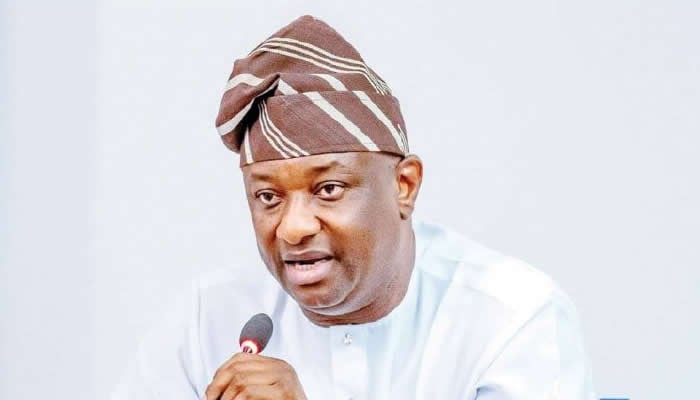
The minister of Aviation and Aerospace Development, Festus Keyamo
Federal government counters national carrier setup as it will amount to waste of resources.
The minister of Aviation and Aerospace Development, Festus Keyamo, has ruled out the establishment of a national carrier for Nigeria, insisting that government-owned airlines cannot thrive under bureaucratic and political control.
Keyamo made the declaration on Thursday in Lagos during the unveiling of two newly acquired Boeing 737-800 Next Generation (NG) aircraft by United Nigeria Airlines. The aircraft were named after the Obi of Onitsha, Igwe Nnaemeka Achebe, and the late literary icon, Prof. Chinua Achebe.
Industry stakeholders at the event described the naming of the aircraft as a reflection of the airline’s cultural identity and commitment to national unity, noting that it strengthens the emotional connection between the carrier and Nigerians.
Speaking at the ceremony, the minister said investing public funds in a national airline would amount to pouring resources into a “bottomless pit,” stressing that governments across the world are moving away from direct ownership of airlines.
“We don’t have a national carrier, but we are proud of our flag carriers,” Keyamo said.
“All over the world, governments are divesting from national airlines. It is neither reasonable nor practical to run a national airline under a bureaucratic and political leadership. Such an arrangement is bound to fail.”
He cited examples of globally recognised airlines that operate independently of government bureaucracy, arguing that Nigeria’s aviation policy is firmly focused on supporting privately owned indigenous carriers.
“We are not confused about where we are going. We are very clear about our policy direction. It is far better and more profitable to support our flag carriers than to own and run a national airline,” he added.
The minister noted that the few successful state-backed airlines, including Ethiopian Airlines, operate with significant commercial independence and are insulated from political interference.
“A few that are succeeding, such as Ethiopian Airlines, are completely detached from bureaucracy and run strictly as commercial enterprises,” he said.
“As a government, we are struggling to mobilise resources for other critical sectors of the economy. We cannot afford to invest in a national airline that could become a drain on public funds.”
Earlier, chairman of United Nigeria Airlines, Prof. Obiora Okonkwo, expressed concern over the high cost of doing business in Nigeria’s aviation sector, warning that rising interest rates and multiple charges are eroding the competitiveness of local airlines.
According to him, Nigeria remains one of the most expensive countries in the world for airline operations, citing findings by the International Air Transport Association (IATA).
“We are not happy that Nigeria has been described by IATA as one of the most expensive places for airlines to operate. We are hopeful that government will respond positively to calls for a reduction in charges,” Okonkwo said.
He also advocated reforms in the sector’s revenue framework, arguing that funds generated by aviation agencies should remain within the industry to support infrastructure development and improve service delivery.
“Government should allow aviation revenues to remain with aviation agencies. When those funds are diverted elsewhere, it creates pressure on agencies such as the NCAA, FAAN and NAMA, which then pass the burden to operators through higher charges,” he said.
Okonkwo further highlighted aviation’s strategic role in supporting key sectors of the economy, particularly oil and gas operations that depend heavily on helicopter services.
He identified access to affordable financing as one of the biggest challenges facing domestic airlines, calling for the introduction of single-digit interest loans to support fleet expansion and business growth.
“What commercial banks offer is purely commercial funding at very high rates. The Bank of Industry has been supportive, but its intervention funds are limited. We need government-backed opportunities for single-digit financing,” he said.
The airline chairman also disclosed plans to expand United Nigeria Airlines’ fleet, announcing that two additional aircraft would join its operations in August under a full dry lease arrangement.
In August, we will celebrate the arrival of two more aircraft on full dry lease. It will be the first such acquisition in about 15 years. Very soon, we will gather again to celebrate another aircraft addition,” he said.
In his remarks, the Obi of Onitsha, , expressed appreciation for the honour bestowed on him and the late novelist, , through the naming of the aircraft.
“I am overwhelmed and delighted to witness this occasion and celebrate our son and brother on the unveiling of these aircraft. It is a great honour that my name will be inscribed on one of them alongside that of Chinua Achebe,” the monarch said.
He commended the resilience and commitment required to succeed in the aviation industry, describing it as one of the most demanding sectors globally, and urged stakeholders to continue driving innovation and growth within the industry.
