

By Manny Ita
For decades, the Nigerian story has been a monotonous dirge of squandered promise. To describe poor leadership as the singular bane of our development is no longer an opinion—it is a diagnosis of a deeply entrenched, almost terminal systemic rot. From the jackbooted plunderers of military rule who treated the national treasury as a spoils-of-war chest, to the agbada-clad civilians who have perfected state kleptocracy under the guise of democracy, Nigerians have remained unwilling spectators to their own impoverishment.
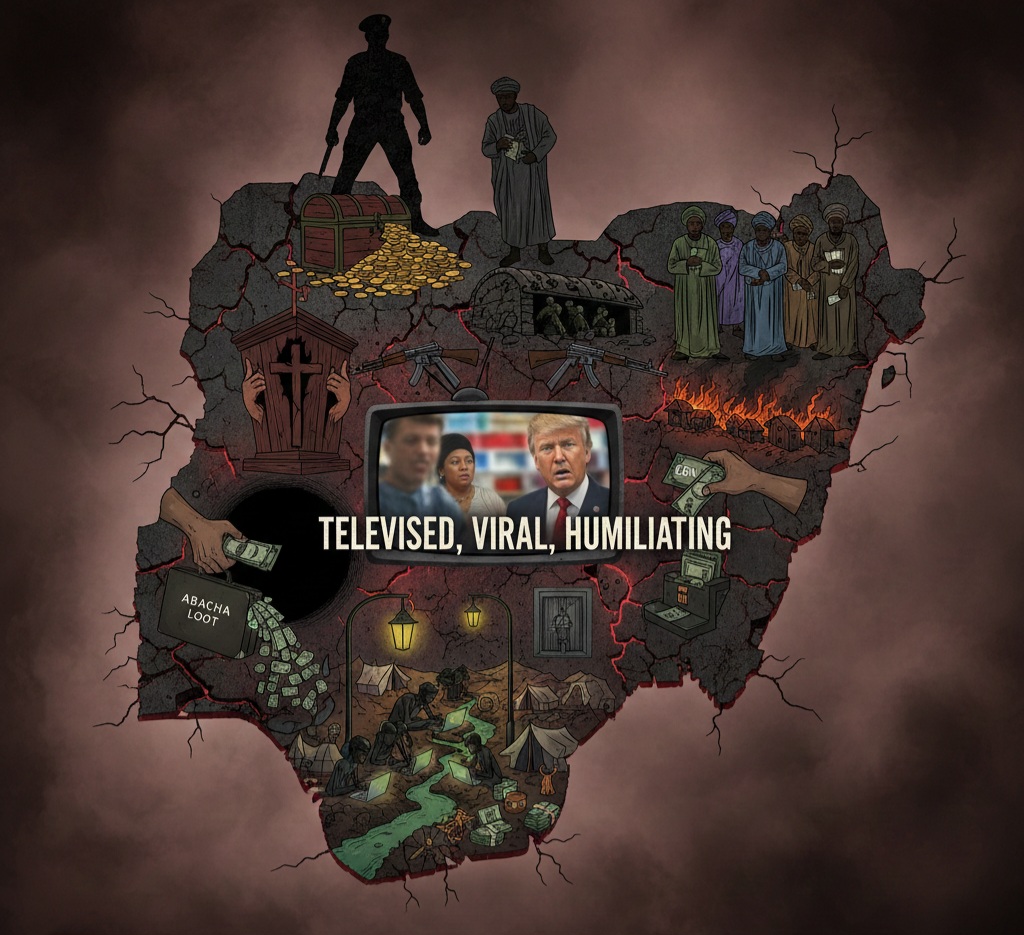
What makes the present crisis more frightening is not merely its longevity, but its spread. The rot has breached institutions once regarded as sacred—the pulpit, the barracks, and the very architecture of the state. No bastion of moral restraint remains untouched.
Nigeria’s decline is no longer abstract; it is televised, viral, and humiliating. We watched in disbelief as a minister of the Federal Republic engaged in a disgraceful public altercation with a uniformed soldier—an incident that exposed not authority, but arrogance, confusion, and the collapse of command hierarchy. In another moment of national embarrassment, the President’s wife publicly dressed down a sitting governor, reducing the dignity of governance to street-level theatrics. These episodes were not trivial; they symbolized a state where power has lost decorum and leadership has lost restraint.
Equally alarming was the spectacle of a Senate President publicly lamenting that Trump was on Nigeria’s neck during the buildup to industrial action in Northern Nigeria. That a principal officer of the legislature would frame Nigeria’s sovereignty around the posture of a foreign president was a tragic confession of institutional inferiority. It was shameful that Nigerians had to hear threats, real or implied, from a president of another country before their own government pretended to remember its constitutional duty—the protection of lives.
A sovereign nation should not require foreign pressure or the fear of external bombs to defend its citizens from internal predators.
The steady degradation of Nigeria is sustained by corruption so sophisticated it has become institutional memory. The Abacha loot remains a global byword for unrestrained plunder—billions siphoned into foreign vaults while Nigerians drank from polluted streams and died in darkness. Decades later, the country witnessed the brazen embezzlement prowess of a former Central Bank governor, turning what should have been the nation’s financial nerve center into a private playground of impunity.
These are not isolated crimes of greed; they are acts of structural sabotage. They throw spanners into every reform, every policy, and every illusion of progress. Even when economic indicators suggest growth, corruption ensures that prosperity never trickle down. Roads remain death traps despite massive allocations. Power stay epileptic. Inflation devour wages. Development is announced, but decay is experienced.
Perhaps the most devastating betrayal is the corruption of the pulpit. The clergy once served as the nation’s moral compass and final refuge for the poor. Today, that sanctuary has been desecrated. Recent sordid revelations involving prominent pastors, including allegations of sexual misconduct and moral excess, reveal a frightening inversion: the shepherd has become the wolf. When men entrusted with divine authority carry themselves in open contradiction to biblical standards, they do more than embarrass the church—they destroy the last moral safety net of the common man.
Nowhere is leadership failure more fatal than in national security. Boko Haram’s metastasis across Northern Nigeria and its creeping spread westward has not merely been a failure of intelligence; it is a failure of character. Billions earmarked for arms procurement diverted into private offshore accounts, leaving soldiers to confront battle-hardened insurgents with obsolete weapons and shattered morale.
This is no longer just a war; it has become a war economy in which terror proves profitable to those at the top. The outcome has been catastrophic: tens of thousands dead, millions displaced, and countless lives wasting away in IDP camps—their suffering exchanged for the grandeur of a corrupt elite.
This incompetence is compounded by a disturbing lack of will from the security agencies to act early. When herdsmen began their violent incursions—killing farmers, occupying land, and displacing communities—the state responded with sympathetic silence. Only when international pressure mounted did official concern suddenly materialize. That silence spoke louder than any speech.
The harvest of this visionless leadership is a country increasingly viewed as a pariah, despite the brilliance and integrity of a few exceptional citizens. Hunger is weaponized through stomach infrastructure politics. Votes are bought with crumbs. Meanwhile, a disillusioned generation of youths, cut off from opportunity and dignity, has drifted into internet fraud and ritual practices—not out of inherent depravity, but because a broken system rewards criminality and punishes honesty.
Bob Marley once reminded the world that “where there is a will, there is a way.” Nigeria has no shortage of ways—committees, reports, and policy blueprints abound—but the nation suffers from a total absence of will. It is governed by a strange admixture of mediocrity and greatness, where mediocrity is subsidized and greatness is suppressed.
The current trajectory is a suicide mission. A nation cannot survive when its leaders—secular, military, and spiritual—see the people as a resource to be mined rather than a flock to be tended. The illusion of grandeur must give way to the cold reality of accountability.
The time for tepid prayers and silent endurance is over. Nigerians must demand leadership that fears God more than it loves gold, a military that values honor above embezzlement, and a government that treats the life of every citizen as sacred. Unless the collective will is summoned to purge these predators from the pulpits, the barracks, and the palaces of power, the future of Nigeria will remain a ghost story told to children who have no country left to inherit.
The day of reckoning is no longer approaching.
It is here.
