

Manny Ita –
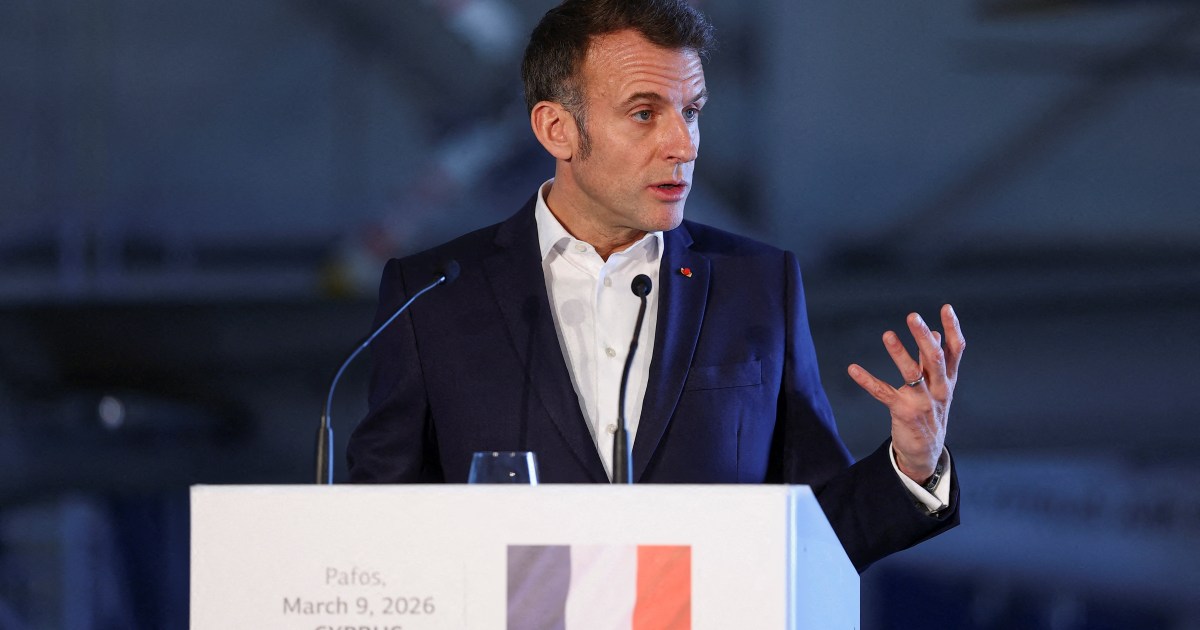
Emmanuel Macron has said there is no confirmation that Iran has laid sea mines in the strategic Strait of Hormuz, while also disputing claims that the country’s military capabilities have been completely destroyed following strikes by the United States and Israel.
The French president made the remarks after participating in a video conference with leaders of the Group of Seven nations, addressing reports that Iran may be attempting to mine the vital maritime corridor used for global oil shipments.
“I have no confirmation of this, either from partner services or from our own services,” Macron said.
He added that although the recent strikes had inflicted significant damage on Iran’s military infrastructure, the country’s capabilities had not been completely eliminated.
“Considerable damage has already been inflicted on Iran’s military ballistic capabilities, but it continues to attack several countries in the region, and therefore its capabilities have not been reduced to zero,” Macron said.
Macron also suggested that the next steps in the conflict would depend on the objectives set by the United States, noting that it was up to Donald Trump to clarify his plans regarding the joint operations with Israel.
“I leave it up to him to clarify both his ultimate objectives and the pace he wants to set for operations,” Macron said.
The conflict began on February 28 after the United States and Israel launched coordinated attacks on Iranian targets, killing Iran’s supreme leader Ali Khamenei and triggering a wider regional confrontation.
Since then, oil prices have surged amid fears that instability in the Persian Gulf could disrupt global energy supplies. The International Energy Agency announced plans to release 400 million barrels of oil from strategic reserves in an attempt to stabilise markets, marking the largest coordinated release in the agency’s history.
Iran has warned that the conflict could escalate into a prolonged war of attrition with severe consequences for the global economy. Ali Fadavi, an adviser to the commander-in-chief of the Islamic Revolutionary Guard Corps, said the United States and Israel should prepare for a long conflict.
“The US and Israel must consider the possibility that they will be engaged in a long-term war of attrition that will destroy the entire American economy and the world economy,” Fadavi told state television.
Iranian authorities also reported attacks on commercial vessels passing through the Strait of Hormuz, saying two ships — the Liberian-flagged container vessel Express Rome and the Thai bulk carrier Mayuree Naree — were struck after allegedly ignoring warnings from Iranian naval forces.
According to officials, Oman’s navy rescued 20 crew members from the ships while search operations continued for three others.
The Strait of Hormuz is a critical global energy corridor through which roughly 20 percent of the world’s crude oil and liquefied natural gas shipments pass, and analysts say any prolonged disruption could have major economic consequences for markets in Asia and Europe.
Macron urged international leaders to act quickly to restore safe navigation in the strait, while the United Nations called on all sides to ensure that humanitarian shipments can pass through the waterway.
The conflict has also begun affecting regional infrastructure and business operations. Authorities in Dubai said drones fell near the city’s airport on Wednesday, injuring four people.
Several international companies have started relocating staff from the city. Financial services group Citigroup and consulting firm Deloitte have reportedly instructed employees to evacuate their Dubai offices as a precaution.
Drone strikes also hit fuel storage facilities at Port of Salalah, according to the Oman News Agency, prompting private maritime security firm Vanguard Tech to suspend operations at the port.
Despite the escalating hostilities, Trump said the war could end soon, suggesting there were few remaining targets in Iran.
“There’s practically nothing left to target in Iran,” Trump told Axios, adding, “Little this and that… Any time I want it to end, it will end.”
Israeli officials have indicated that military operations will continue for as long as necessary. Israel Katz, Israel’s defence minister, said the campaign had no fixed timeline.
“This operation will continue without any time limit, as long as necessary,” Katz said.
Israeli forces have since launched what the military described as a “wide-scale wave of strikes” against targets in Iran as well as positions linked to Hezbollah in Beirut, Lebanon.
An Israeli air strike hit an apartment building in central Beirut, with witnesses reporting a fireball and extensive damage to the upper floors of the building.
“I ran from room to room, pulled my wife and daughter out of the rooms and hid them behind a wall, then the second strike hit,” said Fawzi Asmar, a bakery owner whose shop is located on the street where the attack occurred.
Inside Iran, authorities have warned against dissent during the conflict. National police chief Ahmad-Reza Radan said protesters would be treated as enemies of the state.
“All our forces are also ready, with their hands on the trigger, prepared to defend their revolution,” Radan said in comments broadcast by Islamic Republic of Iran Broadcasting.
Iran’s health ministry reported that more than 1,200 people have been killed and over 10,000 civilians injured since the strikes began, although the figures have not been independently verified.
Residents in Tehran said they were attempting to adapt to life under continuing bombardment.
“We’ve put our faith in God. For now, there’s food in the shops,” said Mahvash, a 70-year-old resident.
“People are calm,” another resident said. “They are getting used to living despite everything and adapting — as best they can — to this situation.”
