

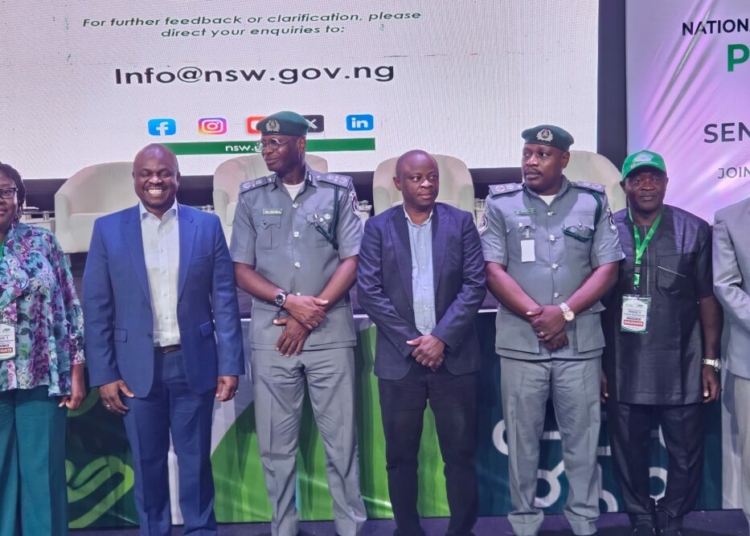
… committee to set up more network of training centres to ensure that importers, exporters and clearing agents were familiar with the platform.
The National Single Window (NSW) platform has processed N17 billion in payments from importers in the last eight months, with over 12,000 importers and clearing agents registered on the platform.
The NSW Committee also disclosed that more than 4,000 trade manifests and 169,211 licences, permits and certificates have been processed through the platform since the commencement of its first phase in March 2026.
The Director of the NSW Committee, Tola Fakolade, disclosed this on Tuesday in Lagos during a stakeholders’ engagement ahead of the launch of the second phase of the National Single Window project.
He explained that the N17 billion processed through the platform comprised payments due to regulatory agencies, including the National Agency for Food and Drug Administration and Control (NAFDAC), Standards Organisation of Nigeria (SON), Nigeria Agricultural Quarantine Service (NAQS) and other government agencies.
Fakolade also disclosed that 27 airlines and 20 shipping lines had been onboarded, while the airlines had transmitted more than 4,000 air cargo manifests through the platform.
According to him, the committee is also working towards onboarding the Nigerian Ports Authority (NPA) and the Nigerian Maritime Administration and Safety Agency (NIMASA) before the end of the year.
He said, “In the last eight months, over 4,000 manifests have been submitted. N17bn payments have been processed till date. And these are payments that go to the coffers of NAFDAC, Quarantine and all the other agencies on the NSW platform.
“169,211 licences, permits, and certificates have been processed through the NSW platform since the 27th of March, 2026.
“We have over 12,000 importers and agents that are registered on the NSW platform. We have 27 airlines on board, and these airlines, they’ve submitted over 4,000 air cargo manifests that have been transmitted through the single window. We have 20 shipping lines, and we are onboarding NPA and NIMASA before the end of the year.”
Fakolade explained that the National Single Window was designed to eliminate duplication of documentation, simplify regulatory procedures and provide a central platform for importers and exporters to obtain approvals from relevant government agencies.
He said the initiative was developed from the global trade facilitation concept promoted by the United Nations Centre for Trade Facilitation and Electronic Business, in collaboration with the World Trade Organisation (WTO) and World Customs Organisation (WCO).
According to him, the Federal Government inaugurated the project on April 16, 2024, to integrate the operations of government agencies involved in international trade and reduce the delays associated with multiple documentation and approval processes.
He said the platform had recorded significant progress since the launch of its first phase on March 27, 2026, despite initial challenges and apprehensions among stakeholders over the payment process.
“We are not taking the job of any agency. Agencies have their acts and their mandates, and they’re going to use their acts. We are not taking away their revenue,” he said.
The NSW director acknowledged that the first phase had exposed operational challenges, particularly concerning the regulation of certain imported products by multiple government agencies under different Harmonised System (HS) Codes.
He disclosed that the NSW Committee and the Central Bank of Nigeria (CBN) were working to resolve conflicting issues surrounding the HS-Code status of some products at the nation’s ports.
He said the committee had commenced discussions with relevant ministries and agencies to streamline regulatory responsibilities and reduce the number of agencies required to approve certain products.
“One of the challenges that we faced when we actually launched is that we realised that sometimes, certain HS-Codes still have three or four agencies that are regulating it.
“We have started asking ourselves, what is the best practice? Is the best practice really for four agencies to be regulating certain products?
“We have been able to streamline some. It’s a continuous work in progress, but there’s been a heavy lift, where we’ve simplified a lot of the number of agencies that are regulating certain products, and that’s based on a lot of discussion, negotiations, and alignment,” he said.
Fakolade added that the committee was expected to introduce the revised HS-Code arrangements into the system within weeks, a development he said would further simplify import procedures.
Ahead of the second phase, he said the committee would strengthen stakeholder engagement, expand training programmes and establish more physical support centres to address knowledge gaps and improve users’ experience.
According to him, the initial challenges encountered during the first phase were partly due to inadequate understanding of the new processes among some users.
He said the committee would therefore increase training opportunities and establish a wider network of training centres to ensure that importers, exporters and clearing agents were familiar with the platform.
“We only have one physical support centre today in Apapa. We hope to establish a bit more of those outside Lagos so that people can receive support even if you are not in Lagos,” he said.
He added that the committee would incorporate lessons from the first phase into the second phase to ensure a smoother implementation and improve the efficiency of trade documentation and regulatory approvals.
