

Manny Ita
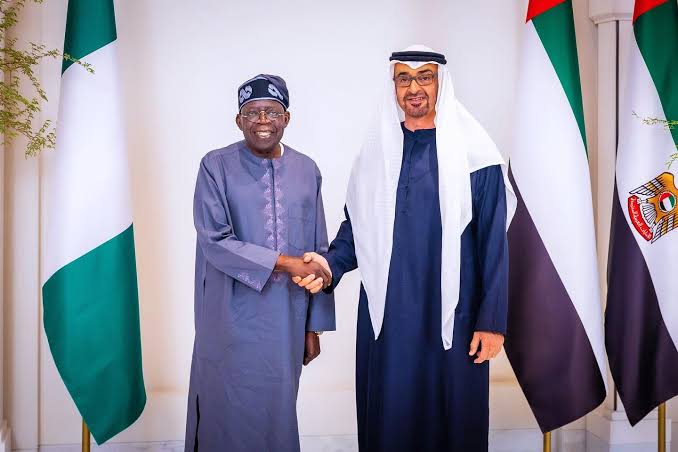
President Bola Tinubu has finalized a Comprehensive Economic Partnership Agreement (CEPA) between Nigeria and the United Arab Emirates during the 2026 Abu Dhabi Sustainability Week, marking a major step in strengthening bilateral trade and investment relations. The agreement is structured to remove trade barriers and integrate Nigerian businesses into Middle Eastern and global value chains, with the UAE committing to the immediate elimination of tariffs on more than 7,000 Nigerian products spanning agriculture and industry, while Nigeria will liberalize 6,243 products, removing tariffs on about 60 percent immediately and phasing out the remainder over three to five years. The deal also opens access to 108 service sectors, including financial services, construction, communications and tourism, and introduces enhanced business mobility arrangements allowing business visitors entry to the UAE for up to 90 days annually and enabling executives and specialists to relocate under renewable three-year visas.
At the summit, President Tinubu announced that Nigeria will co-host the Investopia global investment conference in Lagos on February 2, 2026, with the event scheduled for the Eko Convention Centre. He said the forum is intended to connect global investors, innovators and policymakers and translate ideas into tangible investments, as Nigeria positions itself as a strategic destination for capital across Africa.
Addressing delegates, Tinubu reaffirmed Nigeria’s commitment to what he described as “green industrialization,” outlining plans to mobilize up to $30 billion annually in climate and green industrial finance. He highlighted ongoing initiatives, including a $500 million distributed renewable energy fund backed by the Nigeria Sovereign Investment Authority and a $750 million World Bank-supported electricity access program targeting 17.5 million Nigerians, while also inviting foreign partners to invest in Nigeria’s lithium and other critical minerals with an emphasis on local processing and value addition. The Federal Government said recent economic reforms are beginning to show results, citing over $50 billion in investment commitments, a 21 percent increase in non-oil exports to $12.8 billion in the first half of 2025, and projections that the economy will grow by 4.49 percent in 2026, supported by improved macroeconomic stability and a projected trade surplus of about 4.2 percent of GDP.
