

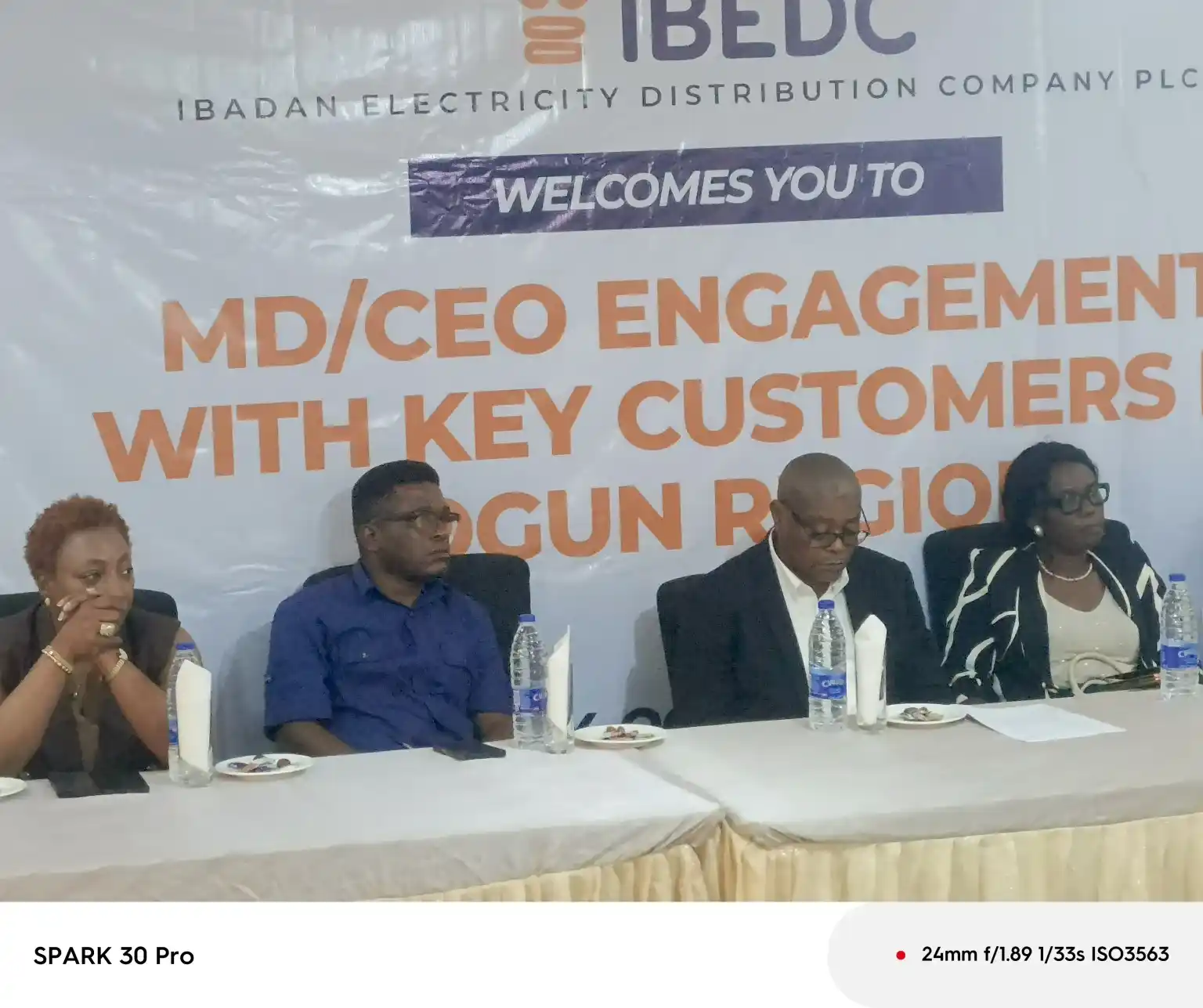
Third from right, the MD/CEO of Ibadan Electricity Distribution Company, Mr Deolu Ijose and other principal officers during engagement with key customers in Ogun Region, Sagamu on Tuesday
The Managing Director and Chief Executive Officer of the Ibadan Electricity Distribution Company, Mr Deolu Ijose, has assured key customers in Ogun State of improved electricity supply, increased investment in infrastructure and faster resolution of operational challenges.
Ijose gave the assurance during an engagement with key customers in the Ogun Region held in Sagamu and Ota on Tuesday.
He acknowledged persistent complaints about inadequate power supply, frequent interruptions, metering challenges and delays in fault clearance.
The IBEDC boss said the company’s new investors and management were committed to addressing the challenges that had affected its operations in recent years, adding that customer feedback would guide its investment priorities.
Ijose said, “The engagement is organised to enable the company to listen to our valued customers and work collaboratively with them towards improving electricity supply and supporting business growth.
“The essence of this gathering is to meet with you, listen to you and not assume that we know it all from sitting in our offices. We want to understand the issues and problems you face and see how we can resolve them as quickly as possible.”
The IBEDC boss explained that the company had experienced a prolonged period of limited investment while under the management of the Asset Management Corporation of Nigeria, which he said affected the pace of infrastructure development and operational improvements.
He disclosed that changes to the company’s board took effect on February 11 following the entry of a new core investor, while the new management resumed in April.
Ijose said the new ownership structure was expected to improve investment capacity and provide the resources required to address longstanding operational challenges.
“The issue is no longer whether funds are available for investment, but where we should deploy those funds. Our customers, particularly those contributing to economic activities, are a priority in determining where interventions are most urgently needed,” he said.
Ijose noted that reliable electricity was critical to the survival of businesses, particularly manufacturers whose operations depend on a stable power supply to run machinery and protect equipment.
He said the company understood the losses businesses incurred when electricity supply was interrupted, stressing that improving supply reliability and voltage stability remained key priorities.
“I know what it means when power supply is interrupted and machines go off. I have also run a manufacturing plant, so I understand the impact of unreliable electricity on businesses. I am not here as someone who does not understand your challenges,” he said.
The IBEDC chief executive disclosed that the company had signed an agreement to procure additional electricity directly from a generation company, with an initial supply of about 125 megawatts expected to support key business and industrial corridors within its franchise area.
He said the initiative was intended to complement electricity supplied through the national grid and reduce pressure on available power, although he acknowledged that the company would also need to upgrade its distribution infrastructure to deliver the additional energy effectively.
Ijose said IBEDC was working with the Transmission Company of Nigeria and other stakeholders to improve electricity delivery to customers, including through network intervention projects being pursued with the support of the World Bank.
He explained that electricity supply depended on the performance of the entire power value chain, comprising generation, transmission and distribution, noting that disruptions at any stage could affect customers.
“We cannot do it alone. Even when electricity is generated, the transmission system must be able to deliver it to us before we can distribute it to our customers. We are engaging with TCN and other stakeholders to ensure that adequate power reaches the areas where it is most needed,” he said.
On service delivery, Ijose pledged that the company would work towards meeting its service-level commitments, including the minimum daily supply stipulated for customers on Band A.
He said the company was reviewing its performance to determine whether eligible customers were receiving the promised minimum of 20 hours of electricity daily and identify the causes of any shortfalls.
“If I promise you a minimum of 20 hours, I must deliver it. It is not about compensation; what we want is for electricity to be available whenever you need it, in the right quality and at the right place,” he said.
He also acknowledged concerns about customer service, meter deployment and delayed fault resolution, promising that the management would improve the handling of complaints and ensure that customers received more timely responses.
The IBEDC boss appealed to customers to cooperate with the company by providing feedback on their experiences, saying such information would help management identify priority areas and develop practical solutions.
He urged the customers to regard the changes in the company’s ownership and management as an opportunity for a fresh start, adding that improved electricity supply would benefit businesses, boost employment and contribute to economic development.
“We want to know you better, listen to your pain points and combine your feedback with what we already know. Once we collaborate, your businesses will flourish more than before, Nigeria will prosper, and employment and economic growth will improve,” he said.
Speaking during the engagement, an agro-allied industrialist, Alhaji Goke Adeyemi, urged the IBEDC management to expedite action and do everything within its capacity and resources to ease the challenge of erratic power supply.
Adeyemi said the poor electricity supply was making life difficult for business owners and residents across the state.
