

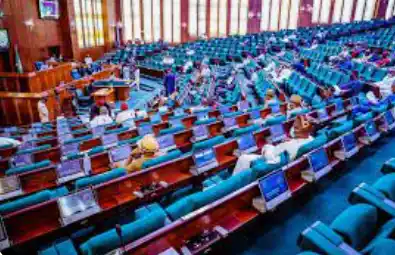
File Copy: House of Representatives
Elegbede Abiodun
• Education sector received N162bn.
The House of Representatives on Thursday passed the 2026 statutory budget proposals of the Federal Capital Territory Administration and the Niger Delta Development Commission, approving N2.29tn and N1.75tn respectively for the two agencies.
The approvals followed the consideration and adoption of reports presented to the House during plenary by the relevant committees.
Presenting the report on the FCT budget, Chairman of the House Committee on the Federal Capital Territory, Muktar Betara, said the N2.29tn proposal was structured to address personnel obligations, overhead costs and critical infrastructure projects across the nation’s capital.
He stated, “Out of the N2.29tn, the sum of N165.78bn is for personnel costs while N378.23bn is for overhead costs.
“The balance of N1.74tn is for capital projects, for the service of the Federal Capital Territory, Abuja for the financial year commencing January 1 and ending December 31, 2026.”
A breakdown of the recurrent expenditure showed that the Federal Capital Territory Administration secured N151.44bn for its operations.
In what lawmakers described as part of ongoing efforts to strengthen security architecture in Abuja and surrounding satellite communities, the House approved N6.79bn for the security services department of the FCTA.
The lawmakers also approved N1.51bn and N910.20m for the FCT Muslim Pilgrims Welfare Board and the Christian Pilgrims Welfare Board respectively.
For capital projects, the education sector received N162bn, while engineering services got the largest allocation of N758.15bn.
The resettlement and compensation department was allocated N143.18bn, public buildings received N2.38bn, while the satellite towns development department secured N212.74bn.
Meanwhile, the House also approved the 2026 budget of the Niger Delta Development Commission valued at N1.75tn.
Details of the appropriation obtained by The PUNCH showed that N47.57bn was earmarked for personnel costs, while overhead expenditure stood at N49.93bn.
The commission also secured N22.36bn for internal capital expenditure, with the bulk of the budget — N1.63tn — dedicated to development projects across the oil-producing Niger Delta region.
The approval followed the consideration of a report presented by the Chairman of the House Committee on NDDC, Erhiatake Ibori-Suenu.
The passage of the two budgets comes at a time the Federal Government is under increasing pressure to improve infrastructure, security and social services in the Federal Capital Territory and the Niger Delta.
For the FCT, the 2026 budget is expected to drive ongoing efforts to expand road networks, improve public schools, strengthen security surveillance and accelerate development in satellite towns that have long complained of neglect despite rapid population growth in Abuja.
The heavy allocation to engineering services reflects the administration’s focus on transportation infrastructure, urban renewal and the completion of ongoing projects aimed at easing traffic congestion and improving connectivity within the capital city.
The allocation to resettlement and compensation is significant amid recurring disputes over land acquisition, demolition exercises and the relocation of affected communities for public projects.
The increased funding for satellite towns is similarly seen as an attempt to bridge the development gap between the city centre and suburban communities, many of which lack basic infrastructure despite serving as residential hubs for thousands of workers in Abuja.
For the NDDC, the passage of the N1.75tn budget is expected to strengthen intervention projects in the oil-rich region, where concerns over underdevelopment, environmental degradation and youth unemployment have persisted for decades despite the area’s contribution to national revenue.
A major portion of the commission’s capital allocation is expected to go into roads, shoreline protection, electricity projects, healthcare facilities, education and youth empowerment programmes across the nine Niger Delta states.
The approval also comes amid renewed scrutiny of the commission’s finances and project implementation process following years of allegations involving abandoned projects, contract irregularities and poor accountability.
Lawmakers have repeatedly stressed the need for the NDDC to ensure transparency and deliver visible development outcomes capable of improving living conditions in host communities affected by oil exploration activities.
