

Manny Ita –
The Vice Chancellor of University of Ilorin, Wahab Egbewole, has unveiled a broad set of diplomatic and security proposals aimed at redefining Nigeria’s relationship with neighbouring countries amid rising instability across West and Central Africa.
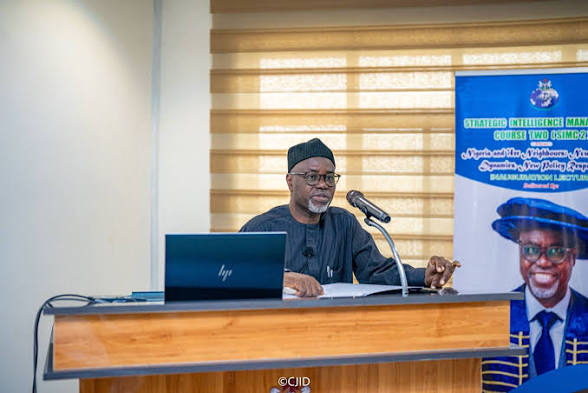
Speaking during the inaugural lecture of the Strategic Intelligence Management Course Two hosted by the Strategic Intelligence Management Institute, Egbewole warned that the changing political and security realities in the region now pose a direct threat to Nigeria’s national stability.
Delivering a lecture themed “Nigeria and Her Neighbours: New Regional Dynamics, New Policy Responses,” the professor of jurisprudence and international law described the growing wave of coups across Africa as more than a political concern, calling it an urgent security challenge demanding immediate action.
According to him, the region witnessed eight successful coups between 2020 and 2023 in countries including Mali, Guinea, Burkina Faso, Niger and Gabon. He added that an attempted coup in Benin Republic in December 2025 was reportedly stopped through Nigeria’s swift military intervention.
Egbewole noted that each political crisis in neighbouring countries weakens regional governance, fuels terrorism, disrupts bilateral relations and creates opportunities for extremist and criminal groups to expand operations closer to Nigerian borders.
To tackle the growing threats, he proposed the appointment of special Neighbourhood Policy Envoys, the creation of a Nigerian Neighbourhood Security Council, and the designation of a Special Envoy to re-engage with the Alliance of Sahel States — the coalition formed by Mali, Niger and Burkina Faso after leaving ECOWAS.
The UNILORIN VC also called for a revamped regional defence structure, including the development of a Nigerian Neighbourhood Defence Doctrine and full activation of the ECOWAS Standby Force. Other recommendations included the establishment of a Nigeria-Benin-Ghana Coastal Security Corridor, renewed support for the Multinational Joint Task Force in the Lake Chad Basin, and stronger maritime security coordination under the Yaoundé Architecture.
On economic cooperation, Egbewole argued that development should now be treated as part of national security strategy. He proposed a Nigeria Neighbourhood Development Fund, stronger engagement through the ECOWAS Business Council, and full implementation of the African Continental Free Trade Area.
He further stressed the need for intelligence reforms, including improved funding for the West Africa Intelligence Fusion Centre, direct bilateral intelligence-sharing agreements, and the digitalisation of Nigeria’s border management systems. He also advocated for a specialised counter-disinformation unit within the National Intelligence Agency to combat misinformation and emerging regional threats linked to climate disruption and displacement crises.
Egbewole additionally urged increased investment in Nigeria’s Technical Aid Corps, stronger research-to-policy integration, and expanded grassroots cross-border engagement programmes.
To ensure implementation of the proposals, he recommended establishing a Neighbourhood Policy Execution Unit within the Presidency, alongside a Five-Year Nigeria Neighbourhood Strategy backed by dedicated funding.
He concluded by urging Nigerian leaders to move beyond rhetoric and embrace deliberate investments in diplomacy, intelligence, education and regional community partnerships, stressing that Nigeria can no longer afford to manage relations with neighbouring countries from a distant multilateral approach alone.
