

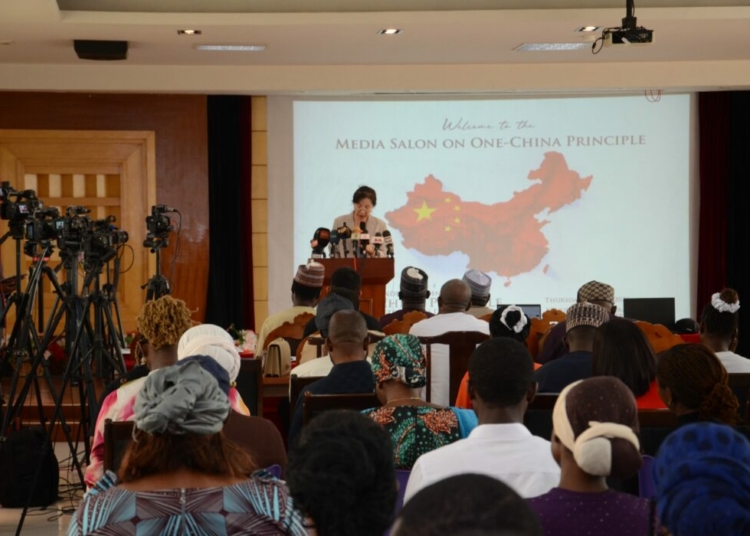
China has reassured of its commitment to peaceful reunification with Taiwan while deepening diplomatic and economic ties with Nigeria and other African countries under the One-China Principle.
The position formed the focus of a high-level diplomatic and policy dialogue held in Abuja, where Chinese officials, diplomats, academics and policy analysts examined Cross-Strait relations and the future of China-Africa cooperation in an increasingly multipolar global order.
Speaking at the event, Counselor at the Embassy of the People’s Republic of China in Nigeria, Dong Hairong, described Taiwan as “an inalienable part of China’s territory,” insisting that the One-China Principle remains the political foundation of China’s diplomatic relations worldwide.
She criticised recent diplomatic engagements involving Taiwanese authorities in Africa, including the visit of Taiwan leader Lai Ching-te to Eswatini and reported interactions between Taiwanese officials and some Nigerian journalists.
According to her, attempts to promote Taiwan independence violate international law and undermine the global consensus established under United Nations Resolution 2758, which recognises the People’s Republic of China as the sole legitimate representative of China at the United Nations.
“China must and will surely be reunified. National reunification is an irresistible trend of history,” Hairong stated.
She noted that Nigeria has consistently upheld the One-China Principle since diplomatic relations were established between both countries in 1971, describing the policy as the foundation of China-Nigeria relations.
Hairong highlighted expanding bilateral cooperation between Nigeria and China, citing infrastructure development, growing trade, zero-tariff access for Nigerian exports into China and the construction of the new Economic Community of West African States (ECOWAS) headquarters in Abuja with Chinese support.
Political strategist and public affairs analyst, Segun Showunmi, said Nigeria’s support for the One-China Principle had yielded strategic economic benefits, including investments in rail transportation, roads, power, telecommunications and industrial development.
According to him, China has emerged as a major development partner for Nigeria and Africa amid ongoing shifts in global power dynamics.
“The world is fundamentally a rainbow civilisation. No single power can sustainably define global behaviour for every society,” he said.
Showunmi argued that future China-Nigeria relations should move beyond infrastructure financing toward industrialisation, technology transfer, manufacturing partnerships, artificial intelligence, energy security and expanded educational cooperation.
He also called for the establishment of a China-Nigeria Strategic Economic Council focused on industrial policy coordination and innovation-driven growth.
Also speaking, provost of the Anti-Corruption Academy of Nigeria, Sheriff Ghali Ibrahim, described Lai Ching-te’s visit to Eswatini as inconsistent with established diplomatic norms and reiterated Africa’s broad support for the One-China Principle.
He noted that 53 out of 54 African countries currently recognise Taiwan as part of China, with Eswatini remaining the only African country maintaining diplomatic relations with Taiwan.
According to him, many African nations support China’s territorial integrity due to shared historical experiences involving colonialism, sovereignty struggles and foreign interference.
Ibrahim added that China’s long-standing “One Country, Two Systems” framework reflects Beijing’s preference for peaceful reunification through dialogue and integration rather than conflict.
Participants at the dialogue also examined the implications of Cross-Strait tensions for global trade, semiconductor supply chains and international security, warning that any escalation in the Taiwan Strait could trigger major geopolitical and economic disruptions.
Stakeholders stressed the need for sustained diplomacy, cultural exchanges, economic cooperation and mutual restraint to preserve peace and stability across the Taiwan Strait.
They also reaffirmed support for stronger China-Africa cooperation in industrialisation, security, digital technology, maritime protection, education and regional development.
