

Made-in-Nigeria smartphones fumble as monthly importation hits N50 billion
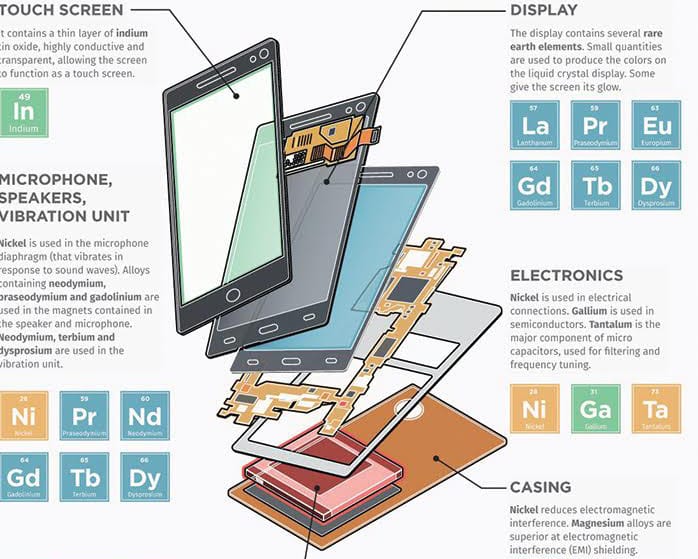
A breakdown of critical metals in a smartphones
• NCC type-approves 2,112 brands in 15 years
• Nigerians embrace fairly used units as devices cost N100, 000 to N1m
• Country has weak regulation, says Chinese Vendor
• Stakeholders urge President Tinubu to look at sector for job creation
• China, South Korea, Finland brands dominate market
• Local vendors decry poor enabling environment, task FG on forex stability
Despite ranking among countries in the world with huge mobile connections, manufacturing of mobile phones in Nigeria has remained a mirage as over 99 per cent of mobile devices in the country come from abroad.
This is coming even as mobile connections in Nigeria are more than 320 million SIMs since the telecoms revolution began about two decades ago. Active mobile connections through technology platforms such as GSM, fixed wired/wireless and Voice over Internet Protocol (VoIP) are around 221.2 million. Connections to the GSM platforms through mobile network operators (MNOs), largely the quartet of MTN, Globacom, Airtel and 9mobile, as at May 2023, stood at 220 million. These figures have pushed the country’s telephone density to 115.9 per cent.
Even with a tough economy and plummeting purchasing power, purchase of telephone devices remains upbeat. Up-to-date data are scanty. From 2019 to 2021, the total telephone shipment to Nigeria was $2.35 billion, bringing the average monthly import to $65.2 million. At the current exchange rate (N768/$), the data, supplied by the International Trade Centre (ITC), suggests a monthly import of N50 billion.
Amid the huge market opportunity, the country relies on foreign countries, especially Asia, for both assembling and manufacturing of devices.
Though local companies including AfriOne, Imose, RLG, Bryte, Solo, Omatek and Zinox have delved into local manufacturing, the companies, except for Zinox (which concentrates on laptop assembling) have since gone down. International brands, which are repatriating huge profits, have failed to fulfill the promise to establish plants in the country.
Checks by The Guardian showed that the number of mobile phone models approved for the Nigerian market increased to 2,112 in April this year. Data from the Nigerian Communications Commission (NCC) indicated that mobile manufacturers had secured approval for 151 new models of phones in the last two months. Chinese mobile manufacturers remained the leader in the market in terms of the number of approved phones.
While local manufacturing suffers, Nigeria has supported other brands from countries including Finland, France, USA, India, Japan, Philippines, Taiwan, South Korea, South Africa and UAE to thrive.
Phone brands including Tecno mobile, Infinix, Nokia, Wiko, Xaomi, Samsung, Panasonic, Huawei, Asus, Apple, HP, Google, Gionee, Alcatel and Oppo have cornered the entire local market. Checks showed that the prices of these brands hover between N150, 000 and over N1 million.
These brands, according to findings from the NCC, sold about 63 million devices in Nigeria, yearly. A report claimed that an average user changes devices six to 18 months.
Between 2020 and 2021, especially when COVID-19 was at its peak across the globe and triggered the new normal, yearly smartphone sales in Nigeria grew by 81 per cent according to Counterpoint Research’s Global Monthly Handset Sales Tracker.
Counterpoint Research explained that improving economic conditions, pent-up demand and entry of new Chinese Original Equipment Manufacturers (OEMs) were driving the market as well as increasing digital adoption due to the pandemic, expansion of social media, entertainment, and mobile money and drop in data costs.
A Research Associate, Ravyansh Yadav, said: “The average selling price of smartphones sold in Nigeria grew by nine per cent in 2021 driven by demand for devices capable of handling heavy Internet use.
“Nearly 90 per cent of smartphone sales in 2021 were in the less than $200 price band, where Transsion brands Infinix, itel and Tecno captured 63 per cent share. Transsion brands are expected to maintain their price competitiveness for the foreseeable future.”
While neither assembly nor manufacturing plants are in the country, Egypt, Algeria, Mauritius and South Africa all have phone assembly factories whereas Rwanda said its Mara Phones are manufactured completely in the country.
In 2017, AfriOne was birthed in Nigeria with an investment put at about $10 million to introduce the “first-ever Nigeria-made phone,” with a factory capacity of between 120,000 to 300,000 units of phones per month.
Indeed, in the first three years of operations, the brand, being an indigenous one, was the talk of the town, but that cannot be said now because its devices are rarely sighted in any of the major mobile device markets in the country.
RLG, a Ghanaian company in partnership with the Osun State Government, set up an assembly plant in Ilesha, in January 2014, with the capacity to produce 5,000 mobile phones and 2,500 laptops per day. But the firm had long returned to Ghana. Those close to its operations claimed that the change of government then greatly affected its operations in Nigeria.
Checks by The Guardian showed that while RLG’s office in Maryland, Lagos, had since been bought by a bank, AfriOne’s office located along the Oshodi/Apapa Expressway, in Lagos, appears deserted and unkempt.
In 2021, the Ministry of Industry, Trade and Investment presented a ‘made-in’ Nigeria phone to the immediate past President, Muhammadu Buhari known as ITF mobile.
The former Minister of Industry, Trade and Investment, Niyi Adebayo, had said, “12 indigenous mobile cell phones produced by the Model Skills Training Centre of the Industrial Training Fund, an agency under the Ministry of Industry Trade and Investment, were launched.
“It gives me great pleasure Mr. President, to present you with one of the phones,” Adebayo had stated. Painfully, since then, the phone cannot be identified in the market.
While the local brands have tried to put both assembling and manufacturing plants in the country, the foreign brands are not considering that immediately.
Transsion, owners of brands Tecno, Infix and iTel, has a major factory in Addis Ababa, Ethiopia, where its smartphone components are assembled, tested and completed.
Though as far back as 2013, the company has said part of its long-term plans was to build a manufacturing plant in Nigeria, but earlier in the year, when the firm was reminded of its promise, the company suggested that opening a plant in the country may not be on the cards just yet.
In 2016, when The Guardian attended Samsung Africa Forum in Monaco, France, Samsung Electronics had cited economies of scale, improved infrastructure and tax reliefs, among others, for the reason it sited its first two African manufacturing plants in South Africa and Egypt ahead of Nigeria.
Then, Samsung didn’t rule out the possibility of a manufacturing plant in Nigeria, the firm disclosed that Egypt’s plant would be serving Nigeria and other West African countries, while the South African plant would cater to the region and part of East Africa.
However, fresh information from sources within the firm, said a Nigerian manufacturing plant is still a long-term plan. In fact, seven years after, those things listed by Samsung are still missing in Nigeria, coupled with heightened insecurity.
Further on why foreign brands are not in a hurry to site a phone plant in Nigeria, an official with a popular Chinese brand with orange colour as an identifier, said, unlike countries such as Turkey, Egypt, among others with strong policies on indigenization, where foreign companies are compelled to have a manufacturing plant in countries outside theirs, “Nigeria doesn’t have such. That is the reason brands are not keen on having a manufacturing plant in the country.”
The official, who categorically said the brand, which hoped to increase its market share in Nigeria from eight per cent to 10 per cent by the end of the year, stressed that siting a plant in a new country depends on the request of the country’s government.
She disclosed that more Chinese brands are coming into Nigeria because of the huge market potential with over 200 million people.
Confirming this, a sales representative with Micro Station, a phone vendor in Nigeria, who preferred anonymity, told The Guardian that the rate at which mobile phones enter into Nigeria is alarming.
According to her, about a year ago, phones came to the shelves almost every quarter, “but these days, almost every two weeks.”
She also confirmed that mobile devices are now also from Taiwan, Hong Kong, and even Algeria.
Another vendor, who simply gave his name as Innocent Aduba, said mobile phones from Pakistan are also in Nigeria, like Qmobile.
Aduba, who couldn’t confirm whether the phones are NCC type-approved or not, called for more proactive regulation and monitoring of the sector, especially the influx of mobile devices.
According to him, more phones, even without brand names are entering and will continue to flood the Nigerian market, “which could be harmful.”
Aduba said though phones are coming into the country, “we discovered lately that more people are now patronizing the fairly used ones because those new ones are very expensive now.”
In its report in March, the International Data Corporation (IDC) said Africa’s smartphone market declined for the sixth consecutive quarter in Q4 2022, with shipments down 17.8 per cent year on year (YoY) to 17.6 million units. It added that Nigeria’s smartphone market declined 32.1 per cent YoY in Q4 2022 due to sustained high inflation and a shortage of U.S. dollars in the country.
The President, National Association of Telecoms Subscribers (NATCOMs), Chief Deolu Ogunbanjo, described the situation as very untidy, adding that there would be a need to revisit the NCC regulation on phone manufacturing. It stressed that the Ministry of Communications and Digital Economy should also look into the matter.
Ogunbanjo said with Nigeria crossing the 200 million mark in mobile connections, there should be a manufacturing plant in Nigeria.
He said players like Tecno, Samsung, which have larger market share in the country should be compelled to own a plant in the country, “that would go a long way to create jobs and reduce repatriation of funds out of Nigeria.”
Though, Ogunbanjo agreed that there is a huge infrastructural deficit in the country, including electricity, good road networks, and insecurity, “they should come. Let them factor all that into their costing. All we want is that they should have a plant here.”
Speaking from market perspective, the President, of the Phone and Allied Product Dealers Association of Nigeria (PAPDAN), Ifeanyi Akubue, the last government didn’t make the environment suitable for businesses to come and site plants in Nigeria because such businesses are highly capital-intensive and require all assurance of return on investments. He appealed to President Bola Tinubu to do everything with his means to ensure the environment becomes business-friendly with adequate infrastructure, good roads and security.
Akubue said the fluctuating foreign exchange has made doing business even worse in Nigeria, saying no investor would invest in an economy that is not stable.
“There are a lot of indigenous individuals as well as foreign investors that are willing to take up this project of smartphone production in Nigeria but they are crippled with the fear of a potential crash of their business due to the current Nigerian economy.
“Nobody wants to invest money into a business and record losses but with the instability of the Nigerian economy, it seems as though that might be the case and with that factor hanging in the air, it would almost be impossible to embark on such a project,” he added.
On his part, the President of Computer and Allied Products Dealers Association of Nigeria (CAPDAN), Dr. Ahmed Ojikutu, revealed that there are 12 local manufacturers, including Solo, Aspire, TD, AfriOne, adding that these brands find it difficult to compete with finished products that come from abroad, “and this stiff completion coming from these international brands have impacted greatly on local brands, which by so doing impacts on their revenue and market share in the country.”
Painfully, Ojikutu said, these foreign brands repatriate their funds, profits and earnings. This, according to him, showed that Nigeria is helping other economies to grow. He said to put a stop to this going forward, there should be a new roadmap that will encourage people to come and set up factories in Nigeria with incentives to them. He said local operators too should be encouraged quickly as most of them have died.
Like Akubue, Ojikutu also called on President Tinubu to address the current forex challenges in the country, saying it is killing businesses, especially SMEs.
Guardian.ng
