

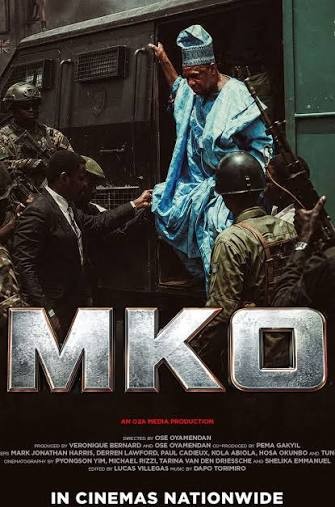
The documentary seeks to shed light on the people, sacrifices and democratic struggle that gave the date its lasting significance.
The story of the late Chief Moshood Kashimawo Olawale (MKO) Abiola and Nigeria’s historic June 12, 1993 presidential election is reaching a wider audience, with the documentary MKO now showing in 48 cinemas across the country.
Directed by Nigerian-American filmmaker Ose Oyamendan, the 108-minute documentary is screening in major cities, including Lagos, Abuja, Port Harcourt, Benin City, Enugu, Ibadan, Ilorin, Kaduna, Jos, Abeokuta, Asaba, Awka, Owerri, Ile-Ife, Ekpoma and Ede, among other locations.
The nationwide release represents a significant step for the production, which premiered at the National Theatre in Lagos on October 1 before its commercial cinema debut the following day.
Now in its second week, the film is being screened by major cinema operators and independent theatres, including Filmhouse, Genesis, Silverbird, Nile and EbonyLife. The current screening schedule covers October 9 to 15.
Lagos accounts for a substantial number of the screening venues, with audiences able to watch the documentary at EbonyLife in Victoria Island, Filmhouse Landmark, Genesis Maryland, Silverbird Galleria, Silverbird Ikeja, Nile x Viva Ikeja and Ozone Yaba, among other locations.
In Abuja, screenings are taking place at The Jays, Silverbird Jabi and Silverbird SEC Abuja. In Edo State, the documentary is showing at Denco and Sandford cinemas in Ekpoma, as well as Genesis and Kada cinemas in Benin City.
Other screening locations include Port Harcourt, Enugu, Ibadan, Ilorin, Kaduna, Jos, Asaba, Awka and Owerri. The distribution has taken the production beyond Lagos and Abuja, giving audiences in several parts of Nigeria an opportunity to engage with the country’s democratic history on the big screen.
Distributed by Nile Entertainment, MKO is the result of a filmmaking process that spanned approximately 13 years. Oyamendan has disclosed that more than $1 million was invested in bringing the documentary to completion.
The film explores Abiola’s political career, the June 12, 1993 presidential election widely believed to have been won by him, the annulment of the poll and the prolonged struggle for the recognition of the election’s outcome.
The annulment remains one of the most consequential events in Nigeria’s political history. It triggered widespread opposition and became a defining moment in the country’s struggle for democracy, eventually cementing June 12’s place as a symbol of the fight for democratic governance.
Speaking at the Lagos premiere, the Minister of Art, Culture, Tourism and the Creative Economy, Hannatu Musawa, highlighted the importance of making the history accessible to younger Nigerians.
“For too many young Nigerians, June 12 is simply a public holiday,” she said. “This film turns it back into our memory.”
The project also has a personal connection to Oyamendan’s professional journey. He began his journalism career at Weekend Concord, a publication within the Concord newspaper group established by Abiola.
Although his career later took him into advocacy and filmmaking in the United States, the story of Abiola and the events surrounding June 12 remained a project he was determined to document.
The film’s distribution across 48 cinemas is noteworthy in a market where fictional features and comedy productions often dominate theatrical releases. Its extensive screening schedule provides an opportunity for a historical documentary to reach audiences beyond traditional educational and archival platforms.
It also brings the events of June 12 to younger Nigerians who were either not born or were too young to understand the political crisis that followed the annulment of the election more than three decades ago.
Through its nationwide theatrical release, MKO is bringing Abiola’s story to a new generation, moving the conversation beyond history books, newspaper archives and political accounts to cinema screens across Nigeria.
For young Nigerians who may know June 12 primarily as a public holiday, the documentary seeks to shed light on the people, sacrifices and democratic struggle that gave the date its lasting significance.
