

How carbon farming, credits can boost Nigeria’s economy
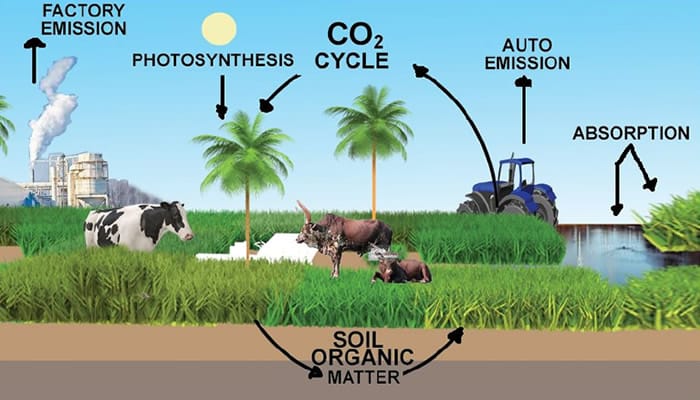
Although concerted efforts have been made, Nigeria is still seen as a carbon-dependent economy. Many businesses still run on generators, in addition to other practices that harm the environment.
A low-carbon economy, experts note, is a system that tries to reduce greenhouse gas emissions while operating as a conventional economic system.
This structure represents the long-term objective of nations attempting to mitigate the effects of climate change by building sustainable ways to run a better and greener economy.
The transition to low carbon economies began with the Kyoto Protocol, which required governments to cut their carbon emissions and continue with the Paris Agreement of 2015.
In the face of the climate crisis, farmers can strengthen plans to remove greenhouse gases in the atmosphere through carbon farming.
A Rivers State-based climate change advocate and engineer, Mr Miracle Morgan, noted that there were several carbon removal techniques that relied on large-scale technological infrastructure.
According to him, carbon farming is only one of the ways excess carbon can be removed from the atmosphere.
“What sets carbon farming apart from other infrastructure-based mitigation strategies is its capacity to develop landscapes beyond carbon storage, with added benefits for people and the environment,” he said.
Research by SourceTrace, a climate-forward online resource, stated that carbon farming had a great potential to cultivate wide scale benefits beyond agriculture.
According to the resource, a big reason why carbon farming is attractive to land managers is due to the immediate and long-term impacts it can provide for land.
“Farming strategies that foster landscape-wide carbon storage also provide in-farm co-benefits for income, farm productivity and soil health, among others,” SourceTrace added.
How carbon farming works
There are several positives of carbon farming. The technique emphasises adapting sustainable methods that predominantly enhance the absorption and retention of carbon from the atmosphere into productive lands.
This unlocks the natural capacity of land to help draw down carbon on a large scale.
An environmental science researcher based in Germany, Dr Usmanu Dauda, said carbon farming was a cyclical process.
He added that the soil, water, air, sunlight, plants and nutrients affect one another in a typical crop lifecycle.
According to him, while carbon farming focuses on emission reduction and removal, it also creates a whole array of other beneficial effects with direct and indirect outcomes for farmers and farm productivity.
He noted that carbon farming provides a unique opportunity to manage land more strategically with added benefits in various socio-economic and environmental aspects.
Dividing the potential carbon farming co-benefits into three, the researchers said it was important to keep in mind that each farmland was unique, adding that its co-benefits might vary from operation to operation.
On the environmental benefits, Dauda listed soil health, soil conservation, improved structure and stability, irrigation efficiency, nutrient availability, water and moisture retention, adding that it also helps to improve water quality by preventing nutrient runoff.
Dauda added, “It enhances the habitats for specie richness, supports complex ecosystem structures and helps to manage plant diseases and pests. It is less reliant on harmful chemical inputs and uses effective and sustainable waste and pollution management.”
On its economic benefits, Dauda listed skills and knowledge development, employment creation, community participation in nature building and cooperation between various sectors in society for a sustainable future.
He added, “Carbon farming expands income opportunities for the farmers. It also saves cost from reduced inputs and fuel efficiency. Also, because of how sustainable it is, it makes it easier to manage farm productivity on a long term.
“Carbon farming has a great potential to generate diverse positive ecological impacts as it innately promotes environmental stewardship, especially on soil health. This is why, for some, sequestering and storing carbon by managing arable land through carbon farming is considered a nature-based solution.”
NBS are methodologies that incorporate nature or natural processes for creating sustainable solutions to challenges such as climate change.
An agronomist and climate change teacher at the Finima Nature Park, Rivers State, Mr Emmanuel Ude, noted that farming practices such as cover cropping, crop rotation, reduced tillage, and reduced use of chemicals in the farm are also tenets of regenerative and sustainable farming.
He added that carbon farming also provides several other advantages that may not be present in other land management systems for agriculture.
According to him, accuracy and incentives are keys to successful carbon farming that maximise co-benefits.
He added, “Opting for carbon farming aligns with sustainability goals and better outcomes, where the process usually begins with accurate measurements, reporting, and verification. MRV is standard in carbon farming to generate credits which can then be sold to people and businesses intending to offset their residual carbon emissions.
“When making plans to operationalise carbon farming strategies, it is important to include potential co-benefits from early-stage reports to ensure progress can be tracked throughout the project lifecycle. Note that different verification schemes classify carbon farming co-benefits differently.”
Verra, a leading organisation that certifies carbon emission reduction, uses the Sustainable Development Verified Impact Standard, also known as SD VISta, to assess and report sustainable development benefits of project-based activities.
SD VISta evaluates projects’ co-benefits based on the United Nations Sustainable Development Goals.
On top of using the natural capacity of soil and plants to store carbon, carbon farming has been noted to generate multiple co-benefits that satisfy other areas of improvements in agriculture.
In fact, a study by BioOne Journal shows that pursuing environmental, social, and economic co-benefits drives success in carbon farming, more so than projects that solely focus on carbon sequestration.
Just as carbon farming addresses issues of climate change, especially emission reduction and carbon removal, as well as promoting farm resilience against extreme climate change effects, it also creates added economic incentives for farmers.
The study states that carbon farming opens up opportunities to engage in carbon programmes that can reward farmers for increasing carbon stocks in the land.
This is how carbon credits are generated as proof that a farm that switched to carbon farming practices has successfully sequestered and stored carbon in the field. Farmers earn from credits when sold to businesses looking to offset unavoidable emissions.
Ude, however, stated that before beginning a carbon farm, it’s important to meet with an advisor to ensure carbon farming opportunities really exist for the operation.
He said, “Each field is different and it’s important to understand whether your land has sequestration potential, to begin with. If so, what farm practices are worth switching to and how much time and commitment are needed to gain economic benefits from carbon farming credits.
“The right carbon farming scheme for your farm can produce added benefits for the environment, people and profit, usually creating income incentives for farmers and sustainable benefits for the productivity of the field.
“It is important to adapt the right farm management changes that are favourable for particular farm conditions unique to each field. If you are thinking of shifting to more sustainable farm practices, seeking the advice of experienced agronomists can help set your carbon farming journey right from the beginning.”
Carbon credits and economic dilemmas
Experts have noted that the dilemma that arises for policymakers is how they can achieve a balance between economic growth and pollution reduction.
Several economists believe the optimum course of action would be a gradual transition from fossil fuels and a carbon fee. Thus, consumers and businesses will be bound to alter their purchasing patterns.
They argued further that a global transition to a low carbon economy might bring enormous benefits to industrialised and developing nations. Numerous nations worldwide are constructing and implementing Low Emission Development Strategies programs, also known as LEDS.
These methods aim to fulfill social, economic, and environmental development objectives while simultaneously reducing long-term greenhouse gas emissions and enhancing climate change resistance.
It is consequently advocated that globally adopted low-carbon economies serve as a prelude to the more advanced zero-carbon economy.
An online resource, Investopedia, stated that carbon credits, also known as carbon offsets, are permits that allow the owner to emit a certain amount of carbon dioxide or other greenhouse gases. One credit permits the emission of one ton of carbon dioxide or the equivalent of other greenhouse gases.
It added, “The carbon credit is half of a so-called cap-and-trade programme. Companies that pollute are awarded credits that allow them to continue to pollute up to a certain limit, which is reduced periodically.
“Meanwhile, the company may sell any unneeded credits to another company that needs them. Private companies are thus doubly incentivised to reduce greenhouse emissions. First, they must spend money on extra credits if their emissions exceed the cap.
“Second, they can make money by reducing their emissions and selling their excess allowances. Proponents of the carbon credit system say it leads to measurable, verifiable emission reductions from certified climate action projects and that these projects reduce, remove or avoid greenhouse gas emissions.”
Dauda noted that carbon credits were devised as a mechanism to reduce greenhouse gas emissions.
He added, “Companies get a set number of credits, which decline over time, and they can sell any excess to another company.
“Carbon credits create a monetary incentive for companies to reduce their carbon emissions. Those that cannot easily reduce emissions can still operate, at a higher financial cost.
“The intention is to reduce the number of credits over time, thus incentivising companies to find innovative ways to reduce greenhouse gas emissions.”
Developing the Nigerian market
A report by Nextier, a research centre, pointed out that developing Nigeria’s carbon market holds substantial benefits for the country.
According to the African Carbon Markets Initiative’s projections, Nigeria can produce up to 30 million carbon credits annually by 2030, which at $20 per credit would earn Nigeria more than $500m annually.
These statistics underscore how carbon markets are an incredible opportunity to unlock billions for the climate finance needed to attain Nigeria’s energy transition plan.
Other benefits include promoting sustainable growth, stimulating economic development and mitigating climate change. Despite these opportunities, Nigeria’s exploration of this potential remains low.
In February, for instance, the National Council on Climate Change confirmed that it was formulating national carbon tax policy.
This policy gives the right to the government to set a price for emitters to pay for each ton of carbon emissions, consequently generating revenue for the economy while aligning the country with its net-zero commitments.
Although Nigeria’s emissions are modest, its fast-growing economy, development ambitions and rapidly growing population signify a heightened energy demand in the coming decades.
Therefore, experts are of the view that developing the Nigerian carbon credit market remained critical to ensuring that the continent’s development trajectory aligns with a just energy transition.
They noted that existing policies should be in place and that capacity barriers must be broken to guide businesses and industries on this pathway.
Dauda, corroborating Nextier, added that establishing an enabling framework that encourages growth was essential to guaranteeing a healthy and vibrant carbon market.
Punchng.com
