

… administration’s unaudited forecast puts the organisation’s surplus for the 2023–2026 cycle at between $5.2 billion and $5.6 billion.
FIFA has proposed increasing investment in football development to $6.35 billion for the 2027–2030 period, with each of its 211 member associations set to receive up to $25 million under a new funding plan.
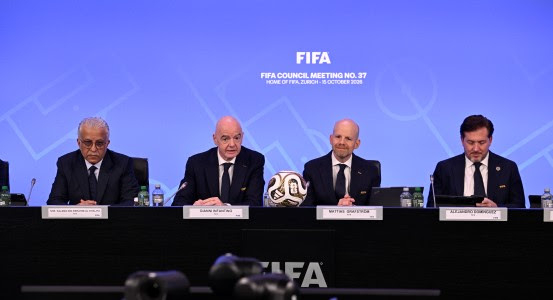
The proposal, presented at the FIFA Council meeting in Zurich, Switzerland, follows the exceptional commercial returns from the 2026 FIFA World Cup and comes amid renewed scrutiny of the organisation’s financial management and the withdrawn FIFA Forward Enterprise (FFE) initiative.
FIFA President Gianni Infantino called for unity among member associations and other stakeholders, while apologising for mistakes in the handling and communication of the FFE proposal.
He also reaffirmed FIFA’s commitment to expanding access to football and supporting the development of the game across its member associations, confederations and regional bodies.
The proposed FIFA Surplus Solidarity Programme would more than double planned development funding for the 2027–2030 cycle to $6.35 billion, using a portion of FIFA’s financial reserves.
According to FIFA, the administration’s unaudited forecast puts the organisation’s surplus for the 2023–2026 cycle at between $5.2 billion and $5.6 billion.
The proposal also provides for $1.7 billion to be retained as hard reserves to cover unforeseen circumstances.
Allocations to individual member associations would rise to $25 million, while confederations, zonal and regional associations, and other football stakeholders would receive increased funding under the Forward 4.0 programme.
The proposed funding arrangements would place emphasis on women’s and youth football, long-term development projects and football infrastructure.
FIFA said the eligibility criteria, application processes, approval procedures, disbursement arrangements and audit requirements would be finalised by the relevant committees before consideration by the Council at its next meeting in December 2026.
The plan would also be incorporated into FIFA’s 2026 annual report and submitted for approval at the 77th FIFA Congress in March 2027.
“FIFA’s money, including its reserves, belongs to the 211 FIFA Member Associations,” Infantino said, explaining that the proposed increase was intended to strengthen global football development following the World Cup’s financial success.
He added that FIFA had increased its funding allocation per member association from $1 million to $25 million during his decade as president.
On the FFE controversy, Infantino apologised for mistakes in how the project was conducted and communicated, confirming that the initiative had been permanently withdrawn and would not return in any form.
He maintained that the original objective had been to increase investment in football and improve how funds were channelled, subject to approval by the FIFA Council and member associations.
External lawyers also briefed the Council on the legal background to the FFE project, although FIFA said details would remain confidential because of ongoing legal proceedings in the United States.
The Council agreed to establish a working group comprising representatives from the various confederations to examine potential reforms to FIFA’s governance framework.
It also tasked the Football Social Responsibility Committee with assessing the FIFA Peace Prize, with a decision expected at the December meeting.
In another development, FIFA will review its disciplinary procedures following the decision by its independent Disciplinary Committee to suspend for a one-year probationary period the one-match ban imposed on United States forward Folarin Balogun after his sending-off against Bosnia and Herzegovina at the 2026 World Cup.
The FIFA Legal Committee will undertake the review and present its findings at the next Council meeting in December 2026.
