

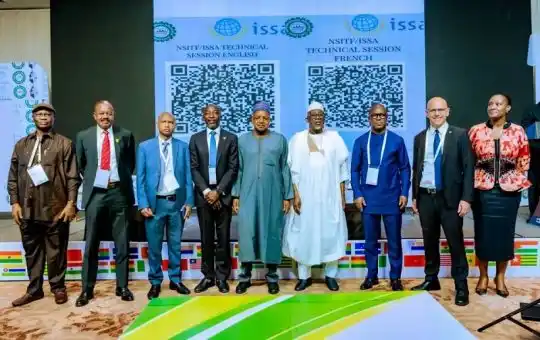
2026 International Social Security Association (ISSA) West Africa Seminar in Abuja
Elegbede Abiodun
• Currently, the Nigeria Social Insurance Trust Fund (NSITF) covers over 7.5 million workers.
President Bola Tinubu reaffirmed the Federal Government’s commitment to protecting Nigerian workers from economic hardship, workplace injuries, and uncertainty after retirement.
The president said that his administration was strengthening social protection systems to guarantee dignity and security for citizens.
Tinubu said this during the opening of the two-day 2026 International Social Security Association (ISSA) West Africa Seminar in Abuja themed “Improving inclusiveness and accessibility of social security services through effective communication in West Africa.”
He noted that the Renewed Hope Agenda was focused on restoring opportunity, safeguarding livelihoods, and rebuilding confidence in the economy.
The President, who was represented by the Minister of Budget and National Planning, Senator Atiku Bagudu, said key reforms across government institutions were already expanding social security coverage.
He disclosed that the Nigeria Social Insurance Trust Fund (NSITF) currently covers over 7.5 million workers under the Employees’ Compensation Scheme.
According to him, “when workplace accidents or disabilities occur, families are protected from sudden economic ruin.”
The president added that compensation payments reinforced the government’s commitment that workers would not be abandoned.
Tinubu also revealed that over 10 million Nigerians are contributing to the Contributory Pension Scheme under the National Pension Commission, with pension assets now exceeding ₦25 trillion.
He said, “What those assets represent is trust, the hard-earned savings of Nigerian workers who now have confidence that after a lifetime of service, retirement will not mean hardship, uncertainty, or loss of dignity, but security and peace of mind.”
On employment generation, the President noted that the National Directorate of Employment (NDE) has empowered more than two million Nigerians through skills training, entrepreneurship support, and job creation programmes.
He further stated that the National Health Insurance Authority (NHIA) has enrolled over 16 million Nigerians, reducing out-of-pocket medical expenses and improving access to healthcare.
According to him, social intervention programmes under the Federal Ministry of Humanitarian Affairs and Poverty Reduction continue to provide support through cash transfers, food security initiatives, and livelihood support aimed at cushioning economic shocks. He also referenced the N-Power programme, which he said has improved employability for hundreds of thousands of young Nigerians.
On housing, Tinubu said reforms under the National Housing Fund and the Renewed Hope Housing Programme are expanding access to affordable housing finance for low- and middle-income earners, stressing that shelter remains a key component of social security.
He added that the National Social Register is being used to improve targeting of vulnerable households, saying government is working toward “an integrated and digitally enabled social protection system” that connects pensions, healthcare, employment support, housing, and social assistance.
Beyond national reforms, the President said West Africa faces both opportunity and vulnerability, noting that while the region is youthful and dynamic, millions remain exposed to economic shocks, unemployment, and health challenges.
Speaking on the seminar theme, Tinubu stressed that communication remains central to effective governance, stating that “communication is not public relations. It is the bridge between government and citizens. It is the architecture of trust.”
He said effective messaging must go beyond technical documents and reflect local realities, adding that “our people communicate through community, culture, conversation, and shared experience.”
The President also emphasised the need for culturally relevant communication strategies, noting that while technology is important, it must be supported by grassroots engagement through community leaders, local radio, and simplified messaging.
“Having the right policies is only half the battle. The true challenge lies in communication,” he said, warning that access alone does not guarantee inclusion.
In his remarks, the Minister of Labour and Employment, Muhammad Dingyadi, reaffirmed the government’s commitment to protecting workers’ welfare through effective oversight of key institutions such as the NSITF.
He said the NSITF, established under the Employees’ Compensation Act 2010, remains central to providing compensation for workplace injuries, disabilities, and death.
“Our commitment is to continue strengthening this institution so that no worker is left vulnerable in the face of occupational risks,” the minister said.
He added that the seminar provided an opportunity for benchmarking Nigeria’s systems against global standards and strengthening regional collaboration on social security.
