

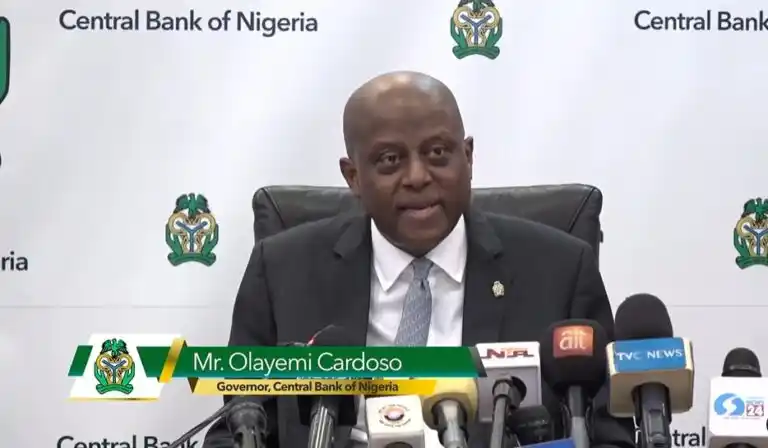
CBN governor, Dr Olayemi Cardoso
Governor of the Central Bank of Nigeria (CBN), Olayemi Cardoso, has reaffirmed the bank’s commitment to orthodox monetary policy, transparency, and evidence-based decision-making, describing the ongoing reforms as critical to restoring confidence in the Nigerian economy and to strengthening macroeconomic stability.
Cardoso reiterated this during the opening session of the Monetary Policy Committee (MPC) workshop on Thursday, May 21, 2026, themed “Strengthening Monetary Policy Effectiveness Towards Sustainable Macroeconomic Stability.”
He commended the deputy governors, MPC members, Directors, and other stakeholders for their resilience and dedication in navigating the economy through a challenging period of reform.
Reflecting on Nigeria’s recent monetary policy history, the Governor noted the significant challenges faced by the Bank at the inception of his administration, including weakened institutional autonomy, reduced policy credibility, and reliance on unorthodox monetary tools.
According to a statement that was issued on Sunday, Cardoso said the challenges blurred the distinction between fiscal and monetary responsibilities, reduced transparency, and limited the effectiveness of policy interventions. He also observed that the foreign exchange market was opaque and inefficient, while weak fiscal-monetary coordination further constrained economic outcomes.
Cardoso stated that these structural issues contributed to rising inflationary pressures, exchange-rate volatility, and a general erosion of investor and public confidence. However, he emphasised that reforms introduced by the current leadership have begun to reverse these trends.
He explained that the CBN has restored a more orthodox approach to monetary policy under the current MPC framework, with renewed emphasis on conventional instruments and the policy rate as the primary signalling tool.
Improvements in liquidity management, forward guidance, and policy communication have enhanced transparency and helped anchor expectations among households, businesses, and investors.
As a result, the governor noted that inflation, while still elevated and requiring close monitoring, has begun to moderate, and exchange-rate stability has improved. Enhanced transparency in the foreign exchange market has also supported more efficient price discovery and reduced volatility, contributing to a gradual restoration of confidence.
He attributed the economy’s growing resilience to external shocks, including recent geopolitical developments in the Middle East, as well as to ongoing reforms and improved policy coordination.
Beyond policy outcomes, Mr Cardoso highlighted progress in institutional strengthening at the Bank. He said that decision-making processes are increasingly anchored in data-driven analysis and structured deliberation, while communication practices have become more consistent and predictable.
The efforts, he noted, align with the Bank’s medium-term objective of transitioning to a more explicit inflation-targeting framework, which will require deeper institutional reforms, stronger collaboration, and sustained technical work.
Furthermore, he described the recently concluded banking recapitalisation exercise as a reflection of effective policy coordination, extensive stakeholder engagement, and the diligence of the Bank’s financial-sector supervision teams.
Reiterating the Bank’s focus on orthodox monetary policy, Mr Cardoso cautioned against renewed calls for interventionist measures, noting that such programmes had previously distorted the Bank’s balance sheet.
He stressed that the institution’s renewed credibility over the past two and a half years has largely stemmed from its disciplined reliance on conventional policy tools.
The Governor reaffirmed the Bank’s commitment to transparency, evidence-based policymaking, and institutional strengthening, emphasising the importance of continuous learning and adaptation for achieving sustainable macroeconomic stability. He expressed confidence that the workshop would yield practical insights to further enhance the implementation of monetary policy and support sustainable economic growth.
Earlier in his welcome address, the Deputy Governor of the Economic Policy Directorate, Dr. Muhammad Sani Abdullahi, emphasised the importance of broad-based participation, noting that facilitators were drawn from policy, research, and professional practice. He stated that the diversity of perspectives is essential to fostering informed dialogue, rigorous analysis, and collaborative engagement, thereby strengthening the effectiveness of monetary policy.
Dr Abdullahi explained that the workshop was designed to provide a platform for structured dialogue, technical exchange, and shared learning. He noted that the theme is particularly relevant in the current environment, where monetary policy is shaped by evolving domestic economic conditions, global spillovers, and heightened uncertainty. According to him, the theme reflects the Bank’s commitment to continuous improvement in policy formulation and implementation.
He expressed optimism that the workshop’s outcomes would support ongoing efforts to strengthen policy formulation, analysis, and implementation within the CBN.
The two-day workshop featured technical sessions led by experts with deep knowledge and practical insights into monetary policy issues. Key areas of focus included policy transmission mechanisms, financial market development, analytical frameworks, and institutional processes, with discussions tailored to Nigeria’s economic context.
