

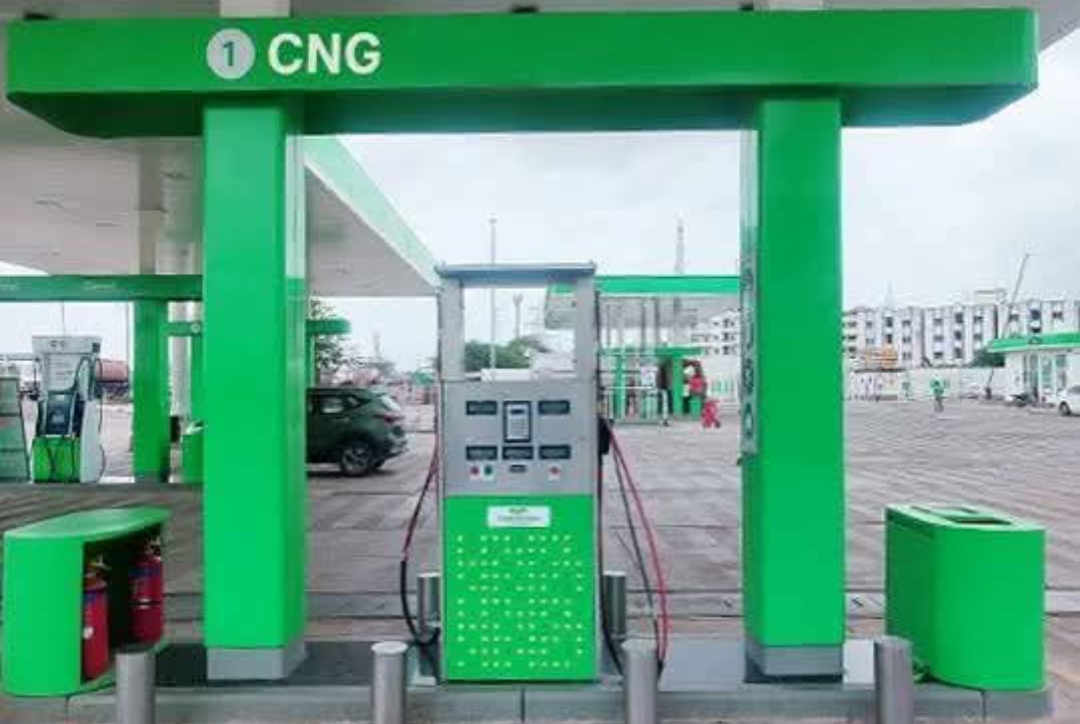
File/screenshot: CNG stations
Tinubu has also directed further infrastructure expansion, with additional facilities expected to come on stream between this year and early 2027.
The Federal Government has disclosed that Nigeria currently has about 160 operational Compressed Natural Gas refuelling stations, while another 170 facilities are at different stages of development and licensing as part of efforts to expand the adoption of alternative fuels and reduce transportation costs.
The Executive Chairman and Chief Executive Officer of the Presidential Initiative on Compressed Natural Gas and Electric Vehicles, Ismaeel Ahmed, disclosed this on Friday at the official inauguration of a CNG Integrated Refuelling Unit station established through a partnership between the State House, Pi-CNG and Electric Vehicles, and Rolling Energy in Karu, Abuja.
Ahmed said the country had moved beyond the experimental stage of CNG adoption, with private investors committing about $2.6bn to the development of infrastructure across the country.
He said the Federal Government was pushing to accelerate the expansion of refuelling facilities, adding that President Bola Tinubu had ordered another round of infrastructure development to increase access to CNG across the country.
He said, “This is almost our 106th station across the country in less than two years. This is not beginning any longer. The market has been proven.
“The investors are chipping in $2.6bn worth of private investment. Our President has ordered another round of about 500 infrastructure units to come in through the MDGIF. So I don’t think it’s a proof of concept any longer.
“It’s not the beginning. It’s a scale thing. Nigeria is 220 million people strong, 12 million vehicles. We are moving at a scale that we need to move. The work is in progress. What we need is to fasten up the scale.”
He added that about 160 refuelling stations were currently operating nationwide, while another 170 were undergoing development or awaiting regulatory approvals from the Nigerian Midstream and Downstream Petroleum Regulatory Authority.
According to him, the President has also directed further infrastructure expansion, with additional facilities expected to come on stream between this year and early 2027.
Ismaeel urged more private investors to participate in the programme, noting that the expansion of CNG infrastructure was necessary to serve Nigeria’s large vehicle population and improve access to cheaper transportation fuel.
He said, “A lot of entrepreneurs are seeing the need for this, and they are coming in, and we are calling them to come in and invest more.
“It took us 60 years to get to 24,000 PMS stations, and like the Permanent Secretary said, these are all privately owned.”
The Pi-CNG chairman also disclosed that the adoption of CNG-powered buses had reduced transportation fares by between 30 and 40 per cent on some routes where the vehicles were operating.
He cited routes in Abuja, Lagos and Kano, including the Kano-Katsina route, where passengers were now paying significantly less than they previously paid for transportation.
The development comes as the Federal Government seeks to encourage the use of natural gas as a cheaper alternative to petrol following the removal of fuel subsidy in 2023, which triggered a sharp increase in transportation costs.
Nigeria has substantial natural gas reserves, but much of the resource has remained underutilised, with significant volumes historically lost through gas flaring.
Speaking at the inauguration, the Permanent Secretary, State House, Temitope Fashedemi, said the new facility demonstrated the government’s commitment to promoting CNG as an alternative transportation fuel and encouraging private-sector participation in the programme.
He explained that the facility was established by converting an abandoned petrol dispensing station belonging to the State House into a CNG refuelling and vehicle conversion centre.
According to him, the State House provided the existing facility, while Rolling Energy invested in its rehabilitation and installation of the necessary equipment without government expenditure on the project.
Fashedemi said the initiative was intended to demonstrate that government institutions could support the CNG programme by making available existing infrastructure and encouraging private businesses to invest.
Also speaking, the Chief Executive Officer of Rolling Energy, Mubarak Danbatta, said the facility demonstrated the benefits of collaboration between government institutions and private investors in expanding alternative fuel infrastructure.
