

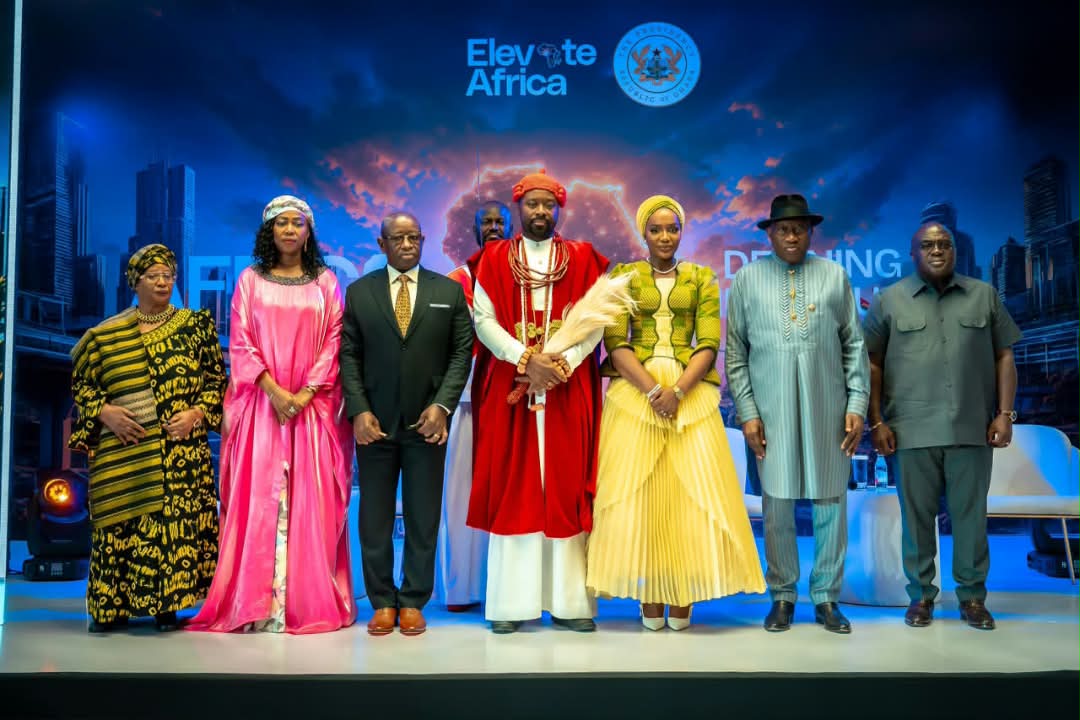
L-R: Former President of Malawi, Dr Joyce Banda; First Lady of Sierra Leone, Dr Fatima Maada Bio; President of Sierra Leone, Dr Julius Maada Bio; Olu of Warri Kingdom, His Majesty Ogiame Atuwatse III; Queen Consort of Warri Kingdom and Co-Founder of Elevate Africa, Her Majesty Olori Atuwatse III; former President of Nigeria, Dr Goodluck Ebele Jonathan; and representative of the President of Ghana, Julius Debrah, during the opening ceremony and Presidential Roundtable of the Elevate Africa Convening 2026, themed “Africa: Defining Her Future,” in Accra, Ghana… on Wednesday. Photo: Elevate Africa.
The Olu of Warri, His Majesty Ogiame Atuwatse III, has called on African leaders to prioritise human capital development, strengthen institutions and expand economic opportunities, declaring that the continent’s future prosperity depends more on the capabilities of its people than its abundant natural resources.
The monarch made the call on Wednesday while delivering the opening address at the third Elevate Africa Convening in Accra, Ghana, with the theme, “Africa: Defining Her Future.”
The two-day gathering brought together prominent African leaders, including heads of state, former presidents, ministers, traditional rulers, business executives, investors, development institutions, creatives, youth leaders and members of the African diaspora to deliberate on trade, governance, leadership, the creative economy and strategies for advancing the continent’s development.
Among the dignitaries at the event were former Nigerian President Goodluck Jonathan, Sierra Leonean President Julius Maada Bio, former Malawian President Joyce Banda and former Mauritian President Ameenah Gurib-Fakim.
Speaking at the well-attended event, Atuwatse III, who is also the co-founder of Elevate Africa, said African leaders should be assessed not only by their achievements while in office but also by the opportunities they create and the institutions they establish for future generations.
“The measure of leadership is about what we achieve while we are here, but what becomes possible long after we are gone,” he said.
The monarch maintained that Africa must move beyond its dependence on natural resources by investing in the skills, knowledge, creativity and ingenuity of its people.
“The true wealth of any nation lies not beneath its soil, but within its people,” he declared.
He identified engineers, farmers, researchers, entrepreneurs, teachers and responsible leaders as essential drivers of sustainable development, stressing that Africa’s global relevance should be measured not only by what it extracts from the earth but also by what it creates through the ingenuity of its people.
Atuwatse III warned that the continent’s rapidly growing population would not automatically translate into economic prosperity without deliberate investments in education, healthcare, innovation, agriculture and other productive sectors.
Citing projections that more than one in four people globally would be African by 2050, he said governments must prepare the continent’s expanding population to compete effectively in an increasingly knowledge-driven global economy.
“Demography is not destiny, just as natural wealth is not prosperity,” he said, urging African governments to create an enabling environment where talent could thrive, irrespective of background or personal connections.
On continental integration, the Warri monarch called for stronger economic cooperation capable of delivering tangible benefits to businesses, communities and ordinary citizens.
He described Ghana as an appropriate venue for the discussions, given that Accra hosts the Secretariat of the African Continental Free Trade Area (AfCFTA), which seeks to promote intra-African trade and economic integration.
According to him, governments, businesses, universities, traditional institutions and civil society must work collectively to expand opportunities, promote innovation and build institutions that support excellence.
“We cannot call for innovation while punishing initiative. We cannot say excellence matters if access to opportunity depends more on connections than competence,” he said.
The monarch also urged Africans in the diaspora to contribute their expertise, professional networks, mentorship and resources to the continent’s development, emphasising that collective commitment was essential to building a more prosperous Africa.
He called on international partners to engage African countries with mutual respect and a commitment to relationships that deliver shared benefits.
“But trust cannot be demanded. It must be earned,” he said, adding that Africa’s development would depend significantly on the quality of its partnerships, the knowledge it generates and the people it prepares for future challenges.
Atuwatse III, whose Warri Kingdom has a history spanning nearly six centuries, challenged participants at the convening to translate their discussions into measurable outcomes that would improve the lives of ordinary Africans.
He urged leaders to invest in people with the same determination with which they pursue infrastructure and other development projects, strengthen public institutions and equip younger generations to surpass the achievements of their predecessors.
“The measure of our service is not the recognition we receive, but the lives that are changed because we chose to serve,” he said.
The monarch expressed optimism that sustained investments in human capital, institutional development and innovation would enable future generations to inherit an Africa better equipped with the knowledge, capabilities and confidence to determine its own destiny.
The convening also featured a presidential roundtable on “Advancing African Leadership,” with former Nigerian President Goodluck Jonathan, former Malawian President Joyce Banda and former Mauritian President Ameenah Gurib-Fakim as panellists. The session was moderated by BBC journalist Waihiga Mwaura.
