

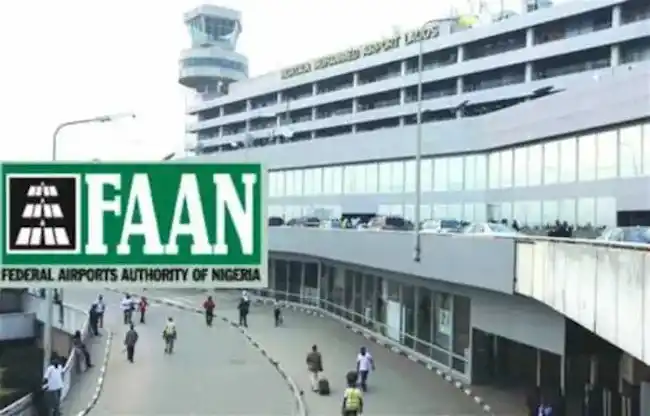
File photo: FAAN
The Federal Airports Authority of Nigeria has rolled out four digital payment options for access gates at airports nationwide as part of its ongoing “Operation Go Cashless” initiative.
According to FAAN, the move, aimed at eliminating cash transactions and enhancing efficiency at key entry points, aligns with Nigeria’s broader push toward a cashless economy.
The authority detailed the available payment channels in an announcement on its X handle on Tuesday.
It wrote, “To ensure smooth and efficient access, the following payment options are available:
• “FAAN Go Cashless Card – The fastest and most seamless payment option.
• “E-Tag – Ideal for frequent users; enables automatic deduction without stopping.
• “VIP Sticker – For authorised vehicles with approved access.
• “ATM/Debit Card via POS – Available on-site; however, processing time may vary due to banking network issues.”
FAAN added that users can obtain their Go Cashless card at any of its commercial offices and access gates. Users can also sign up and manage their cards online at www.gocashless.faan.gov.ng.
The Go Cashless policy, which took effect on March 1, 2026, bans cash at all FAAN pay points, including toll gates, car parks, and executive lounges, in line with directives from the Central Bank of Nigeria.
Launched in partnership with Paystack, the initiative was first announced in September 2025 and began at major hubs such as Murtala Muhammed International Airport in Lagos and Nnamdi Azikiwe International Airport in Abuja.
The authority emphasises that the system will make transactions “faster, safer, and more convenient,” potentially increasing revenue by up to 75% through better transparency and reduced cash handling.
However, on the first day of implementation, chaos ensued at Lagos and Abuja airports, with vehicular gridlock causing some travelers to miss flights. Motorists without prepaid cards resorted to POS payments, leading to delays.
FAAN has appealed for patience, urging frequent users to preload cards in advance to avoid disruptions.
