

FG reveals rollout plan for 125,000km fibre network
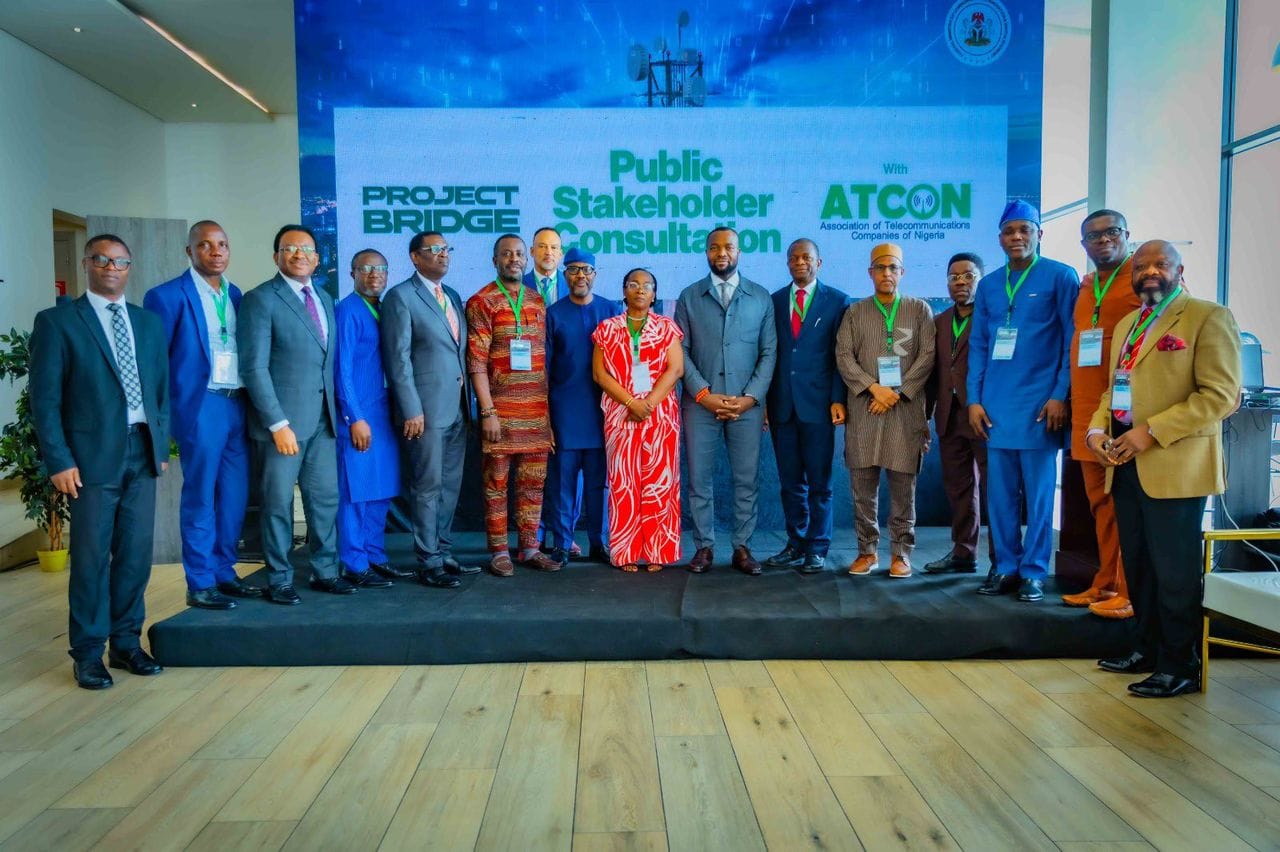
Minister of Communications and Digital Economy, Dr Bosun Tijani with industry leaders and members of the Association of Telecommunications Companies of Nigeria during the unveiling of the technical design for Project BRIDGE in Lagos. Credit: Bosun Tijani
Nigeria is one step closer to building one of the largest digital backbones in the developing world after unveiling the technical design for Project BRIDGE, a $2bn fibre expansion that will stretch the country’s network from 35,000 to over 125,000 kilometres.
The plan will see seven main fibre rings linking Nigeria’s six geopolitical zones with Lagos, supported by 37 city-level fibre loops, 77 regional networks and a series of edge data centres, Minister of Communications and Digital Economy Dr Bosun Tijani told stakeholders at the weekend.
The design was presented in Lagos at an event hosted in partnership with the Association of Telecommunications Companies of Nigeria, bringing together industry leaders, policymakers and the media.
Each of the country’s 774 local government headquarters will get a Point of Presence, a hub that distributes internet connections to surrounding areas.
From these hubs, fibre will run to smaller administrative wards, focusing first on schools, health centres and underserved communities. On average, each hub will be about six kilometres from the wards it serves. The network is designed for both large and small internet providers, encouraging competition and speeding up last-mile connections to homes and businesses.
“Over the past two years, we have worked tirelessly on what is arguably the most ambitious and foundational digital infrastructure project in Nigeria’s history, Project Bridge,” the Minister said in a statement.
The Minister noted that the deployment will be phased by population density and demand, allowing for scalable expansion. At the heart of the network, each regional ring is planned to strengthen interconnectivity, supporting governance, education, economic activity and access to digital services nationwide.
The project is structured to support the needs of both large and small ISPs, offering scalable access through core, metropolitan, and middle-mile layers. By enabling healthy competition and network sharing, it will accelerate fixed broadband growth nationwide.
Project BRIDGE will be implemented through a Special Purpose Vehicle, with the Federal Government holding a 51 per cent stake and private sector partners owning 49 per cent. Funding commitments include $500 m from the World Bank, $200 m from the African Development Bank, and additional resources from the European Investment Bank, the Islamic Development Bank and private investors.
The plan was first announced in June 2024 as part of the National Broadband Plan (2020–2025) and approved by the Federal Executive Council later that year. In August 2024, Dr Tijani indicated that the fibre deployment could begin within six months, although the Federal Government has since confirmed that large-scale rollout will start in the fourth quarter of 2025.
Middle-mile infrastructure has long been a bottleneck in Nigeria’s broadband delivery, despite substantial international bandwidth capacity at its shores. Current deployment rates of around 5,000 km per year have been insufficient to meet demand, prompting the government to set a target launch for the project in the first quarter of 2026.
The initiative is also expected to strengthen regional digital integration, with potential benefits for the Economic Community of West African States, the West and Central African Research and Education Network and the African Continental Free Trade Area Secretariat.
“The last mile remains essential and will involve linking service providers to homes, offices, and institutions using fibre or other technologies. This final layer will be supported by the foundational middle-mile network, enabling broader internet access across Nigeria,” Tijani stated.
Managing Director for West Africa at Equinix, Wole Abu, said telecommunications had evolved from a standalone sector into the “engine room of economic growth” and warned that without robust backbone infrastructure, Nigeria would struggle to deliver essential services in sectors such as security and agriculture.
“As a trusted advisor to global businesses and countries, we all at Equinix, the digital company of the world, are excited to witness Nigeria taking bold steps towards digital transformation,” the executive said.
