

PERSON OF THE YEAR 2025: Aliko Dangote shines still
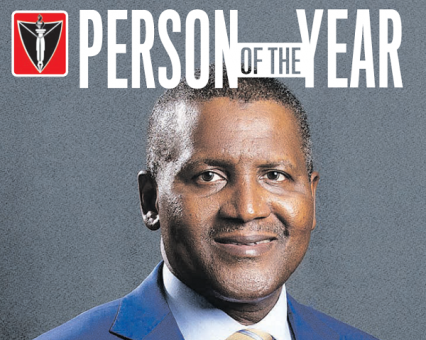
… proud to have a relentless achiever of Africa on the globe.
Aliko Dangote stands at the summit of a fresh chapter, watching his refinery surge beyond Saudi Aramco’s benchmark by 250,000 barrels a day. It’s one rare feat among many by which he seduces the world into his orbit. The precocious child who once sold sweets for pocket change now commands the world’s largest single-train refinery, shepherding energy through steel corridors and silos for profit.
His Dangote Refinery is proudly Nigerian. A sprawling behemoth that remarkably stands taller than forecasts once imagined, besting the Arabian oil plant’s famed capacity of 430,000 barrels per day.
Dangote Refinery, however, is simply the first of a trifecta of feats that have reshaped global industry tables; second is the ascent of his cement empire to the world’s second summit; third is the elevation of his fertiliser enterprise to that same rare altitude; and an export arc that now bends toward the United States with 37 per cent of its output.
Dangote cuts the rare picture of the particular kind of man that history rewards: the one who walks into storms armed only with conviction, and refuses to buckle even when the odds stack to break him.
There is no gainsaying that he has spent the last decade battling an oil establishment so entrenched it once dictated the country’s economic trajectory. While the country grappled with scarcity, social upheaval and uncertainty, Dangote did what governments failed to do for fifty years: he ended fuel queues. And he did it while fighting what he openly calls “the oil mafia.”
His refinery, a $20–$23 billion undertaking, was never a venture for the faint-hearted. Describing it with a mixture of candour and fatalism, recently, he said: “It was the biggest risk of my life. If this didn’t work, I was dead.”
No billionaire speaks like that unless the stakes are daunting. And they were. From the moment the project broke ground, he found himself in a conflict with forces that have long profited from keeping Nigeria dependent on imported fuel, comatose infrastructure and chronic dysfunction. These forces moved against him with precision: flooding the market with subsidised imports, sabotaging distribution channels, undercutting prices, and, in some cases, withholding crude that legislation required they supply.
“They tried to suffocate us,” he said. “The same way they killed other sectors, they now want to use in killing us.” It was an accusation, but more significantly, a map of battle lines. Dangote understood that to successfully build and operate a refinery, he must confront an economy organised around failure.
The conflict escalated when the Nigerian National Petroleum Corporation Limited (NNPCL) reneged on investment terms, slashed crude commitments, and forced him to import feedstock from foreign markets. Local unions accused him of endangering jobs. Marketers accused him of distorting prices and international traders moved to drown the refinery in cheap imports.
But Dangote’s response was surgical. He tightened production schedules, expanded exports and resorted to litigation when need be. He launched a media battle too, speaking bluntly about his travails, lest his silence become complicity. And through it all, he repeated one line that felt less like a boast than a warning: “I’ve been fighting battles all my life, and I have not lost one yet.”
The refinery itself became his greatest rebuttal. Within months of operations — after the shaky start, the supply interruptions, and coordinated attempts to derail it — the plant began exporting over 1.6 billion litres of petrol. Nigeria’s retail price curve, which had spiked to nearly N1,100 per litre, fell toward N841 (fuel currently sells at N885 per litre at some Lagos filling stations). Fuel queues, a humiliation that had persisted since 1975, dissipated. Distribution improved with the rollout of thousands of CNG-powered trucks, and for the first time in decades, Nigeria’s demand for imported petrol plummeted.
Some deemed this an industrial victory, while others described it as a corrective civilisation. The undeniable variable in Dangote’s endurance and defiance of the oil mafia was President Bola Ahmed Tinubu. Determined to end the petroleum chaos, Tinubu backed reforms that strengthened local refining, stabilised pricing regimes, and blocked the monopoly of import cartels. This earned Dangote enemies but helped his refinery breathe.
In truth, Nigeria needed Dangote Refinery to survive. Thus, when Dangote paused naira-based petrol sales because the official exchange window made operations untenable, it was Tinubu who pushed the naira-for-crude policy that reset the market and slashed forex demand.
Dangote’s triumph is neither accident nor fortune’s fleeting kiss. It manifests in the marrow of his lineage; from recited lore in courtyards lit by patrician glow of the lanterns and legacy of the Dantatas, whose caravans traversed old trade routes across West Africa’s tracts.
Born on April 10, 1957, into an affluent and entrepreneurial Kano family, Dangote grew up under the watchful influence of his maternal grandfather, Alhaji Sanusi Dantata, one of West Africa’s most illustrious merchants. The latter who was arguably one of the richest Africans and traders of his generation, raised Dangote closely, teaching him the logic of enterprise and markets, until business felt less like a career to the lad and more like a native language.
For scholarship, he proceeded to Al-Azhar University in Cairo, Egypt, where he acquired a degree in Business Administration. Following his graduation at just 21, he chose to strike out on his own rather than settle into a comfortable role within the vast Dantata business empire. He secured a US$500,000 loan from his uncle, Alhaji Dantata, and moved to Lagos. With the capital, he began importing sugar from Brazil and rice from Thailand, and astonishingly paid off the loan within three months, thus earning the admiration of his maternal uncle and mentor, who died on June 28, 2025, at 94.
Dangote established Dangote Industries Limited (DIL) in April 1985. For two decades, he focused on importing staples—pasta, sugar, salt, and flour—before shifting into manufacturing in 1997. Dangote Industries had earlier incorporated Dangote Cement in 1981 and later acquired Obajana Cement Plc in 2002, a firm originally set up by the Kogi State government in 1992. By 2010, DIL owned the company outright, renaming it Dangote Cement Plc. The company became central to Nigeria’s push for self-sufficiency in cement production, a challenge first laid out by the Obasanjo administration in 2002.
By 2021, Nigeria had become a net exporter of cement. Today, DIL controls roughly 60 percent of the domestic cement market, manufactures cement in 10 African countries, and produces more than 52 million metric tons annually across the continent.
DIL’s most ambitious undertaking remains the US$20 billion Dangote Refinery and Petrochemicals complex. With a 650,000-barrel-per-day refining capacity, it is designed to meet all of Nigeria’s petrol demand and support a sprawling network of fertilizer and petrochemical operations.
Dangote’s next major goal is to make Africa self-sufficient in fertiliser production within 40 months. Beyond cement, sugar, fertiliser, and oil, he turns his gaze toward medicine, unsettled by how Africa’s dependence on imported pharmaceuticals chains its health systems to distant factories. Thus, he envisages a partnership with Bill Gates, to the applause and chagrin of disparate actors.
Dangote’s interest springs from philanthropy as much as enterprise. The Aliko Dangote Foundation, endowed with $1.25 billion, channels an annual $35 million into nutrition, health, education, and empowerment. His foundation runs a $100 million war against childhood malnutrition, strengthens early childhood education through community-based programs in Kano, builds hostels for universities, including the N1.2 billion complex at Ahmadu Bello University in Zaria, funds vocational training and scholarships.
On Thursday, December 11, 2025, through his Aliko Dangote Foundation, the billionaire magnate pledged N1 trillion ($688 million) to support education in Nigeria over the coming decade. Starting with 45,000 scholars next year, the foundation expects to eventually support 1.33 million students with a focus on the so-called STEM disciplines of science, technology, engineering and mathematics, as well as the schooling of girls and teacher training.
That same instinct for timing and empathy surfaced on the same date (December 11) when the Dangote Petroleum Refinery announced a sharp reduction in the ex-gantry price of petrol. The refinery cut the price to N699 per litre, a N129 drop from the previous N828. The adjustment pulled prices close to levels last seen two years earlier and arrived with deliberate precision ahead of the Christmas travel rush, when millions of Nigerians take to the roads.
“My mother instilled in me the ethos of giving back,” Dangote said. “I trust my three daughters will continue this legacy, just as they will continue to grow our business and impact. I want to be known not just as Africa’s richest person but also as its biggest philanthropist.”
His wealth story arcs like a long, unpredictable journey. Forbes first listed him in 2008 with $3.3 billion. When markets shifted, his worth dipped to $2.1 billion. But the winds reversed; cement boomed, and his wealth surged to $13.8 billion by 2011. The years swung between turbulence and triumph, yet he regained his position as Africa’s wealthiest by September 2024.
Dangote attained a new milestone, with his recent attainment of the $30.3 billion net worth, in October 2025, according to the Bloomberg Billionaires Index.
Since he became Nigeria’s first billionaire, The Guardian (UK) has christened him the richest Black man on earth. TIME Magazine places him among the Titans in its inaugural TIME 100 Philanthropy list. Nigeria decorated him with the Grand Commander of the Order of the Niger (GCON), a distinction once reserved for senior statesmen, among several honours.
While it is easy to romanticise Dangote as merely a billionaire with an oversized dream, the reality is grittier. The man operates like a titan forged in industrial fire. He visits his plant unannounced, sits with engineers for hours, and recalibrates operations line by line. He has repaid billions in loans. He has survived sabotage attempts he still will not fully describe. He has endured public attacks, private betrayals, and political complexities few business leaders could navigate without retreat.
But what qualifies him for the symbolic mantle of Person of the Year is not the size of his refinery, nor the wealth behind his name and status as “Africa’s richest billionaire.” It is his capacity to assert in vision and practice that Nigeria’s future does not lie in crude oil exports but in value creation.
Dangote represents the industrial future Nigeria has been too timid to claim; the possibility of an Africa that refines, manufactures, exports, and competes. His refinery, sprawling over 6,200 acres, may one day be recorded as the engineering feat by which Nigeria turned from perennial crisis to continental leadership.
Dangote is not a perfect figure. No titan ever is. But in a year that demanded audacity and an almost obstinate commitment to national rebirth, he stood where others buckled, delivering what half a century of governments failed to: stability in the sector that shapes the Nigerian economy.
His success may be traced back to his lineage, which held commerce as both duty and inheritance. From the Madrasa and classrooms of Birnin Kudu, where he sold sweets to classmates for profit, to Kano’s markets and Cairo’s lecture halls, Dangote evolves fully formed. He married early and raised his daughters, building a dynasty private enough to elude tabloid intrusion yet strong enough to anchor his empire. Nothing in his personal life distracts from his mission.
To honour such a man is to acknowledge fortitude and name, plainly, the one who reshaped Nigeria’s trajectory in a year defined by flux.
The refinery subsists beyond Dangote’s personal triumph. It is Nigeria’s proof of concept: that greatness is possible here, at scale, through a citizen’s grit and refusal to bow.
And in that sense, Dangote is unmistakably the Person of the Year.
