

Manny Ita –
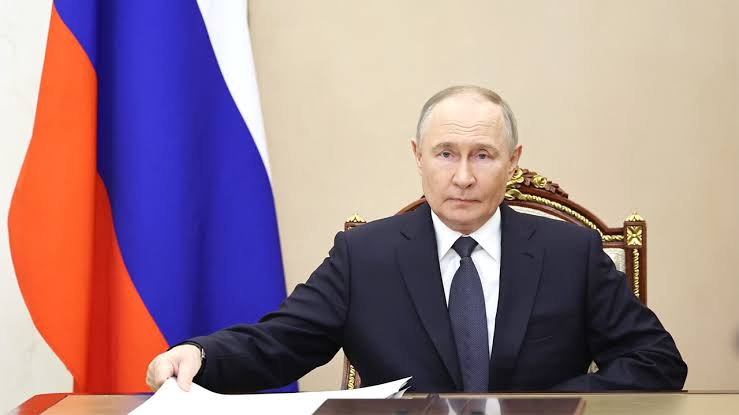
Russian President Vladimir Putin has condemned the killing of Iran’s Supreme Leader, Ali Khamenei, describing the incident as “a murder committed in cynical violation of all norms of human morality and international law,” while extending condolences to the Iranian leadership and people.
In a message addressed to Iranian President Masoud Pezeshkian and published by the Kremlin press service on its official communication channels, Putin praised Khamenei’s role in strengthening bilateral ties between Moscow and Tehran. He stated that “in our country, Ayatollah Khamenei will be remembered as an outstanding statesman who made a huge personal contribution to the development of friendly Russian-Iranian relations, bringing them to the level of a comprehensive strategic partnership.”
Russia’s Foreign Ministry had earlier issued a strong condemnation of the joint United States and Israeli military operation that resulted in the Iranian leader’s death, describing the action as “a pre-planned and unprovoked act of armed aggression against a sovereign and independent UN member state in violation of fundamental principles and norms of international law.”
According to Moscow, Washington and Tel Aviv had “once again embarked on a dangerous adventure that is rapidly bringing the region closer to a humanitarian, economic and, not exclude, a radiological catastrophe.” The ministry further alleged that the justification of preventing Iran from acquiring nuclear weapons amounted to “an imaginary concern,” insisting that the true objective was “to destroy the constitutional order and destroy the leadership of a state they do not like, which has refused to submit to forceful dictate and hegemonism.”
The Russian government called for “an immediate return of the situation to a political and diplomatic settlement,” warning that continued escalation could destabilize the wider Middle East and threaten global security.
Amid growing regional uncertainty, the Russian Foreign Ministry also urged Russian citizens in Iran and Israel to leave both countries immediately where possible. Officials recommended evacuation routes from Iran through Azerbaijan and Armenia, while Russians in Israel were advised to depart via Egypt and Jordan. Citizens remaining elsewhere in the region were instructed to “observe appropriate personal precautions, avoid crowded places and limit non-urgent movements around the country.”
Analysts in Moscow noted that developments in Iran carry significant strategic implications for Russia, which regards Tehran as a key regional ally. Experts warned that potential regime instability in Iran could create security challenges near Russia’s southern periphery, including the Caucasus, Central Asia and the Caspian Sea region, where NATO maintains a growing presence.
Orientalist and political analyst Nikita Smagin said instability in Iran could jeopardize major economic and transport initiatives linking the two countries, particularly the North-South transport corridor, which has become increasingly vital for Russia under Western sanctions. Smagin noted that “even if the current government in Iran remains in power, the general instability in the region still calls into question the creation of the North-South corridor,” describing it as a critical lifeline capable of sustaining Russia should other transit routes become restricted.
She added that broader cooperation projects, including investments in Iran’s oil and gas sector, plans for a regional gas hub and proposals for new Russian-built nuclear power facilities, were now facing uncertainty. According to Smagin, “all of this is now seriously in question,” warning that Moscow could ultimately lose long-term strategic prospects tied to its partnership with Tehran.
The analyst further argued that regime change in Iran would likely be unfavourable to Russia, stating that any successor government could adopt a distrustful or openly anti-Russian stance due to Moscow’s longstanding support for the previous leadership.
Khamenei was reportedly killed on February 28 during coordinated US and Israeli strikes targeting his residence. Initial reports of his death were repeatedly denied by Iranian authorities before Tehran officially confirmed the announcement late on March 1, declaring a 40-day national mourning period for the leader who had ruled the Islamic Republic since 1989.
The confirmation of Khamenei’s death and Russia’s strong reaction underscore deepening geopolitical divisions as global powers respond to the expanding conflict and its far-reaching political, economic and security consequences.
