

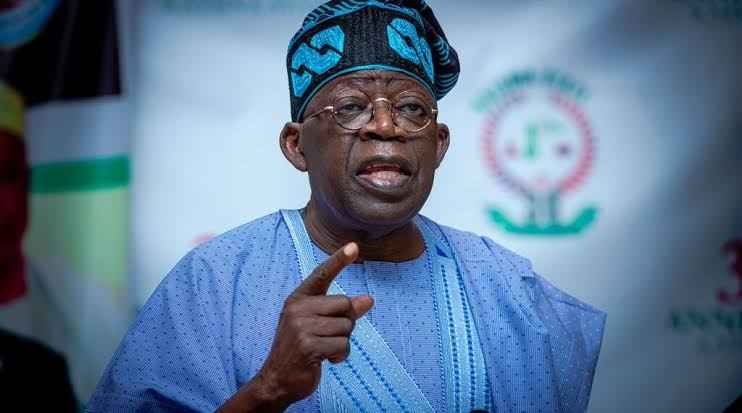
President Bola Tinubu. Credit: File
The agreement followed a facility tour of the company’s integrated steel plant, where the Nigerian delegation inspected operations spanning Direct Reduced Iron, pig iron, billets, and ductile iron pipe production.
The Federal Government has secured a fresh $1bn steel investment commitment as part of efforts to accelerate industrialisation, with total foreign direct investment in the steel sector rising above $2.2bn under President Bola Tinubu’s economic reform agenda.
The latest deal was sealed on Tuesday in Kolkata, India, where the Minister of Steel Development, Prince Shuaibu Abubakar Audu, signed a Memorandum of Understanding with the Rashmi Metaliks Group for a projected three-year investment valued at $1bn.
The agreement followed a facility tour of the company’s integrated steel plant, where the Nigerian delegation inspected operations spanning Direct Reduced Iron, pig iron, billets, and ductile iron pipe production.
A statement by the ministry’s Head of Press and Public Relations, Salamatu Jibaniya, confirmed the development, describing it as a key milestone in Nigeria’s industrial expansion drive.
The statement read, “The Minister of Steel Development, Prince Shuaibu Abubakar Audu, in a landmark investment drive, signed a Memorandum of Understanding with the Indian conglomerate, Rashmi Metaliks Group, on Tuesday, 14 April 2026, in Kolkata, India, for a projected investment of $1 billion over a three-year period.
“This followed the Minister’s tour of the Rashmi Metaliks Steel Plant in Kolkata, where he commended the scale of the operations and advanced technology deployed at the facility. He also lauded the company’s integrated operations, spanning Direct Reduced Iron, pig iron, billets and finished ductile iron pipes, describing them as a strong example of industrial efficiency and excellence in modern steel production.”
Speaking after the signing, Audu said the agreement reflects growing global confidence in Nigeria’s reform trajectory and its emerging industrial opportunities.
“Nigeria’s proactive investment drive is already attracting significant global capital.
“The MoU signed with Rashmi Metaliks Group represents a major milestone in Nigeria’s efforts to reposition the steel sector, reaffirming President Bola Ahmed Tinubu’s commitment to revitalising the industry, creating employment opportunities and conserving foreign exchange through strategic import substitution,” the minister said.
He added that Nigeria’s engagement with the Indian conglomerate is part of a broader strategy to attract technology-driven investment into the country’s industrial base.
Audu noted that Nigeria is transitioning from a raw material exporter to a value-adding industrial economy, anchored on its vast mineral resources.
“The efficiency of the facility underscores the importance of value addition, innovation and sustainability in modern steel production, emphasising that the visit further reflects the strengthening economic ties between Nigeria and India in the areas of steel, mining and manufacturing.
“Nigeria is richly endowed with over three billion tonnes of iron ore reserves, some grading as high as 67 per cent iron content. With such an endowment, there is no reason we should remain dependent on imported steel,” he said.
The minister disclosed that domestic steel consumption is currently estimated at about $10bn annually, describing it as a clear gap that local production must fill.
He also outlined Nigeria’s ambition to produce about 10 million tonnes of crude steel annually by 2030, positioning the country as a regional steel hub in Africa.
The deal with Rashmi Metaliks adds to a growing pipeline of investments entering Nigeria’s steel sector.
According to the minister, recent commitments include a $400m Stellar Steel plant in Ogun State, a Chinese-Nigerian joint venture expected to begin operations by November 2026.
Also on the list is the African Industries Group’s $300m integrated iron and steel facility in Kaduna State, alongside galvanising and fabrication operations in Lagos.
Energy support projects are also being developed, including a $500m mini-liquefied natural gas initiative in Ajaokuta, Kogi State, aimed at improving gas supply to industrial users.
“We are deliberately building the ecosystem around steel production, energy, mining, logistics and manufacturing. Steel does not thrive in isolation; it requires an entire industrial chain.
“That is why we are also focusing on gas infrastructure, mining expansion and downstream manufacturing to ensure sustainability,” Audu said.
The minister used the India visit to further court global investors, inviting Indian industrial players to explore opportunities in Nigeria’s steel value chain, including electric arc furnace technology and integrated steel plants.
He assured investors of policy stability and government support.
“The Nigerian government is committed to creating an enabling environment through reforms, incentives, and ease-of-doing-business measures. Investors will find Nigeria stable, open and ready for industrial partnership,” he said.
On his part, Vice Chairman of Rashmi Metaliks Group, Mr Sunil Kumar Patwari, said the company was committed to the partnership and confident in Nigeria’s industrial potential.
“We appreciate the Nigerian delegation for visiting our facility. It demonstrates the seriousness of this partnership. With the right support, we are committed to delivering on the objectives of this MoU,” he said.
The minister’s delegation included senior ministry officials and representatives of the Nigerian High Commission in New Delhi, led by Acting High Commissioner, Ambassador Ubong Akpan Johnny.
Audu is also scheduled to meet India’s Minister of Steel, Shri H. D. Kumaraswamy, to deepen bilateral cooperation before returning to Nigeria.
